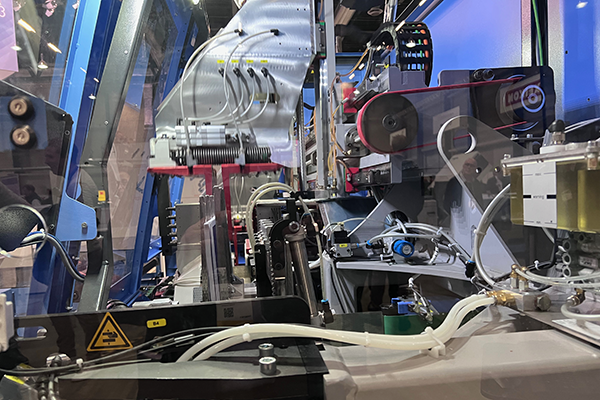
The drive to automate is finally reaching the finishing department, until now the last bastion of manual processes in print. Finishing has held out for so long because labour has been available and it has been cheap, descriptions which no longer hold water. Add in the impact of ever shorter production runs and for an increasing cohort the extra cost of investing in robot arms, integrated finishing lines and automated technology can pay for itself. The trend, underway for the last couple of years, has gained greater urgency with the rise in the minimum wage and the increase in National Insurance contributions. It now pays to invest in automation and many companies are investigating how to take this step.
This is confirmed by suppliers to the sector, all reporting that interest in integrated solutions rather than one off standalone devices has increased exponentially. IFS chief executive Eric Keane says the company took on Tim Clifton as technical director precisely because the business was becoming involved more in helping specify and implement integrated solutions. Clifton used to run his own finishing business and so understands what happens on the ground and how to link processes – the cornerstone of automation.
IFS still sells standalone Horizon BQ500 perfect binders for example, but increasingly the purchaser adds an inline three-knife trimmer or perhaps an automated infeed. A manual step is eliminated and that operator can be deployed elsewhere.
“We have supplied or are in the process of supplying quite a number of more integrated print finishing systems for book binding in particular,” says Keane. “It is a factor of rising employment costs, of lack of skills and recruitment challenges and of shorter runs. We are seeing that all the big names in commercial printing are investing heavily in automation.”
The perfect binder, rated at 500 cycles an hour, is fully automated so well suited to an integrated production line. Settings are read from a barcode to set clamp pressure, to understand the spine length and so on. Book of one production is possible.
That automation is available from Horizon, from network production data organised through IceLink, its cloud based production server, through to servo motors fitted on folders to move buckle plates or roller gaps automatically as well as the settings on binders, the latest StitchLiners and creaser slitters, almost instantly. The impetus in development has come from the Japanese market which is at least five or six years ahead of the UK and Europe in terms of automation says Keane. However, the same factors that drove Horizon to automate are now coming into play in this country.
At the same time the shift towards shorter runs and digital printing has helped bring Horizon into the mainstream of finishing systems. If at one time its products might have been considered lightweight and not robust enough for European use, this has disappeared. There are no qualms about investing in Horizon.
The more nimble machines are ideal for our times, whether a StitchLiner which takes out the need for a separate folder in producing a stitched brochure or magazines, a perfect binding line to do the same or a SmartStacker to deliver simple stacked products inline from a B2 HP Indigo. There are versions of the StitchLiner for litho sheets fed from bins on a tower collator and for digital print where sheets have already been collated, or have been printed in sequence on a reel. In this case the reel unwinds, is cut and sheets delivered to the plow and accumulator in order. A cover can be fed from a separate feeder.
“Horizon has spent a lot of time thinking about the direction of travel in the market and have decide that automation is the right way to go,” says Keane. “They are generally right about these things.”
Not all needs are met from Horizon’s chest. Until recently it had no web processing technology and while that is now available many in Europe prefer to work with Hunkeler or Tecnau While the agency for the Italian business is now in Friedheim’s hands, IFS can still sell Tecnau technology when allied with Horizon devices.
Here there is something of a surprise comeback for the Horizon SmartStacker. This machine has been around ever since Indigo moved up to B2 printing. At that time the Smart Stacker never caught on, a combination of its cost, a lack of productivity and concern about its value in an agile production environment. Now with the shortage of experience and rising costs, there is strong interest in the machine “as a labour saving solution”. The system runs inline to a B2 digital press, cutting, trimming and stacking products neatly without the need for additional guillotining or assigning a staff member to this task. “We are doing lots of demos on this at the moment” says Keane.
In effect it is a large version of Duplo’s multi finishing DC family operating inline, or a sheetfed version of machines from Hunkeler or Tecnau that also turn printed material into stacked products, albeit when printed on a reel for the most part.
Duplo’s multifinishers range in sophistication and performance (and price) from entry level to sophisticated and fully automated units. They have undoubtedly become a must have for printers where the workforce is stretched and the working space constrained. The unit will trim, slice, crease, perforate and even fold in one pass with nobody to mind it other than ensuring the feeder is topped up and that finished work is removed from the delivery end. Duplo can supply and extended delivery to lengthen this unmanned working period.
It will also work with a stack of different jobs provided there is a printed barcode to read and identify a job and the download the settings for the following sheets, automatically triggering any necessary changes to the settings.
Duplo does not have a B2 version, but can accommodate the larger sheet size by having the DC20K system which cuts a sheet into a size that will suit the higher end of its DC units.
The arrival of cut sheet inkjet and larger format digital presses has spurred a greater requirement for matched finishing equipment, either in inline or near line configurations. At the last Hunkeler Innovation Days the company demonstrated the sheetfed version of the Starfolder. This both folds and cuts sheets from digital presses, the Canon iX3200 in this case, and joins Hunkeler’s Docutrim which lacks the folder functionality. This is in effect two machines joined by a 90º turn to deliver speed in production. The design has limited the appeal as the price is high.
Tecnau is having more success with its BookReady device operating inline to Canon’s toner and iX3200 printers for book production. The unit runs inline to the printer with stacks for books emerging on the delivery table, each offset to avoid confusion between the separate books. A first has been installed at Micropress followed by one at ESP. Both connect to the iX3200. The TC1010 is a sheet by sheet finishing unit to cut, slit and stack flyers, postcards and full bleed posters, in effect Tecnau’s multi finisher.
Tecnau can also integrate this to Heidelberg’s version of the inkjet press, the Jetfire50. This configuration is in the digital print area of the Home of Print, Heidelberg’s major showroom in Germany. Alongside is a CP Bourg booklet maker. The press can also integrate with Bourg’s BB3002 perfect binder.
A Stahlfolder Fireline completes the trio of automated finishing devices. This is an automated folder which sets itself according to data accessed via a barcode. The device can deliver multiple formats from four page brochures through to more complex concertina, parallel, letter or gatefold as well as bespoke folding patterns that a business might want to set up.
UK distributor for CP Bourg is Encore Machinery which also handles the MB range of folders, the first in Europe to include servo motors for automated set up. This function enables the folder to be included in a range of finishing systems where different elements combine in a touch free production line. It results in a system that is set up to deliver one style of product very, very efficiently.
A case in point managing director Paul Davidson points out is having a UV coater inline with a digital press. At Drupa this concept was seen with Fujifilm running its B2 Jetpress inkjet press inline with a coater, using a conveyor rather than stacker to take sheets from the press as they were printed. More integrations of this nature, aided and assisted by robots, can be expected from Fujifilm.
For some packaging applications or for printing book covers where a UV varnish is almost universal such an integration makes sense. Davidson points out that these decisions can be taken after installation and as the work mix changes. “If a customer is getting enough of one type of product it can make sense to go inline say with coating or folding,” he says. “MB folders have the unique facility that if not needed, there is a bypass to take sheets away from the feeder. Thus the machine can run both inline and offline.”
The equally important aspect that automation tackles is the dire skills shortage in finishing. The time was when apprentices might spend the first year of their indenture period simply handling paper to understand how to set up folders to cope with different substrates. Even just a generation ago four year training periods in finishing were standard. Now employers want recruits to hit the ground running. Training has to be packed into as short a time as possible and to be on as many machines as possible. The trainee may not understand the materials intimately but will know how to follow the touch screen set up and which buttons to press.
Automation via servo motors to make adjustments and software that can store settings for recall or can download them from a production network, is vital for this. It means too that machines can be left to run unattended.
For the smallest companies, such automation means a manager can attend to a customer coming into the shop or office without having to stop production. It eliminates the need for guillotining, and creasing, combining a number of process steps into one and one with no labour required. Printstore in Kingston is among the recent customers for the DC618. General manager Benjamin Pickard says: “It filled a really important gap for us. We’d lost a guillotine operator and instead of rehiring, we invested in the first DC618. It’s fully automated, the interface is simple and best of all it doesn’t need a skilled operator. That kind of technology is essential now as the skilled labour just isn’t out there anymore.”
Like Horizon, Duplo is steeped in automation and is moving upstream to meet a demand for simple to operate machinery that nonetheless can produce high quality output without the compromises that used to come with touch-free production of booklets. Top production speeds are not high, but with shorter digital print runs, this is not necessary.
What is needed is simplicity of operation to keep training requirements to a minimum and quality of finished product at an acceptable level. It is not unusual now for a booklet maker to sit alongside a conventional saddle stitcher to handle the short runs that would otherwise sap efficiency because of the extended makereadies on more traditional equipment, however automated.
With the latest and flagship version of the booklet maker, the Senshi, Duplo is taking deliberate aim at the population of ageing stitchers that are no longer efficient under today’s market conditions.
The booklet makers can be configured to run inline to a digital press, Duplo having demonstrated this capability with a Ricoh at its Addlestone showroom. Few however want to commit to this extent, choosing instead to run in a near line configuration.
Plockmatic is the the dominant supplier for inline operation. At one time those choosing inline were invariably inplants, and product quality was not the first consideration. This is no longer the case. Watkiss Automation, now part of Plockmatic, started the change with the development of square back finishing as a faster and lower cost alternative to perfect binding.
Plockmatic is bringing all its manufacture together on one site in Latvia where it says it will have greater capacity and can expand the range of products offered to “support the expansion in production cutsheet toner and inkjet devices”. The site in Milton Keynes becomes a showroom, warehouse and R&D hub for developments in packaging and labels where a small finishing line is a recent introduction to the range.
Even more recently Plockmatic has acquired Renz, 15 months after that business went into administration in Germany. It is too early to see how wire binding fits into the portfolio and what changes will be made, but Plockmatic clearly sees that its experience of automation can be taken to new markets as digital press suppliers release their new products.
Morgana’s general manager Ed Hudson is a recent recruit to take charge of both inline and offline finishing technologies. “It’s a customer and application led approach. It is the customer application that is key. As an organisation we need to be able to offer the right solution for the client,” he says. “We understand the challenges that graphic arts customers are facing because the skill set has been lost, so the need is to provide more innovative easy to use products that can be integrated.”
Prior to joining Plockmatic Hudson had worked for Ibis, one of leaders in integrated and automated finishing. This was a return to the industry where Hudson had previously worked for Canon and Océ on continuous feed inkjet. Those contacts and experiences could be useful to Plockmatic’s development.
He had seen automation at close hand with Ibis where a number of its SmartBinders are used in production of exam papers. This can operate either inline or in a near line configuration, the web being cut and correct number of pages delivered as a sealed booklet, personalised for the the school, the class and the individual student. The system will gather and wrap the set of exam papers needed by the school or test centre. Some printers complete the hands-free journey using a robot to load the bundles into a carton for secure delivery.
Not all printers will want to break into exam paper production. It’s something that takes years as trust is absolutely paramount, but it’s also indicative of how automated finishing can become. “The new opportunity for printers is with fully automated lines like this,” Hudson says.
Plockmatic is not in this area – yet. It is however the clear leader for inline finishing with Plockmatic fold and stitch units as much an integral part of many SRA3 print engines as the Fiery front end
Inline finishing is the ultimate answer to the lack of skills in a finishing department as having no separate machinery requires no staff other than those doing the actual printing to operate it. Set ups have to be automated.
The cost comes in a loss of versatility and the always present question of both print and finishing element having to stop should there be a problem with the other half of the production path. If there is a wide disparity in running speeds, it will make more sense to split printer from finishing as the faster unit will have to slow down.
Even after a short time back in the print saddle, Hudson has seen the pressure from the street. He says: “I was with one client a couple of weeks ago and they said that due to the NI changes they would not be employing more people and that this is forcing them to look at a more integrated hands off solution.”
Automated inline finishing is more common with larger print set ups, book printers in particular, where press, book block creation and binding can be part of the same end to end line. If inkjet is really to take over many litho jobs, hands free delivery of finished products is a crucial step.
Many will prefer to print to the reel and then feed the reel into a finishing line which folds and cuts the web into signatures then gathers these signatures, adding a line of glue to hold the block in place before the block arrives at the binder.
The growth in digital print production of books has driven interest and a number of companies can supply integrated finishing lines, Horizon, MBO and EMT as well as Muller Martini/Hunkeler, Meccanotecnica or Tecnau.
Muller Martini was fast into position with its SigmaLine as soon as inkjet book printing became viable. Its approach has always been that finishing should control and dictate printing, building its Connex workflow family to support this. Connex now goes across all Muller Martini products and into the Hunkeler portfolio.
Like IFS, head of sales for Muller Martini UK David McGinlay says that Muller Martini has noticed a step change in attitudes towards automation in recent months. “We have been working on a number of projects which will come to fruition this year. What they have in common is the importance of Connex. Printers have fewer people around and do not want to expand the workforce.
“It means that discussions are not really focused on price in the way that everything used to be price driven. Now it’s about how we can automate and take away the need for people in the process.”
A finishing line with Connex and using JMF to communicate with a print machine can determine the best imposition to use and when a copy is ejected for quality reasons can fire a request to print an additional copy to the print engine.
This can be a challenge as a finishing company is not normally expected to handle PDF files and to dictate to the print engine how it should run. Muller Martini though has form. Connex says McGinlay, evolved from the earlier Mailroom Production Control system which effectively controlled newspaper production, taking single copies of newspapers into bundles of varying sizes and assigning these to different delivery routes.
This is not a solution that has been developed from the need to manage a print engine, folding and enclosing for a transactional application as many digital press workflows have been.
“Our background can bring reassurance to press manufacturers,” he says, “who automatically prefer their own workflows because working with a third-party supplier can open the door to an alternative press supplier to come in and pitch for the business. However, when we show the customer what it can do in our showroom they understand the benefits.”
There is a depth of expertise in software and applications through associated companies in Switzerland to ensure that Muller Martini remains at the forefront of technology and thinking. This will inevitably include robotics, both as a static arm to load pallets and as mobile robots to move work in progress. There is already a partnership with Solema which supplies robotic palletising and cartoning lines. More are sure to follow.
The robots are coming, again helping to reduce the labour element in the factory or easing the burden on those in the factory. MBO, part of Komori, has been pushing CoBo Stack products using an approach where a man works closely along side the robot arm to pick up sections from the delivery of a folder and then arrange them on a pallet. The speed of the arm is limited because the human is in close proximity and it is relatively easy to damage a human.
In contrast the first P-Stacker from Heidelberg was designed to work at high speed and therefore needed to be caged for health and safety reasons. The latest generation of pallet loading robots from both falls in between these extremes; in operation, the high speed arm is protected by safety beams and immediately responsive if any beam is broken, slowing the arm to a snail’s pace and accelerating when the operator withdraws.
Such technology is going to be common place alongside folders and finishing lines. It replaces a need for labour but more importantly, it eases the strain on those that continue to be employed. Nobody will volunteer for a job where moving 8 tonnes of paper a shift is part of the job description when they can join a printer where robots and automation take on the heavy lifting.
The next step for the robot arm technology is to pick up the folded section and feed it to a binding or stitching line. In the days when web offset printing was supreme, high volume printers would automate feeding their high speed finishing line using logs of folded sections or perhaps drum technology. Both Ferag and Muller Martini could supply this kind of high end automation. In short the technology to feed sections from an unmanned hopper or station exists, if the robot can load signatures from the pallet. MBO believes that it can do this thanks to the way that signatures are arranged and because its gripping head system allows a stack to be picked up from a pallet.
Robots are also going to be a familiar sight in printers for moving pallets from one production step to another. Newspapers and high volume printers where reels or paper are heavy and many are used have adopted Automat Guided Vehicles which follow a set route across the floor, guided by wires laid into the floor. The future though belongs to Automatic Mobile Robots, some like a large Roomba to lift and move a pallet, others like a robotised forklift truck.
Again the appeal here is replacement of labour intensive activities, freeing up people for more productive tasks. And again this technology that is already established and in place in Japan. At Horizon’s Smart Factory open house last year, AMR robots were picking up pallets of print from the end of a press and delivering the stack to a folder or other unit.
This level of automation was also shown at the recent China Print show. Robots delivered printed sheets from Canon and Konica Minolta printers to a StitchLiner MkV. China is considered one of the countries with low cost labour. It is also Horizon’s second largest market, so what Horizon brings to these shows has to be relevant.