Isaac Newton described how white light comprised seven colours which when combined produce all the colours under the sun or the rainbow at least. Extended colour gamut printing uses the same idea in reverse. Three primary and three secondary colours plus black deliver the widest colour space possible with a printing machine running without spot colours. Digital presses have used this principle for years. Litho lags, but not for much longer if Koenig & Bauer is correct.
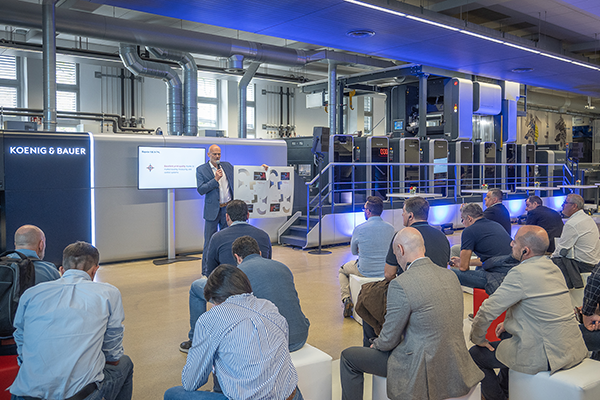
Seven-colour printing was everywhere at its recent open house in Radebuel near Dresden. The event was targeted at carton printers, the group that stands to gain the most from ECG printing. Instead of using spot colours, requiring a wash up between jobs, the same seven colours, CMYK plus Orange Green and Violet, stay on press and can eliminate the need for almost all spot colours. As pressure on run lengths continues to grow and turnaround times to shorten, the argument is that ECG represents the best way to tackle this without losing time and money. The time saving, and therefore production time that can be reclaimed can be enormous.
“Most carton presses used for short run luxury packaging are in make ready for 40-55% of the time,” says Koenig & Bauer UK managing director Chris Scully. This is due to wash up between colours and reloading the different ink for the next job. Then there is the expense of maintaining an ink library, the waste as ink beyond its use by date has to be discarded, and the cost associated with the consumables involved.
Because ECG printing can deliver multiple spot colours on the same sheet, the world opens up in terms of combining jobs on a sheet which would otherwise need to be printed separately each with its own spot colour. A company like Clipper Teas with different colours for each flavour or sku within the range and that can order a different combination of packs each month, can cut waste and cost as a result.
Koenig & Bauer argues that it is uniquely placed to deliver ECG thanks to inherent features of its presses. For in order to be successful, consistency and process control are vital. All settings need to be checked and rechecked, materials need to be consistent and above all the printed dot has to be precise and repeatable. Only once these conditions are achieved can four-plus-spots become seven colours.
Certainly the majority of presses being assembled in the vast factory suit the process. Regardless of format, seven print units plus two coaters is almost standard. Seven colours, two coaters, another print unit and coater is gaining in popularity as this enables the use of a drip off or reticulated varnish where a matt image is printed on top of a gloss varnish to eye popping effect. The extra unit can also be used for a spot colour or a metallic, giving the printer the greatest possible flexibility to meet customer requirements.
The ability to print ECG with confidence is built on the stability of the platform and technology included on press. Every sheet is measured for colour and deviations. Any corrective action is taken after every ten sheets before colour shifts are detectable by eye. Further reassurance if necessary is provided by Instrument Flight, the system developed to help press operators achieve perfect grey balance and which by virtue of controlling dot gain, is ideal for ECG. A print out of the data from a completed run is reassurance for customers.
The press needs to be kept in an ideal consistent state, maintained as specified and profiled to check for any unwelcome changes. Blankets and inks need to be the same. While there is no standard for the OGV additional inks as there is for CMYK inks, using a consistent set from the same manufacturer is essential. That should provide the consistency needed to feed the profile of that press for that sheet back to prepress to apply the profile as needed.
There can be no room to make adjustments on press says Scully. The idea is that all adjustments are made in prepress, well before the job gets to the press. The press itself should then be considered a digital press albeit one using an analogue process.
“We are trying to offer the most consistent platform for output,” he says. “The technology is based on what is coming from prepress, how prepress applies the profiles and so on. Each system does this in a slightly different way.”
A suitable proofing platform is an essential first step. Most inkjet proofers are running with seven or eight colours to begin with. Normally these have to be interpreted down to CMYK and to the spot colours that are to be printed. With ECG the seven colours on the proofer should match more neatly with the seven colours on press. “That’s another source of consistency,” says Scully. “There are certain segments of the market where this is a no brainer: the returns are phenomenal.”
The use of up to seven colours (for the most part the impact and extra colours can be achieved with five or six colours) results too in much more vibrant print, more akin to RGB that designers and consumers are used to seeing on screens. Brands want to replicate that, he adds.
“This has been gaining real traction.” There are Koenig & Bauer customers in this country that are now talking about and are starting to implement the set up with the agreement of their customers. There is no doubt that it is not easy; it is all about process control and operation to a tighter latitude than before.
It requires printers to produce the samples and look books to show their customers what can be achieved, how printing with a greater number of colours delivers the sort of impact that can be noticed on the supermarket shelf. But where compromise is necessary, the customer can see exactly where the difference lies and whether in the face of the other advantages, this matters in a sales sense.
There is potential too for commercial printers from using additional colours to boost the colour gamut for high end art books, catalogues and posters. This is an argument deployed by digital press providers that offer gamut boosting pinks and neon colours. Commercial litho needs to keep watch on developments in the digital world where the Xerox Iridesse, and presses from Fujifilm and Ricoh as well as HP Indigo can produce higher impact colours.
Back in Germany, the first demonstration from Koenig & Bauer was the half-sheet Rapida 76. This was an eight-colour machine specified for luxury or pharmaceutical packaging. “We have seen a surge of interest for an offset press that can print ECG. It is in effect an digital offset press. Plates can be changed in three minutes and the press has a ceiling of 18,000sph, has automatic colour correction, tabbing to identify where the quality of the sheets falls short. If the fault does not correct itself with the next ten sheets, the press is stopped to avoid uncontrolled waste.”
The Rapida 106X is the flagship press being demonstrated at the open house. The Rapida 142 large format press is not demonstrable as a new press is being installed to replace the machine that had been in operation and has since been sold. The Rapida 106X was set up to exploit the maximum from automation. A number of users deploy logistics to bring paper to the press and, according to the demonstration to German and European printers but not the UK or US visitors, to move printed stacks on an autonomous forklift.
The press in use was a seven-colour with a coater and two drying towers ahead of another print uint and coater. It was set up to print black, violet, cyan, green, magenta, orange and finally yellow as the ideal sequence for ECG printing. The press also had Instrument Flight to measure and control the size of the printed dot. “Being able to control the size of the dot is very important to achieve success in ECG,” says Koenig & Bauer US SVP sales and marketing Eric Frank.
The press was set up to switch within a couple of minutes from one job to the next, including one with heavy black coverage and a matt varnish applied above a gloss flood varnish. The material printed had not changed, being a coated board which enabled Koenig & Bauer to demonstrate three ways of finishing the sheet: the Ipress 106 developed from the acquisition of Iberica and made in the Barcelona factory, the CutProQ, a platen launched at Drupa that takes experience from Iberia and merges it with sheet handling expertise from Koenig & Bauer and is built in Germany. “We learned the strengths and weaknesses that Iberica had and we designed what is a Koenig & Bauer machine with strengthened side frames and all digital lock up positioning,” says Frank. A new style of blanking device has reduced makeready to zero.
The third die cutter is the CutPro X106 rotary die cutter, a revolutionary system that looks outwardly like a four-colour printing press with in sequence embossing, creasing, cutting and blanking units. Each set of tools is positioned on the the cylinder using magnets with a claimed accuracy to +/-15 microns. The great attraction is an operating speed of 16,000sph. Unsurpisingly the first installations are at four of the world’s largest packaging groups where long runs and therefore potential savings can be significant.
Nevertheless it is not a luxury item to operate – a set of tools for the rotary system is around 10% above the cost of the equivalent flatbed dies.
The blanking system is a fully automated unit using robots to move stacks of work into and away from the blanking head, leaving stacks of carton blanks ready for the final step though folding and gluing on a Duran Allegro 110 folder gluer running 400m/min.
Koenig & Bauer also put a wet label or in-mould labels set up through its paces using an inline foiling unit above another Rapida X106, using a CutProX to its cut the labels from the backing sheet using a rotary die.
Commercial printers could not help but be impressed by an eight-colour perfecting Rapida X106 which ran unattended except for a machine assistant loading and removing plates from the press.
Closed loop colour and quality management monitoring bring the press into colour within 40-60 sheets before printing a further 400 sheets in that section before stripping the ink from rollers over the final ten sheets on that section.
Printing so few sheets as part of the job removes the need to wash blanket and impression cylinders. It helped that the demonstration stuck with Novatech Matt 135gsm, a versatile and quality paper that is not going to cause problems on press.
Arguably the high point of the series of demonstrations was that of the Varijet 106, the inkjet press jointly developed with Durst. This is not a press like most digital presses for short run work, though capable of personalised print. A production speed of 5,500sph with priming ahead of the seven inkjet heads and followed by a coating unit puts medium length runs within its scope.
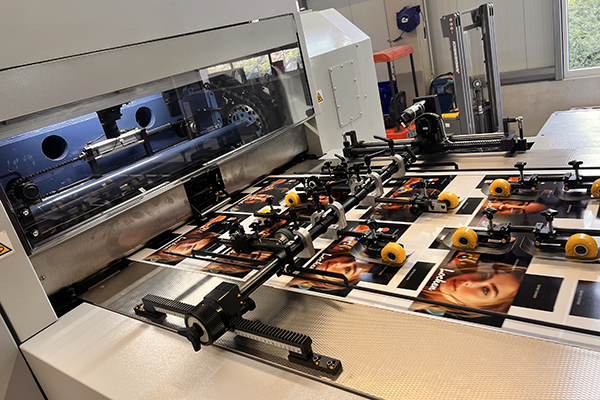
The press borrows freely from modules developed by both parents. The feeder is taken from Koenig & Bauer with the SIS infeed. At this point the sheet is held in conventional grippers into the flexo applied primer followed by a drying section using hot air knives. The sheet then lands on a steel vacuum belt for inkjet printing. This is the module developed by Durst and has 168 Fujifilm Samba print heads each printing at 1200dpi though 2,048 nozzles.
The sheet passes through a combination dryer and into a further SIS feeder into further grippers through a coater and any other Koenig & Bauer units that the customer specifies.
That customer will want to match the output from the inkjet press to the output from the litho press that the business has. Inkjet is not going to be printing with Pantone inks or other special colours. Instead the seven-colour inkjet print array is able to match more than 90% of PMS colours thanks to the extended gamut used. The same advantage that ECG offers to the litho printer.