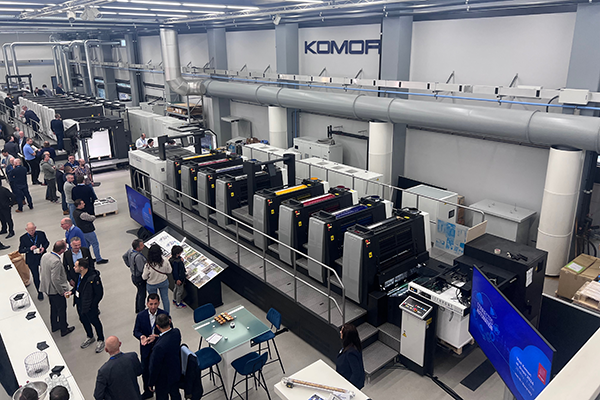
The trump card that Komori has in its hand to play is not the new B2 inkjet press launched at Drupa, nor the inline pseudo embossing technology announced in the report and accounts, nor the double-side coating project announced at the same time. Komori’s ace up its sleeve is its Smart Factory concept.
While European companies have been trying to define what is meant by Industry 4.0, the Internet of Things, and artificial intelligence, Komori has been implementing this kind of automation, brought together as KP-Connect. This is a single view and control console for everything that can go on inside and outside the factory, regardless of whether the equipment has a Komori badge on the side or not. This had its own studio presentation during Drupa last year which attracted a constant stream of visitors, not least from other press providers.
Komori has moved further and faster along the automation and network connection road than European or US companies because the labour and skills shortages that are becoming a crisis in Europe have long been a consideration in Japan. Add in the pressure to cut energy consumption after the Great Eastern Earthquake and these sorts of development are a business necessity.
The energy saving steps have included the use of DC motors for running air blowers and Smart Inking Flow, reducing the number of rollers in the ink train without any impact on inking power. On a B1 press power consumption can drop 18% says Komori.
The technology is also saving on materials that are wasted thus cutting the overhead in the business and helping to improve margins, at least for those that have the technology compared to rivals without this advantage.
Examples of Smart Factory implementations in this part of the world are few at present, but they exist. Veldhuis in the Netherlands, for example, where the presses communicate with a robot which moves pallets of printed sheets to the next process is a flagship example.
This is just one aspect of the concept where KP-Connect is at the heart of a system where information is shared with all processes and systems that can act on it. At Veldhuis when the press operator has completed a pallet, the AMR robot is summoned and the pallet is removed to the holding area ahead of the line up of folders. The movement and position of the stored pallet is logged and the situation where under pressure finishing crews had to walk over to the press operator to ask when the last section would be printed has vanished. “It’s another step towards streamlining the process,” says Komori Europe marketing director Peter Minis.
Komori has demonstrated sending AMR robots from the delivery of the press to the feed end of MBO folders and into a Finishing Alliance set up that also includes Hohner saddle stitching for hands-free magazine or brochure production.
The streamlining has always included the press itself. Komori was the first to introduce automatic plate changing and over the years has quietly automated the set up and makeready process to a greater and greater extent. It can now run presses with no operator intervention at all, the press moving through the sequences, stripping ink, blanket wash up, remove and reload plates, inking up and starting to print including running to colour and then printing the requisite number of sheets before the process is repeated.
There is now also a three-step quality control process. Cameras on the machine check the content against the signed off PDF. This was first shown at Drupa last year. If the operator overrides this, the press will monitor content and colour against the designated pass sheet. Checking against the colour bar only can control colour, but may then miss a hickey or other flaw in printing elsewhere on the sheet. The operator can set a number of consecutive sheets with an issue before the need to apply changes. That might be different for a job with light ink coverage to one with heavy ink use where a deviation is harder to identify.
The company demonstrates the AutoPilot operation on an SRA1 press in its Utrecht showroom running a sequence of jobs of 500 sheets each, as if printing different sections of a magazine or catalogue. This cuts out the need to adjust for a different paper or size of paper.
Plate change and simultaneous blanket wash, should one be needed after so few sheets, are established technology. The onboard automation checks registration and colour with the extra ability to check the content. When the press gets to a good sheet, a tab is inserted in the pile and the count begins.
Before the total is reached, inking is turned off to strip excess ink ahead of the next job. As this begins will plates in position, the preset information from prepress has been loaded and ink keys set.
It takes around 70 sheets to have a four-colour job in colour and fit. It takes around two minutes from the end of one job to the start of the next.
If in a packaging application a spot colour needs to be changed, this is possible in two-and-a-half minutes, leading to a compete change and make ready in less than ten minutes.
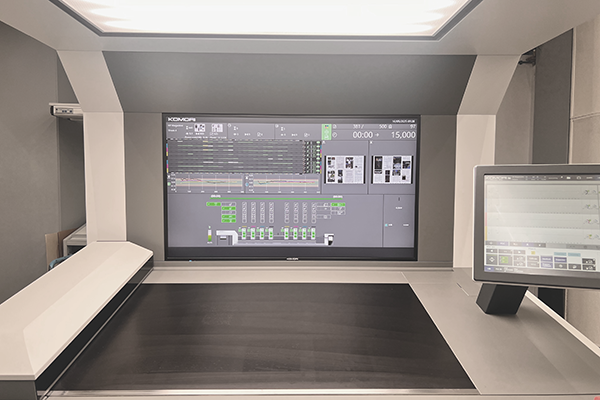
All the data is presented to the operator on a large flat panel screen with the operator able to choose which information will take precedence at that point in the cycle. All data can be reached within a minimal number of clicks. The clean user interface is another aspect that has captured the interest of other suppliers and is going to prove an inspiration to the next generation of console screens. The view enables the operator to focus on the task in hand without further distraction. There is a progress bar which changes as first registration is achieved, then colour stabilised and finally the job matches the PDF.
“KP-C allows us to bring in the Smart Factory,” says Minis. “We need this because there is a loss of skills across what is an ageing workforce, there is an increase in material costs making materials saving important for margins as well as sustainability.”
The aim behind the Smart Factory is to move paper from the store to out the door at dispatch as swiftly as possible and to raise the OEE of the printing presses. “Our research shows that machines only have an OEE of 33% on average and that they are standing still waiting for paper or plates for another 33% of the time.”
Data is the answer as the status of the press is measured at every point. When this is analysed, the patterns show that there may be an issue getting spot colour inks to the press or that a certain grade of paper does not run well from cold on a Monday morning.
A key function is scheduling, prioritising jobs with the nearest delivery dates, then the spot colours, if any, to be used and then by paper format and type. The priorities can be changed to, say, batch all jobs needed in the next week on one type of paper. Emails requesting artwork from the customer can be part of this. Where a specific press has not been identified, to take advantage of a fifth colour or coating for example, the algorithm will balance the jobs in the system against those presses and operators. The aim is to reduce standing times to a minimum, though it will also remove the morning headache from production managers and will make adjustments as necessary throughout the day.
KP-C Pro will communicate with the company’s MIS and the prepress system (to trigger plate production at the right time) in one direction and to MBO’s Data Manager in the the finishing direction. Information flows in both directions. It will also communicate a cutting programme to a Komori Apressia guillotine with data returning to KP-C Pro via an iPad for recording job progress.
This is the top level of KP Connect needed to become a Smart Factory. But not all print businesses are ready for this level of automation, nor do they need it. Each new press comes with KP-C Basic, linking the press to the Komori cloud for a year. The manufacturer hopes that this period will convince the customer of its value in providing the data to improve efficiency. With a link into a prepress system, this becomes KP-C Edge and able to operate across up to ten presses, including older machines that predate KP-C.
Older machines can be connected through installation of a PLC device to record speeds, timings, and the operational status of a machine. This connection is also possible using an iPad and relevant app.
The data is securely held on European based Amazon Web Servers. The software uses Heroku for translation into different languages and Salesforce for its CRM tools. Monitoring is constant allowing Komori’s engineers to be proactive. “We can call to say that we notice a machine has been down unexpectedly for 30 minutes, can we help?”
“Basic is not really basic,” says Komori Europe software specialist Aaron Latimer. “It tracks job progress; it provides access to how to videos to deliver expert knowledge to the press operators and this helps free up our engineers from the trivial calls and simplest tasks. It will provide a downloadable report on what has happened on press, leading to a fully detailed report at the end of the month. This can be downloaded as a CSV file to feed into an MIS. We can also benchmark a press against others in the region to reveal other insights.
“With Edge we have the JDF/JMF link to an MIS. We are starting to use Web APIs for this. Edge resides on a PC linking to multiple presses.”
Komori has a partnership with Dutch MIS provider Dataline, but is not restricted to integration with its MIS tools. It can connect into any MIS including legacy systems that have been developed internally.
“Pro will talk to any application and can request information from a third-party machine, providing real time visualisation of what is happening on the press. This then can be used for auto scheduling of work, making adjustments on the fly. It is a server based application that can run multiple sites.”
Should a job be held up in prepress for some reason, the scheduling system can reconfigure which jobs go to which machines so that the press is not idle while waiting for a delayed set of plates to arrive.
Part of the integration can be with robots, either static robots like the CoBot pallet loading arms used by MBO, or mobile AMRs that can move pallets of work in progress from the end of one process to the start of the next, tracking the progress of each job identified by a scannable data matrix code printed on each sheet.
This moves Industry 4.0 into Industry 5.0 defined as the reintroduction of the human touch back into the Smart Factory, by focusing on the collaboration between man and machine, thus making the most of human creativity and robot consistency. The role of robots is working alongside humans for loading pallets and moving materials.
Connection to the mobile robots can trigger the delivery of the correct pallet of paper to the appropriate press at the right time, even when the schedule has been disrupted by hold ups or by a demand to accelerate a job through the process. This can include instructions to robots used to move pallets of printed sheets to finishing or from plate making to the press. There is no requirement for humans to be involved in the changes.
Data that is available for analysis includes information about energy used on press and from other equipment in the network. This was initially developed to comply with energy saving measures introduced in Japan following the earthquake and tsunami that followed. All new equipment has to have a lower energy footprint than the machines being replaced, even if its not a like for like change, a five-colour press rather than a four-colour machine for instance. This data can now be used to calculate the CO2 footprint of a job or by time, used per day, per week. This can be used for comparisons against predictions of energy usage, displaying this on the KP-C Pro dashboard.
Data is only useful if it is used to provide insight, to draw attention to problems. Komori does this with Salesforce to identify where wider actions need to be taken and then creating a project to tackle the issue with metrics to assess progress towards the goal.
The dashboard display can be organised to show the different machines, which jobs are in progress or which are waiting, which jobs are running to time or perhaps are behind schedule. If a job is running late by ten or more minutes, this is highlighted in red compared to green for when the job is running inside the allowed time for it. This information can be distributed around a plant via flat panel screens, what Komori calls digital signage.
That is a window into the data that is being collected, being analysed and processed and being used to improve performance and efficiency across the business. Welcome to the age of the Smart Factory.