When the earthquake and tsunami struck Japan in 2011, it took out the Fukushima nuclear plant and with it a major source of electricity in the country, forcing the sort of public spirited self rationing that only Japan seems capable of. Air conditioning was turned off, lights restricted and industries encouraged to think about the power their products consumed.
Among these products were printing presses and RMGT has made a virtue of its response ever since. The company, formed through the merger of Mitsubishi’s and Ryobi’s printing press operations, has struck a rich nugget in highly efficient litho presses. The crisis prompted the widespread adoption of LED UV curing, something that Ryobi had unveiled to the world at Drupa in 2008, as this is far more energy efficient than hot air and infra red drying. It also results in instantly dry sheets which can be processed immediately leading to a significant saving in floor space as there is no need to have room for pallets of work in progress waiting to dry. This too is a consideration in space constrained Japan.
Most importantly RMGT realised that an SRA1 press can print almost everything that a B1 press can print at a much reduced cost, less for consumables, less for energy and less space on the floor. The SRA1 format can print eight A4 pages to view, easily the most common requirement of any B1 commercial printer. The SRA1 format is also by the most popular size for sheets supplied by paper merchants.
RMGT started with a 920 model with a sheet size of 640x920mm and image area of 615x900mm and has since introduced the 970 with a 650x965mm sheet and a 640x930mm image area, which provides a little more room for perfecting or application of control strips, including RMGT’s PQS-D register control marks if required.
Yet it remains highly efficient for printers. RMGT is able to compare data from the SRA1 machines with the true B1 RMGT 1060 model with Mitsubishi heritage. That works shows that plate costs are 20% less, space required around 30% less and energy consumption falls by 34% compared to the B1 machine.
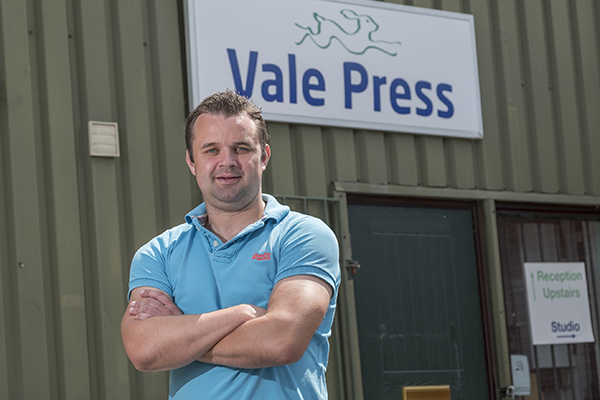
Tom Stowe, managing director of Vale Press, confirms this. “Energy consumption on the RMGT 920 is less than on the five-colour B2 press it replaced while printing twice as many pages,” he says.
The Chipping Camden company took delivery of the machine after Christmas and three weeks later it was up and running and has been in operation ever since.
“The decision on the press was all about printing our existing work more efficiently,” he says. “Now we find we have stepped up in B1 work as the majority of this can be produced on the SRA1 sheet. The RMGT press has given us the ability to grow.
“There are certainly savings: we are printing double the pages we used to with less power. There is the additional cost of the UV inks, but we don’t have to seal the sheet and it is immediately dry.”
The new press runs alongside a Heidelberg CX74 with LE-UV so the company was used to paying the premium for the UV inks.
“So for us it was a no brainer. There is no marking because the sheet is not perfectly dry and if we were to print a 32pp job, we would be using half the number of plates, which are less expensive anyway.”
The company has been investing to boost capacity in finishing to cope with the additional work coming through. It has bought a Polar 115 guillotine, a pile turner for the larger sheets and installed a Ricoh 9500 to increase digital print capacity. It has followed up more recently with an order for a Horizon StitchLiner MkIV ICE machine.
This all comes from the success of the press, helping the company to expand at a time when other commercial printers in the area are either closing completely or are choosing to become Printers In Name Only by closing down their presses and farming work out, including to Vale Press. That Vale has a full range of services, litho and digital printing, stitching and perfect binding, spot varnish and lamination, under one roof is certainly a help.
“It was our 40th anniversary last year,” says Stowe. The family business can anticipate many more.