Battersea Dogs Home was behind the campaign “A dog is for life, not just for Christmas” to stress the importance of long term care for a pet. Manroland Sheetfed wants that message to apply to its long-lived presses, promising that printers are not only buying a press, but a lifetime of training and support and no surprises. “We will help you achieve your KPIs,” promises UK managing director Daniel Godbold.
He joined the business a year ago having spent the first part of his long career in production positions in print companies. Godbold understands first hand what happens on the shop floor and the pressures there.
He joins at a time that Manroland Sheetfed is coming out of its shell. It has been a bit of an underground cult for the years since Langley Holdings bought the business out of administration in 2012 and trimmed away any of the unnecessary costs, refocused the business to the emerging markets, China and Latin America in particular. And while the German press manufacturer has been successful with this strategy having shipped multiple machines in all configurations to customers in these markets in recent years, it now needs to reclaim its status in Europe and the UK.
This is led in part by market reality. The press manufacturing arm needs to contribute more to a print division that includes Druck Chemie consumables business and above that to the £1.2 billion privately owned and highly profitable Langley Holdings. There is no risk to Manroland’s future. Godbold points out that the size and strength of Langley Holdings provides support that other press manufacturers lack.
The appointment of Mirko Kern as CEO in April last year has been followed by a modernisation of the business internally says Godbold something which is now becoming evident to the wider world. Kern had started his career as an apprentice at Manroland and had been the successful CEO of Druck Chemie.
The product line is now about the Roland 700 as the B1 press and the Roland 900 as the large format machine. “Narrowing the portfolio down to two models of press that are very well built is how we have retained a relatively low price and maintained build quality,” says Godbold.
Both machines are targeted at carton printers, the international groups as well as family owned independents. It is a focus that is also in line with the tight ship that Langley Holdings runs.
“The groups, GPI, Smurfit WestRock and so on, want another supplier of VLF presses to create competition with Koenig & Bauer, the only other manufacturer with a large format press,” he says. That is now changing as Heidelberg re-enters the contest with the Cartonmaster CX145 – based solidly on the Roland 900 Evolution. The groups are important because they have the spending power to buy multiple machines at one time for plants across the world. These companies do not always want the most advanced technology and highest speeds, but they do demand reliability and robustness.
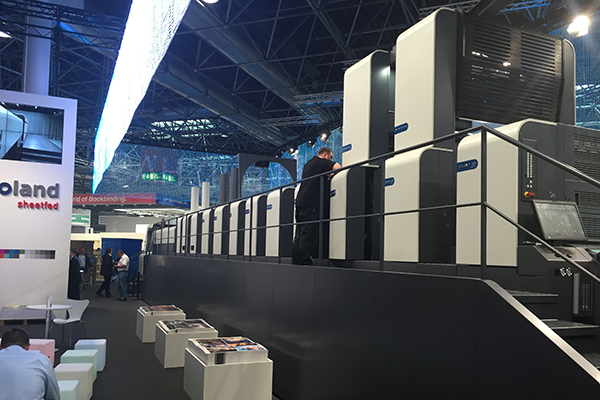
This is a strength that Manroland Sheetfed has, Godbold explains, thanks in part to its ability to cast a side frame in a single piece rather than building a press unit from a base housing the transfer cylinders and paper path and the upper print unit with plate cylinders and inking systems. All elements of the press are produced in the factory in Offenbach. There are no components sourced, say, from China to keep costs down. Manroland Sheetfed aims to achieve competitive prices through manufacturing efficiency.
The press design and build provides the longevity that keeps Manroland presses in use for longer than other machines. “The robustness of the build means we can print the sharpness of the dot even on the older presses,” Godbold says.
The company has the necessary technology elements to be competitive with rivals: simultaneous plate changing, impression and blanket washing by longlife brush rather than cloth systems, inline inspection and EagleEye to check that the sheet being printed is an exact match to the file approved in prepress. Any deviation, through a quality issue or imperfections introduced since the decision to make plates, will result in the sheet being marked out as sub standard.
Manroland also has one or two elements that set its technology apart. Godbold highlights the TripleFlow, an inking system that can on the fly divert ink towards the front or rear of the sheet or to run in balance across the sheet so avoiding issues associated with ink starvation or flooding. This is managed from the press console where the operator can move a roller out of contact to direct ink in one way or the other – useful when a heavy solid might otherwise prove problematic to print – with the press of a button.
This, like other parts of the technology are directed at the needs of carton converters rather than commercial print. It is a market led choice, for despite the marquee installation of a Roland 700 at publication printer Warners last year followed by commercial printer Potts, packaging is going to be the fertile ground for the business. “Carton demand is rising 5-6% a year,” Godbold says, “helped by the switch away from the use of plastic. We are seeing a lot of printers choosing to switch from commercial sheetfed to packaging before they find themselves in trouble because their market is shrinking.”
And Manroland’s heritage is very much in packaging: 40 years ago it was not unusual to see press rooms filled with machines to Roland’s five cylinder press design which would print cereal packets with the same job on press for days at a time following a make ready of several hours.
These machines have long been retired, but there are 20-year-old Manroland presses still giving good service in packaging printers across the country. It’s a testament to the design and quality of the press and forms a loyal user base that provides another opportunity for the company to grow sales. The newer versions of the B1 press, now the Manroland 700 Evolution, will make ready in fewer than 100 sheets “and there is no waste on the run”.
As print runs are falling with many companies printing just 15,000 sheets at a time (short runs in packaging are not the same as short runs in commercial printing where digital technologies have made a huge impact), makeready is more important than overall running speed. Even so the B1 press will reach 20,000 sph says Godbold.
He adds: “We are leading the way in quality and fast makeready and low running costs. Customers tell us that the press is at the right price for what they want to be paying.”
They are also telling him that they are not interested in adopting extended colour gamut printing. “It’s not a topic that we find is interesting for litho. Their customers want an exact match for brand colours, an area where ECG often falls down when it fails to meet expectations. Printers would rather run special colours. They can also find that using ECG means that this can affect the integrity of four colour images. Unsurprisingly printers don’t like risk: it makes print more complicated.
“It works in digital print where if the client rejects a job, there are only 1,500 sheets to reprint; but if a customer rejects a litho job with 15,000 or 20,000 sheets, that can become a very expensive cost for the printer.”
Manroland Sheetfed is selling more than the machine alone. The press comes with a two-year ProServ 360 deal, the service and support package that includes operational analysis, maintenance and remote check ups. This can be extended after the initial two-year period.
It is part of the way that the company says it keeps total cost of ownership low. But it is just one part of the deal. Godbold says that its network of electrical and mechanical engineers can be on the doorstep the next morning along with the required part. Demonstrators are available when needed and training is provided for life. This means, he says, that when a machine manager leaves (most likely through retirement) an incoming operator will be trained to the same level as the departing employee. “We will train a number two to become a number one as well as the youngsters that come in. We want to help make sure that all operators work in the same way,” he says. There are good operational benefits from this as it evens out fluctuations between shifts and between the tendency of the incoming operator to adjust the press set up. It means too that quality on the nightshift is the same as day shift quality.
This is what the company means by helping companies reach their KPIs. “It’s a true partnership,” he says. “I’ve worked in places where once the installation is done and the training finished, that is the last you see of the supplier. We want to help our customers by training people to same standard that means there is no difference between operators. We know that the operations director at a business cannot spare the time to stand by the press to supervise training.”
This also helps support the ability to be confident that the same job printed in different locations will be the same, a factor too of the build quality of the press.
That is the message that Godbold and Manroland Sheetfed needs to spread. Godbold has a final card tucked away. “We have a very strong selling point that Manroland Sheetfed is a British owned business, part of a very successful engineering group. We manufacture in Germany with German engineering, in the traditional highly skilled manner.”