
Kyana, the website tells you, is a name that shares the same root in ancient Greek as cyan. It means dark blue, the sort of dark blue that Koenig & Bauer uses as its brand colour. Kyana is also the press manufacturer’s first all encompassing artificial intelligence engine, restricted currently to its inkjet coding technology AlphaJet, but surely pointing the way to a roll out across the company’s portfolio: digital press first and then litho, flexo and intaglio.
Kyana is accessed through a single-screen web browser giving real time status updates of a device that is part of a production line in what might be a hard to access part of the line. It provides instant feedback on how the machine is running, whether maintenance is going to be needed in the near future, where any consumables are needed or if these need to be reordered, it can run comparisons with other AlphaJets to ensure this is operated to maximum productivity, and there is instant online support.
A technician located in Germany can plug into a press in operation in Scandinavia, France or the UK to run diagnostic checks and identify the fault without the need for an extra visit. When the engineer is needed, no time is wasted identifying what needs to be done. VR glasses can be used by the remote technician to show the operator on the spot what parts need to be touched, cleaned or replaced, guided by a tablet and 3D exploded CGI to point out parts of the machine.
Koenig & Bauer has started to use AI on its larger presses in this way, demonstrating the potential of smart glasses to project a virtual view of the machine for maintenance or training. The price of smart glasses has been a barrier to take up, while high speed reliable internet is also essential.
It has worked for identifying maintenance issues, where a vast number of data points can be trawled by an AI in real time far faster than checking print outs at the end of a shift, week or month to try to spot a problem. The company provides a concrete example, saying how discrepancies in the data fed back from a large sheetfed press led the support team to call the printer to alert him because of an unexpected spike in oil temperature inside the press. It turned out that by accident the wrong grade of oil had been introduced into the press, something that would have caused a catastrophic breakdown if not attended to.
As more and more data is accumulated over time and more machines, the AI will become smarter and more responsive to interrogations: what is the impact of this paper, or these inks, how do they affect press speeds and so on. The data is fed back to the MIS or the hub that runs the business.
The different press manufacturers are each working on technologies that automate make readies, that communicate to upstream processes like platesetters and downstream finishing processes. The communication will be in JDF or JDF based formats. The inclination to flavour JDF to a specific manufacturer making integrations more of a challenge is falling away. The variety of integrations required and the reluctance of printers to pay for them as once they did, is pushing companies towards API led integrations. These will be faster to set up and with AI can become faster still. At heart however, standard ways of describing print and processes will still need to be agreed, even if not to the rigidity that JDF can impose.
This delivers automation along the process, but not necessarily driven by an AI. The physicality of print tends to impose limitations on what can be done, so imposes restrictions on the benefits of using AI. Signals can be sent to couriers to improve efficiency for example but by the time ink is on paper, there is little that AI can do about the data.
However, there is plenty of scope to use AI or machine learning to reduce set up times, cut waste and automate press operation as much as possible. Its use is intrinsic to Heidelberg’s Push to Stop concept, for example. The manufacturer says that the AI journey has begun with Preset 2.0, Intellistart 3, Wash Assistant, Power Assistant and Colour Assistant. The algorithms learn about the changes needed for different paper types, ink coverage and from this how much washing is necessary, what sort of drying power is needed and what air settings are needed though the press. In short the algorithms take the strain from the operator and reduce the number of sheets needed to get to good colour.
Heidelberg claims that a productivity improvement of 5% is possible using Preset 2.0. As ChatGPT and other large language models are trained on vast amounts of written data, the AI algorithms in Preset 2.0 have been trained on 600,000 jobs gleaned from connected Speedmasters around the world. As more data becomes available, the AI will improve.
Ink presetting is similarly optimised through the Colour Assistant Pro function, and similarly for other settings that would at one time have required highly skilled operators to carry out.
“Artificial intelligence simplifies workflows, enables more accurate prognoses and creates new, data based business models. It permits faster decisions on the basis of a wide range of data and real time information as well as prognoses beyond human capabilities,” the company says.
This is not unique to Heidelberg. Koenig & Bauer, Komori, RMGT from the litho side and the whole swathe of digital press providers are working in the same direction. Exactly how will become clearer at Drupa, but they simply cannot afford to be left behind.
The applications of AI continue once sheets are on a pallet. The use of full AI on running finishing lines may be disproportionate currently. Scheduling and management of jobs through the process, particularly when rapid changes are needed will be an area that can be improved through AI. And there will be an impact on the physical movement of jobs. However, AI is unlikely to be of much use in running finishing machines as decisions about production flows will have been much earlier in the process.
Robotic vehicles are going to be used to move pallets of work in progress. Robotic arms for loading boxes or pallets will follow programmes to ensure the optimum way to load a pallet or a box. Automated Mobile Robots (AMRs) by contrast understand how to change a route if something is blocking the original path and will respond to the chaos of an operation where assigning pallets to machines is likely to be fruitless as production timings shift for any number of reasons.
There will be more AMR systems deployed across the industry as it becomes increasingly difficult to find manpower to move pallets of work in progress. Robots will take on the repetitive tasks that humans do not want to do, just as AI handles repetitive administrative tasks. And finishing is ideal for a robot takeover because their use can reduce the need for labour. Horizon uses robot arms to load book blocks to a binder, perhaps learning how to replicate the subtle movements that an experienced operator will carry out instinctively when running different papers or so on. That would also require different grips to those in use currently.
There is more scope for AI at the start of the process, and systems exist already that manage conversions from one file format to an other, optimising colour for specific output types and in improving the quality of images, perhaps introducing interpolated data to transform a low rez screen only image into something that can be used across a full layflat spread.
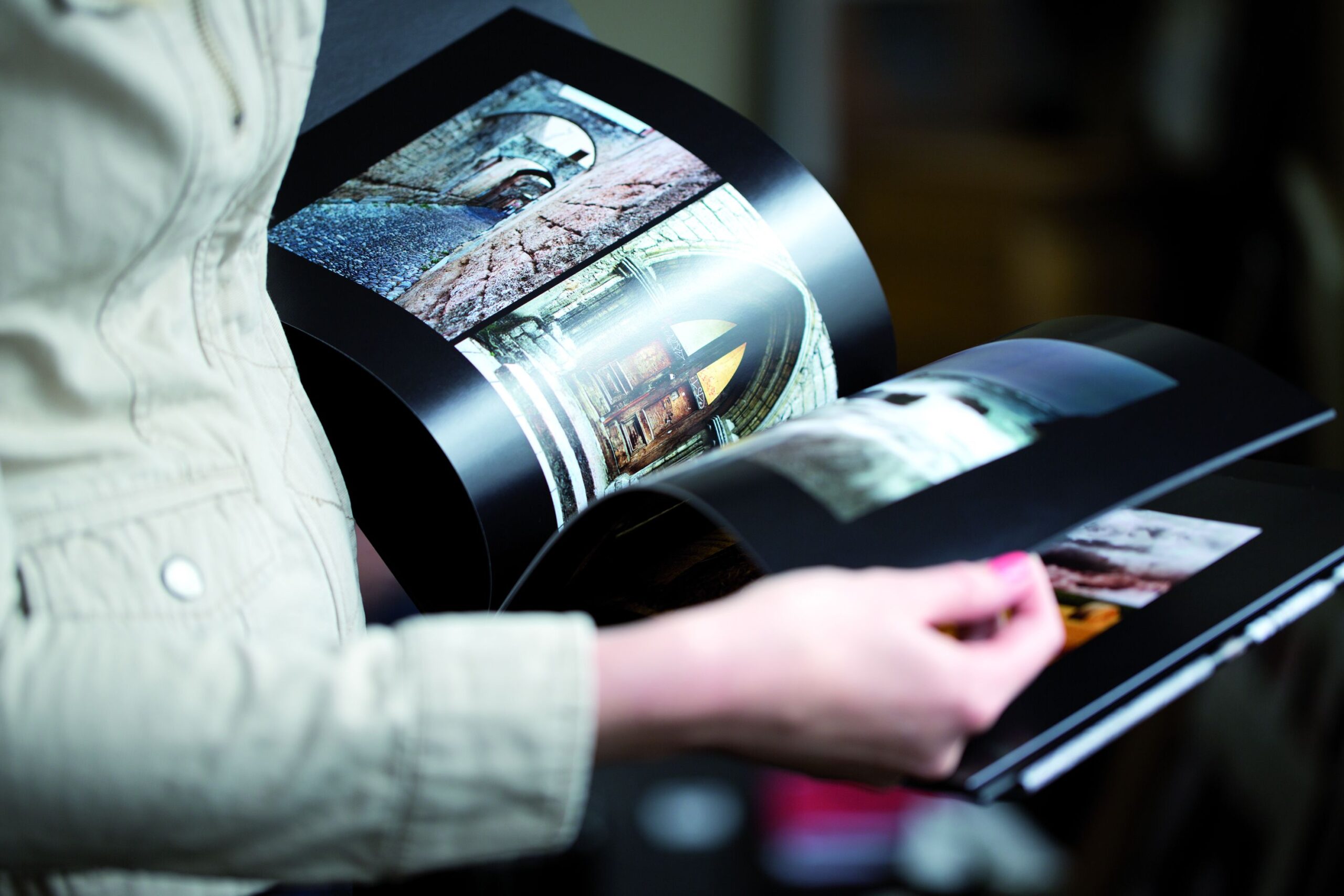
Taopix is making use of AI to encourage people to make photobooks by taking away some of drudgery associated with choosing and placing photos on a page through a web browser. This leads to a high drop off rate and even when a book has been completed and is in a shopping basket, it can mean baskets are abandoned.
A greater rate of completion will mean more orders and more print being placed. “We are using AI to help customers build their books,” says managing director Neil Bather. “It can take a lot of time for customers to sort their pictures, while the AI can take the photos and build a beautiful book. That’s the concept.”
The AI will sort the images into themes, perhaps of the same location, or the same day. For a wedding album for example it can sort the images into the story of the day, or versions from the point of view of the groom or bride’s family. “People are waking up to the questions of how we can automate photobook creation and we are getting more inquiries about this.
“The AI analyses the photos that might have been taken by different people at a wedding, will understand that many are the same, will further sort out which are the best and will select the best to be used. It uses facial recognition to avoid unwanted crops.
“It creates what we call mini stories by grouping the photos around themes and in two minutes or so delivers a book that probably needs a little tweaking but which is already a commercially viable book. Ultimately it’s about making it really easy for people to put together a photobook.
“Lots of pro photographers don’t want to do weddings because of the difficulties in sorting through the images and compiling the books. Now they can throw them into a web folder and the algorithm creates the book.”
What is possible for a photobook will also be possible for a self published book, of family recipes, family history and so on, making it as painless as possible to produce something that ends up on a printing press. Moonpig, Bather points out, is using AI to create a personalised poem to be printed on the inside of a greetings card, again increasing the likelihood that a sale is completed rather than abandoned at check out.
“We are only scratching the surface of where AI can take us,” says Bather. The image generating AIs like Dall-E or Midjourney result in some highly creative images that become real when printed out as a poster, wallpaper or textile design, or as a wrapper for bar of chocolate as was suggested by the recent DScoop event focused on AI. “If it’s easy, it can and will be done,” says Bather. “I don’t think AI should be feared. It’s a change of technology. The arrival of Lotus 1-2-3 and the Excel spreadsheet changed the nature of book keeping. AI is the next step. It’s quicker and more powerful than anything else to date and it’s moving so quickly. For our purposes, AI is helping the end user, it’s helping the retailer and it’s helping production. In our applications there’s no downside to AI and it will improve.”
At the more industrial scale of image handling, Dalim already uses AI in its ES digital asset management product. Advantages it says cover data analysis, keyword search and content optimisation. This will lead into real time content generation, responding to actions from a potential customer or to outside events; advanced distribution where the content is optimised automatically for whichever channel is best in a particular situation. With extensive use of APIs, the real time content generation can trigger a customer specific catalogue to be printed and mailed at the most suitable location with no human intervention.
AI will enable Dalim users to load assets into the database without having to follow strict guidelines on tags and keywords to find that asset at a later point. Instead those keywords will be self generating enabling more assets to be loaded, faster and with greater levels of accuracy. It takes away the tedious repetitive tasks which, as with pro photographers using Taopix, become a barrier to use.
Likewise Infigo is starting to harness AI rather than worrying about any threat to its web to print software business. Marketing director Chris Minn says: “We don’t have to worry about AI taking over the human race. But we do need to be able to utilise it.
“We have already started using AI. The parametric design feature for cartons that we introduced earlier this year uses AI. The end users create the box they want starting from a template library and uses this as the basis for the design which adapts the the dimensions of the product it carries.”
Even if Infigo wanted, it cannot ignore developments in AI. Many of the most widely business applications that the software provider has to integrate with are already using AI to some extent. Minn says: “A lot of the third party tools that we connect with, Xero, LinkedIn, Salesforce, Hubspot are developing with AI.” It is in short impossible to put the genie back in the bottle.
However, for the benefits to be felt by printers, says Minn, there needs to be automation behind it. The sort of automation he is talking about was demonstrated at the Print Show when Infigo showed how details of a job created in a web portal appeared instantaneously in an Imprint MIS. To do this Infigo needed an API connection in Zaikio’s Mission Control platform with another connection leading to the MIS. Information flows in both ways, seamlessly through Mission Control. But this is not an AI and Christian Weyer, founder of Zaikio and a neuroscientist by training, is not a cheerleader for AI – at least in this space. Defining print requires agreed specifications and standards which is not conducive to the AIs that are popping up at the moment.
Steve Richardson is managing director of Optimus, another MIS provider. Recent developments have focused on connectivity and integrations to create seamless implementations for some very sophisticated applications, including for some of the most globalised packaging groups. But it is not AI.
“We have explored how we might use AI in our pricing model and we have some plug ins to deliver real time pricing, not just to Optimus but also to web to print portals. We have handling huge volumes of data and are pretty fast as it is and our customers are asking for more of that.
“I’m not sure that AI can improve what we already have. Consequently we have nothing to look at right now, but it is on the horizon.”
Instead Optimus changed course to use web services to expand processing power as and when it is needed. The data structure has been optimised in this way. So for the immediate future Optimus is not rushing to implement AI.
Minn at Infigo points out: “There’s no point in having AI until there’s automation behind it.” And for the moment there is relatively little automation across the printing industry. There is connectivity between a prepress system and a press using JDF, but not full implementations that make full use of JDF or other drivers of automation. The digital mindset is all too frequently absent. “People like the idea of connectivity, but are reluctant to change how they operate,” says Richardson.
MORE FROM THE MAGAZINE
MORE ON DATA DRIVEN PRINT