
The Print Show perhaps lacked the brashness of its transatlantic cousin, Printing United. There were fewer product announcements, fewer exhibitors, less space and fewer visitors. None of which is surprising. The US is exponentially larger than the UK; Americans have a greater propensity to travel (in their own country at least) and budgets are greater. Birmingham in late September though has its charms and these were enough to draw visitors to the most distant hall in the NEC complex for a day of looking at some of the latest machinery that technology providers have to offer.
Printing exhibitions are all about digital printing these days. There is no space for a litho press nor any likelihood of achieving a return from erecting a press for a three-day show. Even Fujifilm, which continues to be a major litho printing plate supplier, did not mention the L word. It had one of the largest stands at the show and it was all about digital printing, both cut sheet toner and large format inkjet.
This is the direction for Fujifilm’s future. The company created a splash with the launch of the six colour Revoria PC1120 and Apeos Pro C machines in May and at the NEC introduced the two presses that sit between these: the Revoria SC170/180 and EC1100. It gives Fujifilm the full complement of presses to match the likes of Xerox, Ricoh, Konica Minolta and Canon.
They were received well. There was a constant stream of visitors wanting to know more and to put the presses through their paces, and to understand Fujifilm’s thinking and how it, as a new – albeit large – entrant to the market, planned to compete against those that are already present.
There will be a network of distributors, including a start up first time dealer Fujitech and the well established SOS, but these are not yet officially named. These will handle first line support along with a call centre system that has been honed by Fujifilm’s operation in Asia where it has been selling this type of technology to commercial printers for many years.
This will, together with a dose of technology, an emphasis on reliability and training operators to replace consumable and other parts themselves will enable Fujifilm to achieve the spread of support required without needing as many feet on the ground as might traditionally be the case.
Andy Kent, division manager for Fujifilm Graphic Arts, says that this was the first appearance at a UK industry exhibition since Ipex 2014. “We have supported dealers at Sign & Digital, but never before as Fujifilm,” he says. The introduction of the two new toner presses, but also a hybrid Acuity 30 large format printer, explains its participation. “We had four existing and three new presses on show,” Kent adds, “and it worked really well for us.”
The company gathered 60 strong leads immediately as well as positive impressions that may feed into later interest. “We had already gained some opportunities from the launch of the PoD products in May. After that we needed another platform and the timing of the Print Show was perfect for that. It was perfect too that the two new machines came along.” The timing was wrong for the B2 toner press he says. “We would have needed a bit more space.” Instead the Revoria GC12500 will be introduced in Europe at a Performance Print in Germany in January rather than waiting until Drupa for the official launch.
In the meantime, Fujifilm will be continuing negotiations with potential distributors and customers. “We did not have massive expectations when we signed up; we weren’t sure about the numbers. I feel the footfall was quite good, certainly good enough for us to justify returning next year.”
By then the larger Revoria might be part of the stand. It is already a hotly anticipated launch.
The GC125000 prints on a six A4 pages to view sheet from 64gsm to 600 micron boards, in four-colour only (additional colours would be possible at a future date) and at a speed of 2,500 sheets an hour. This means in terms of A4 page output, the press will be more productive than the SRA3 Revoria PC1120 but not as fast as the Jetpress 750 HS, also at the B2 format. Fujifilm reports that a number of customers had abandoned litho printing during the Covid pandemic and had not returned to litho printing, depressing demand for printing plates, but increasing interest in a B2 digital format.
Konica Minolta has long ceased to be involved in printing plates. Its last role in litho was the supply the plates used on Screen’s Direct Image press, a machine that has faded into history as the interim between conventional offset printing and true digital print. Its Print Show presence this year was around ultra short run carton production calling on a web to print portal peered by Solimar and EPS, its C12000 press, the AccurioShine 3600 for varnish and foil enhancement and a Morgana SC6000 cutting device to produce personalised favours boxes for visitors to carry away with a bag of chocolates.
The demonstration started with entering visitor details into an on screen template to reflect the online portal. The name is applied to the requisite template, the other details carried forward for delivery address and invoicing where this is linked. With that the back end takes over. A job number is assigned and the job sent over to the Fiery acting as the DFE for the AccurioPress C14000. The additional layer, containing the visitor’s name is sent as a tiff file to the AccurioShine along with details of the code to be printed on the box.
When the job gets its turn in the production queue the identifier QR code is added to the sheet. This will identify the job to the embellishment and cutting stage of the job, automatically calling up job details. It will also add the crop and registration marks.
“The point we wanted to get across and to show printers a finished product rather than flat sheets and we wanted to show printers what it is possible to produce. We chose packaging and a children’s colouring in book, but business cards, greetings cards and anything where there is variable data on a template is possible,” says category manager Malcolm Smith.
Head of the professional print business unit Jon Hiscock put his finger on it. “We were able to show how much we can do with as few people as possible and deliver a really good professional job as well. One or two operators can drive this entire production process.
“We are finding too that embellishment is something that printers can get involved with at the B3 level. We see being able to offer embellishment, which others cannot, as something that can help customers be successful and is adding value to print for their customers.”
The AS3600 was making its UK debut at the exhibition, another first for visitors. More unobtrusively Zaikio was demonstrating a global first: the integration of two separate workflows through its Mission Control platform. On one side this was Infigo and Imprint as the MIS on the other. Orders placed through Infigo, with specifications for printing, the numbers, customer details and so on including the artwork. A job ticket appeared almost instantly in the MIS with an estimate for that job automatically.
This has required no detailed integration between the two applications, possibly unique to that customer, so difficult to replicate or justify. Instead both have completed an integration to Mission Control. Job details are translated into Zaikio’s internal structures and then this is translated on exit to the protocols that Imprint has needed.
Information on job tracking and progress, if available to the MIS, can take the reverse journey and can be provided to the end customer via a log in page, email or SMS.
Zaikio has previously proved this is possible with its own Keyline MIS and has established links into paper merchants and other consumable suppliers for automated search and order for paper. But this was a first for this type of integration. While the company has Heidelberg as its major shareholder, the API link into Prinect is not ready for release.
“The Prinect connection is coming,” says Karl Ciz, Zaikio partner. “And we have customers using this with Keyline. It’s nice to have someone else using the API.”
The connection is not yet a plug and play solution because every implementation will have slight differences, but it does simplify, accelerate and should reduce the cost, of creating seamless integrations. Even where one supplier produces a substantial upgrade, the only work will be on the Mission Control interface for the system to continue to be seamless.
At the heart of the connection is a static data model which understands the strictures around and structure of a print job. All external data can be mapped to this or mapped from this data model to the requirements of the connected application. There is no need to test the validity of each machine to machine connection.
The current connection automates the process of entering job details from the order placed through the portal into an MIS, either using a hot folder or manual entry of details. Nor does it matter whether the job is first raised in Imprint or Infigo, the conventions remain the same and the job is processed in an identical fashion.
It should not be long before what was possible to demonstrate at an exhibition, becomes a reality in the fields: a number of customers are discussing an implementation. “It has gone beyond the concept phase,” says Ciz. And it tees Zaikio up nicely to demonstrate more sophisticated implementations in the new year leading up to its presence at Drupa next year.
Another technology that will wait until the German mega show to appear is the first four colour high quality inkjet press from Kyocera. The company remains best known for its printheads which are used by numerous label press manufacturers and also by Canon for its continuous feed web presses and for the VarioPrint iX series cut sheet presses.
To date Kyocera has only had one card to play in terms of production print equipment – the Pro C15000, a press printing on uncoated papers, particularly for letters and statements.
The machine in Birmingham was adorned with decals extolling its position as having the lowest environmental footprint of any production digital press. This is thanks to using aqueous inks on papers which need no assisted drying. It can therefore run from a 13-amp plug. It uses 70% less power than an equivalent toner press. This amounts to a lowest cost per copy of any digital press.
“But it’s the whole story that’s important,” says Kyocera sales director business solutions Steve Doust. “It’s not just the cost of the box. We support the environment, and it’s easy for people to run. This is the chance for printers to step into inkjet.”
The press can be configured with various paper drawers and with options on inline finishing. The downside is that this is a press suited to letter work, not high quality commercial printing. Resolution is 600dpi and because of the paper used, sharp colours with strong lift from the page cannot be expected. But product manuals, education, appointment letters, invoices and other statements, communications from government at all levels are ideal. And where Kyocera has notched sales, around 11 or so in the last year. “It is not competing with any other press in the market. This serves a unique market space.”
The technical limitations will no longer be the case with the Taskalfa 55000. It will print on coated papers, so will need help with drying so a three-pin plug will be inadequate. But there will be no need for a primer of any kind.
The press has been in development for a couple of years between Kyocera and Screen. It will use the same SC+ ink that Screen uses on the TruepressJet 520 HD and Kyocera’s 1200dpi printheads. These are also used on the Canon iX series of cutsheet inkjet presses. The Canon machine is currently the dominant inkjet press for commercial printing in the two page format and must be the target for the project. It will however be somewhat more compact than the iX which has a large circumference drum for drying. The drying technology that will be used on the new press is not public.
“The new press will be in that iX market,” he says. “It will shake up the market.”
It can be expected in the new year, certainly to appear at Drupa where the possibility of a continuous feed inkjet press is not out of the question. Kyocera has a well defined road map it seems.
There seemed to be just as many trade printers participating in the exhibition as companies selling print technology. Solopress, Tradeprint and Bluetree were joined by Flexpress, Baker Labels and Very Displays. Kirsty Corcoran says Very is now a regular exhibitor, aiming to encounter both regular and new customers. Echoing other exhibitors she says that there might have been a fall off in overall numbers, but that this was balanced by the quality. “It meant that we collected the same number of leads. We were able to show new products and brought our account managers which meant that those who have been dealing with us by phone or online were able to put a face to the name,” she says.
Tradeprint had been to the Print Show for the first time in 2022 and returned with a stand that stressed sustainability. The stand itself was printed on corrugated board that after the three days was carefully dismantled and will be used to decorate the corridors of its premises in Dundee.
Anthony Rowell was also impressed by the level of visitor. “The quality of people visiting was a bit improved on last year. It was also nice to meet competitors and suppliers and those we already collaborate with,” he says. “We received some great feedback on the product the stand was produced from and we plan to be selling this from the website as soon as we can. The challenge is find a way of commercialising a stand build material that uses fibre rather than plastic.”
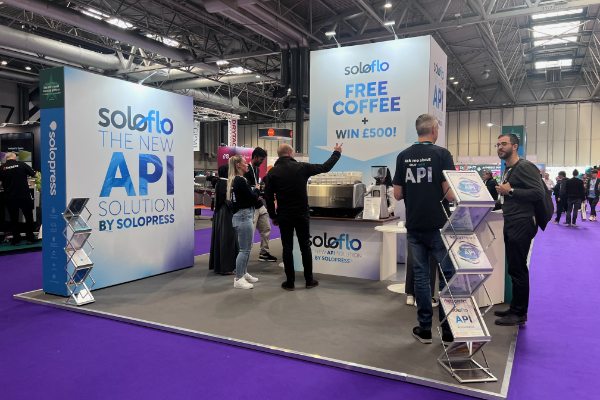
The emphasis for Solopress, aside from a Ripple coffee machine that printed pictures of visitors to be shared on social media, was on its recently introduced Soloflo API connection to customers. Glenn Eckett says: “The show was again very positive for us. This year we went with a very clear objective which was to launch Soloflo and to get into conversation with people about. We were successful.
“Last year we had feedback from people asking whether we could offer an API for their website, so that prompted us to develop it. We now have that with Soloflo.”
The coffee gimmick also worked. Visitors were invited to submit a photo of their face on the top of the coffee to their LinkedIn feed for a chance of a £500 prize. This created a vast social reach in all, says Eckett, more than 1,100 cups were served up over the three days providing an opportunity to quiz those in the queue as well as reaching beyond the show itself.
The approach meant too that those account managers at the show had a clear sense of purpose. It worked, says Eckett, with enough business to justify the investment in attending. Baker Labels’ gimmick was a basketball hoop as a sideshow game that both attracted visitors and kept its own staff occupied as the crowds filtered out after the show closed each day. As well as labels the Essex trade supplier was promoting pouch production, its strategy being that customers should use a trade supplier to build up a customer base before investing in a new sector. And pouches are a growing market, using recyclable plastics and gaining environmental kudos by being lightweight rather than the weight of a glass jar. The pouch also offers a brand greater real estate than a label to promote itself.
There is another approach. Oki which already has a low cost label press using its four- or five-colour laser print engine, introduced a version that will print on a preformed pouch. The investment suits small scale production, perhaps going direct to the brand rather than through a print business. It suits small volumes, personalisation and fulfilment of orders placed through a web portal, for wedding favours for example. The small demonstration area as part of the ASL stand attracted a constant flow of visitors, enabling ASL’s team to then draw the visitor’s attention to another of the products in the portfolio, whether printing, finishing or adding value.
Another of the hot topic areas for this year was direct to film, using inkjet presses to print to a film which is then bonded to fabric for a T-shirt, or to a solid object. It overcomes some of the limitations of dye sublimation, printing on cotton for example, and was present in a number of locations across the exhibition hall. Inktec, a company that offers a range of high level display graphics printers, chose not to bring these choosing instead to show its direct to film technology, matching the printer with the substrate.
MORE FROM THE MAGAZINE
MORE ON THE PRINT SHOW