It has been a good time over the last couple of years for labels printing, for flexible packaging and for carton printing. All have been spurred by sharply growing demand for packaging. However, if these sectors are doing well, corrugated packaging is soaring, accelerated by technology change, social change and structural change – the elements needed for a lasting revolution.
The technology change is the advent of machinery for digital printing beyond inkjet for coding purposes. Inkjet is falling in cost, inks have improved and presses that target digital print for corrugated are ready for market.
The social change is the rise of home delivery and ecommerce. Since the middle of 2020 more than 85,000 businesses have been registered in the UK and many have launched online sites along with restaurants, farms and artisan producers that have started selling direct to the public.
Consumers are buying directly from producers, bypassing retailers and the likes of Amazon, and those producers are sending out products in corrugated as the only form of packaging for their products.
With the related interest in unboxing videos, this packaging needs to look good as well as protecting what is inside. It is creating a demand for printing on both sides of the corrugated board.
The structural change is a rapid swing to sustainability. Corrugated board is considered better for the planet than anything that uses plastic packaging, to the extent that consumers will shun brands that continue to use plastic in packaging when recyclable fibre based packaging is available. At the same time brands are responding to consumer concern through smaller order quantities, to retail ready packaging cases, with a shift towards shorter supply chains that may in time reduce dependence on manufacturing in Asia. Localised production will in turn increase demand for packaging that is produced locally.
Different pieces of research highlight that modern consumers are averse to packaging that includes plastic, that retailers that support fibre based packaging are preferred and that younger consumers in particular consider packaging in their purchase decisions. Equally ecommerce requires a mechanism for returning unwanted purchases and a way to remarket these. Corrugated is the answer.
Concern about sustainability and consumption is a key Gen Z characteristic.
Smurfit Kappa CEO Tony Smurfit says in the company’s latest annual report: “With corrugated demand growth of 8% during the year, this is a clear indication that paper based packaging, which is renewable, recyclable and biodegradable, is the choice of our customers and the end consumer versus the less sustainable alternatives.
Governments are also following suit by legislating against non recyclable and less sustainable packaging. Ecommerce is now a way of life and the protection that corrugated packaging provides as a transport medium is the preferred choice for a mobile and sustainable world.”
Combined, the changes result in a heady brew of pressures that will drive the sort of change in the corrugated sector that digital printing has wrought on commercial printers. The giants of the industry, the DS Smith and Smurfit Kappas, Schumachers and VPK in Europe, the WestRock, Georgia Pacific and International Papers from North America, may not be agile enough to change rapidly. As in commercial printing larger corrugated converters may not feel the pressure to adapt business models. At this point at least, leaving the opportunity for independent box producers and perhaps for new entrants to the sector with a digital only offering.
Like their carton converting cousins, the multi-site groups are businesses that are geared to maximise production efficiency on longer runs with agreed order cycles and volumes. And this ties in with the same highly efficient production cycles of their customers: they know when they will be producing certain products and where and when the packaging will be delivered at the right time for this. They also naturally strike relationships with the larger companies that are focused on volume production.
The converting groups cannot easily cope with the disruption to their business model that short runs and digital printing implies. While each of these businesses has explored digital printing of corrugated packaging, none has as yet adopted the concept wholesale. It is a nice add on, something to explore and use to address specific needs, perhaps for samples or prototypes. It is not mainstream for the major corrugated board and box businesses.
This is not to say that the giants are ignoring digital production, it simply is not a major part of their overall business. Smurfit Kappa is working with companies like online shaving requisites supplier Harry’s and the flowers arm of Waitrose to create packaging that suits their ecommerce propositions.
DS Smith has developed a web portal specifically for customers to order plain corrugated packaging in a variety of styles and formats. But this does not yet include an option to upload artwork which might then be printed digitally.
Nor is digital print mainstream for the independent box producer. But these are companies that are investing in machinery for faster turnaround, shorter makereadies and which are effective at this supplying packaging on demand.
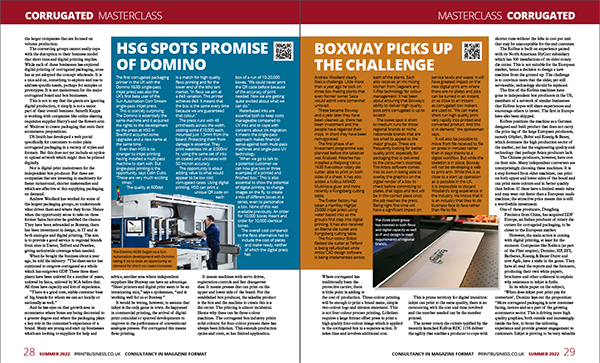
Andrew Woollard has worked for some of the largest packaging groups, so understands what drives them and where they focus. Hence when the opportunity arose to take on three former Saica factories he grabbed the chance. They have been rebranded as Boxway, there has been investment in design, in IT and in both analogue and digital printing. The aim is to provide a good service to regional brands from sites in Exeter, Telford and Peterlee, giving nationwide coverage when needed.
When he bought the business about a year ago, he told the industry: “The sheet sector has continued to outgrow corrugated as a whole which has outgrown GDP. These three sheet plants have been unloved for a number of years, unloved by Saica, unloved by SCA before that. All three have capacity and lots of experience.
“There is a good core, stable customer base of big brands for whom we can act locally or nationally as well.”
And he has eyes on that growth area in ecommerce where boxes are being decorated to a greater degree and where the packaging plays a key role in the consumer’s experience of a brand. Many are young and start up businesses which are looking to suppliers for help and advice, another area where independent suppliers like Boxway can have an advantage. “Sheet printers and digital print seem to be an intoxicating mix,” says a spokesman, “and is working well for us at Boxway.”
It would be wrong, however, to assume that inkjet is the only game in town. As happened in commercial printing, the arrival of digital print coincided or spurred developments to improve to the performance of conventional analogue presses. For corrugated this means flexo printing.
It means machines with servo drives, registration controls and fast changeover dies. It means presses that can print on the upper and lower side of the board. For the established box producer, the saleable product is the box and the machine to create this is a die cutter. The printing is almost incidental. Hence why these can be three-colour machines. The corrugated box industry prints solid colours: for four-colour process there has always been litholam. This extends production cycles and costs, so has limited application.
Where corrugated has traditionally been the protective carrier, there is little point in adding to the cost of production. Three-colour printing will be enough to print a brand name, simple two-colour logo and mission statement. This is not four-colour process printing. Litholam requires a large format offset press to print a high quality four-colour image which is applied to the corrugated box in a separate action. It takes time and involves additional cost.
This is prime territory for digital transition: inkjet can print to the same quality, there is no outsourcing with the cost and time involved and the number needed can be the number printed.
The newer rotary die cutters typified by the recently launched Kolbus RDC 115S deliver the agility that enables a producer to cope with shorter runs without the hike in cost per unit that may be unacceptable for the end customer.
The Kolbus is built on experience gained with its North American HyCorr subsidiary which has 300 installations of its older rotary die cutter. This is not suitable for the European market, hence a decision to design a new machine from the ground up. The challenge is to convince users that the older, yet still serviceable, technology should be replaced.
The first of the Kolbus machines have gone to independent box producers in the US, members of a network of similar businesses that Kolbus hopes will share experiences and encourage others to invest. The first in Europe have also been shipped.
Kolbus positions the machine as a German designed and built product that does not carry the price tag of the large European producers, namely Göpfert, Bobst and Koenig & Bauer, which dominate the high production sector of the market, yet has the engineering quality and technology that perhaps Asian producers lack.
The Chinese producers, however, have cost on their side. Many independent converters are unsurprisingly choosing these machines. It is a step forward from older machines, can print on both upper and lower sides of the board and can print more colours and in better quality than before. If these have a limited resale value and may wear out faster than a European made machine, the attractive price means this is still a worthwhile investment.
One of these producers, Dongfang Precision from China, has acquired EDF Europe, an Italian producer of rotary die cutters for corrugated packaging, to be closer to the European market.
However, the main action is coming with digital printing, at least for the moment. Companies like Xeikon (as part of the Flint empire), Domino, HP, EFI, Barberan, Koenig & Bauer Durst and now Agfa, have a stake in the game. They have all read the reports and the forecasts, producing their own white papers, brochures and other collateral to explain why resistance to inkjet is futile.
In its white paper on the subject, ‘When does inkjet post print pay for converters’, Domino lays out the proposition: “More corrugated packaging is now consumer facing, instore and as a part of the growing ecommerce sector. This is driving more high quality graphics, both outside and increasingly inside the box, to boost the unboxing experience and provide greater engagement to customers. Inkjet is proving to be very valuable in helping corrugated buyers satisfy these demands.
“Single-pass inkjet printing is the most dynamic sector in corrugated. The market is expanding with new press installations growing rapidly, helping users find new ways to delight their customers and make money.” Up to a point.
EFI with Nozomi has the most installations of single-pass inkjet machines, some 35 or so, and not all these are for packaging applications. The presses at Delta and McGowans are for display work as much as corrugated packaging. Domino has placed one machine at a US company Independent II, likewise Xeikon at ProCorr Display & Packaging. This is the dawn of the inkjet age in corrugated.
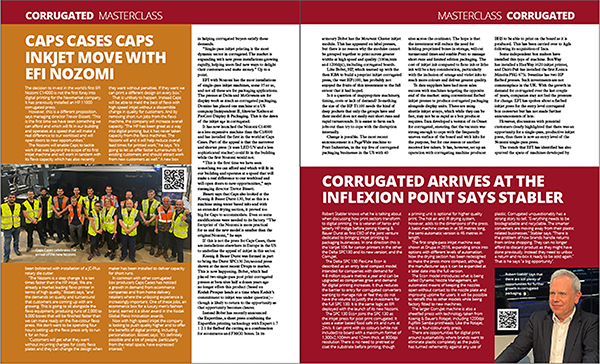
It has now launched the Nozomi C14000 as a less expensive machine than the C18000 and has installed the first in the world at Caps Cases. Part of the appeal is that the narrower and shorter press (it uses LED UV and a less sophisticated stacker) could fit in the building while the first Nozomi would not.
“This is the first time we have seen something we can afford and which will fit in our building and operates at a speed that will make a real difference to our workload and will open doors to new opportunities,” says managing director Trevor Bissett.
Bissett says that Caps also looked at the Koenig & Bauer Durst 130, but as this is a machine using water based inks and with an extended drying section, it proved too big for Caps to accommodate. Even so some modifications were needed to its factory. “The footprint of the Nozomi is more practical for us and the new model is smaller than the original Nozomi,” he says.
If this is not the press for Caps Cases, there are installations elsewhere in Europe in the US to underline the appeal of inkjet in this sector.
Koenig & Bauer Durst was formed in part to bring the Durst SPC130 2m/second press shown at the most recent Drupa to market. This is now happening. Bobst, which had placed two single-pass post print corrugated presses at beta sites half a dozen years ago no longer offers this product (based on Kodak Prosper heads at a time when Kodak’s commitment to inkjet was under question) – though is likely to return to the opportunity as that opportunity becomes clearer.
Instead Bobst has recently announced the Expertline, a sheet press combining the Expertflex printing technology with Expert 1.7 | 2.1 for flatbed die cutting as a combination for ecommerce and FMCG boxes. In its armoury Bobst has the Mouvent Cluster inkjet module. This has appeared on label presses, but there is no reason why the modules cannot be grouped together to print across greater widths at high speed and quality (100m/min and 1200dpi), including corrugated boards.
Like Bobst, HP, which teamed up with the then KBA to build a preprint inkjet corrugated press, the vast HP1100, has probably not enjoyed the fruits of this investment to the full extent that it had hoped.
Is it a question of inappropriate machinery, timing, costs or lack of demand? Something the size of the HP T1100 needs the kind of deep pockets that only the groups have and their model does not easily suit short runs and rapid turnarounds. It is easier to farm such jobs out than try to cope with the disruption internally.
Change is possible. The most recent announcement is a PageWide machine to Pratt Industries, in the top five of corrugated packaging businesses in the US with 40 sites across the continent. The hope is that the investment will reduce the need for holding preprinted boxes in storage, will cut turnaround times and enable Pratt to manage short runs and limited edition packaging. The cost of inkjet ink compared to flexo ink or litho ink will be a key consideration, particularly with the inclusion of orange and violet inks to reach more colours and deliver greater quality.
To date suppliers have had more sales success with machines targeting the opposite end of the market: using conventional flatbed inkjet presses to produce corrugated packaging alongside display units. These are using shuttle inkjet arrays, which while they can be fast, may not be as rapid as a box producer requires. Inca developed a version of its Onset for corrugated, ensuring that the vacuum was strong enough to cope with the frequently uneven surface of the board and with inks for the purpose, but for one reason or another received few takers. It has, however, set up an operation with corrugating machine producer BHS to be able to print on the board as it is produced. This has been carried over to Agfa following its acquisition of Inca.
Some independent box makers have installed this type of machine. BoxWay has installed a HanWay 1620 inkjet printer, and Dairi-Pak has installed the first Konica Minolta PKG 675i. Swanline has two HP flatbed presses. Such investments are not commonplace in the UK. With the growth in demand for corrugated over the last couple of years, companies may not feel the pressure for change. EFI has spoken about a flatbed inkjet press for the entry level corrugated box converter but has not made further announcements of late.
However, discussions with potential customers clearly highlighted that there was an opportunity for a single-pass, productive inkjet press, thus there is now an entry level of the Nozomi single-pass press.
The trends that EFI has identified has also spurred the spate of machines developed by companies without a background in corrugated but which understand inkjet technology. Their arguments would appear compelling: fewer process steps enables shorter run work to be accommodated; simpler workflows and opportunities arising from new products.
In its white paper, Domino quotes Finn MacDonald, president of Independent II on the company’s experience as the first user of the Domino X630i. “It takes one to three business days to receive and mount flexo plates, and over 15 days to source and laminate litho sheets. With inkjet it is much easier to produce jobs with multiple versions. There is both demand and there is plenty of room to educate and inspire the Customer to consider versioning. The visual and functional benefits of versioning and digital flexibility are dynamic to say the least. Customers who benefit from this are customers for life.”
The first Xeikon Idera machine has gone to a similar company, ProCorr Display & Packaging, part of TriState Container in the US. It took delivery of the press in January this year. Allen Friedman, president of the business, says that he has been watching single-pass inkjet for corrugated for some years and has been impressed by developments. It will handle jobs that can be too small for flexo and too large for a multipass inkjet printers. “In the past these brands were afraid of the labour time and costs when they wanted to improve print quality or make a design step change. Many have indicated a desire to change their order behaviour.
“We’re looking forward to being able to print short and long runs with all the benefits of a digital print on demand solution, including reduced waste.”
Companies in Europe have been slower to adopt this kind of technology, though this is starting to change. Koenig & Bauer Durst has the Delta SPC130 installed at The Royal Group in the US and has an order for a machine for a €25 million plant being built by Rondo Ganahl in Austria. The company bought its first of these machines three years ago. Rondo’s managing director Karl Pucher says: “Digital printing was a big step for us three years ago with an unknown future, but we have never looked back.
The transformation is being driven by brands who need to get products to the market quickly, and with digital printing we are very fast from development to getting the products to customers, among them Lindt & Sprüngli who are very big in display products and have been with us on our digital journey from the start.
“Digital printing is the future and is really helping us get a whole raft of new customers. Quality is no longer a topic of conversation. Digital is a very important development for us because we now have a total solution for our customers that has been integrated into our whole plant process.”
Operations manager Robert Posch adds: “The decision to print digitally is based on speed, more precisely the cycle time through the plant, because brands increasingly need to get products to the markets quicker, as opposed to waiting seven to 14 days with conventional production. Our target is always to be with the customer within one week, often it is even within only a few days.”
Robert Stabler joined the new organisation during lockdown and brings a deep experience of digital print technology and the transformations it can create. The experience of Rondo is indicative of a market poised to change.
“Most converters will invest when they feel they have sufficient volume of work of the right kind to justify the cost,” says Stabler. “Only once they have filled the press do they tell the brands. Every converter will have a digital press in the future. It will be a natural part of their arsenal they need to fulfil customer choices.”
Digital scores, and not just in corrugated packaging, where turnaround times are short and print runs reducing. “Digital is getting to the tipping point,” he says.
This is similar to experiences in other print markets where there is greater experience of digital printing, commercial print or labels for example. There will be a higher unit cost perhaps, but utility more than compensates. Being closer to the point of need means more accurate numbers and the absence of lengthy set up times and consumables like the printing plate reduce that unit cost. “Digital fits perfectly with challenger brands as it fits with challenger converters,” says Stabler.
For higher quality output, when completing against litholam for example, the non contact nature of inkjet means there is no crushing of the surface of the board. And specifiers can reduce the weight of the top liner sheet, from 150gsm to 90gsm.
“And when printers can print direct to material and reduce the weight, that can be a big cost saving,” says Stabler. “There’s a shift from coated to uncoated, from white papers to brown – these are the sorts of conversations we’re having.”
Currently cost per 1,000 boxes is the largest obstacle to more widespread adoption of digital printing. And that corrugated converters are not always leading the pack in terms of marketing nous. “They are brilliant at production, at logistics and managing supply chains, but not so at marketing,” he says. It means that those that do have a marketing message around the benefits of digital printing are ahead of the game. Rondo now thinks digital first with customers, creating custom packaging and displays. It’s a question, Stabler says, of converters finding the brands that are in line with this way of thinking. “Like Schumacher, Rondo is three years in and knows what it is doing and to approach the more nimble brands.” The big brands are increasingly aware of public pressure and the need for transparency. They are also keenly aware of total cost in the supply chain and waste in the supply chain and are taking sustainability seriously.”
Digital printing of packaging chimes with all these trends Stabler believes, the only note of caution being recession and how this reduces both consumer spending and the demand for packaging. However, with home shopping and ecommerce continuing to rise sharply, demand for the digitally printed box is heading in one direction only.
Smurfit Kappa was the first company to invest in the HP C500 single-pass inkjet post print press and has two in operation at its Interwell plant in Austria, having collaborated in the development of the single-pass water based inkjet press. The Boxmaker, a US corrugated packaging plant, has two of the HP machines and has bought its third Highcon digital die cutter for corrugated. The first, installed less than two years ago, operates at the company’s Seattle plant alongside the second. The third is part of a web to pack venture at an all digital factory in Arkansas.
The US is well ahead when it comes to what Highcon vice president marketing Simon Lewis calls web to box. “Web to box has gone through the roof in North America” he says. “It’s allowing smaller businesses to specify boxes to ship their products direct to consumers without going through an Amazon shipping box.
“It means too that there are a lot of new customers buying corrugated boxes, perhaps in the hundreds or low thousands of units at a time. And that favours digital printing. These printers are companies that can work to shorter lead times, unlike the larger businesses that have long lead times. They are agile and dynamic and growing fast.”
In Europe by contrast, there is investment in digital printing, but with larger businesses that have a finishing set up and are not buying Highcon. “That’s a bit of a mystery,” Lewis says. “Web to pack is much slower in Europe which is a surprise considering the uptake of web to print. In Europe web to box is still in the gestation period, but I believe the opportunity is there.”
Highcon is starting to supply new customers and new machines into the European market thanks to a more focused approach to its sales and marketing efforts, away from the intricate value added cutting approach and towards achieving real production needs. And the influx of digital presses for corrugated suggests that the real production needs exist.
Specifiers want to order on demand, they want flexibility. Converters, or new entrants to the sector will succeed if they can use technology to respond to be able to deliver shorter run jobs in a faster time, moving from analogue processes and thinking to digital.
“It is,” says Lewis, “like moving from using a rotary dial on a handset to phone someone to moving to a smart phone. It’s not just that production process, it’s the whole end to end system that supports it. To succeed, the industry needs to examine the whole process.”
The UK is beginning to swing towards single-pass inkjet printing at least. Models around online ordering will doubtless follow. Durham Box was the first to install an EFI Nozomi for packaging, followed by Caps Cases with the first Nozomi 14000 in the world. HPG is running the Domino press while David S Smith installed HP’s T11000S and T400S, though little is heard about the impact these have had on the group.
The packaging giant is more likely to make its next investment a traditional corrugated press, perhaps from Göpfert, Bobst or perhaps Koenig & Bauer. In each case the growth in demand for corrugated packaging has led to a flood of orders which has pushed delivery times for new analogue machines beyond two years. This too may create space for a digital investment, because as in other sectors, moving short runs to digital frees up capacity for conventional presses to take on new work.
While Bobst has dabbled and will surely come back with a digital print offer and Koenig & Bauer has combined with Durst, Göpfert is not yet talking inkjet printing.
This must change as the market evolves. The digital print revolution is coming to corrugated. As with commercial printing, the transition will be slow at first with a few machines scattered across converters, but, assuming those users are able to persuade customers of the benefits of inkjet printing, within a few short years, digital printing will be everywhere.