EXCLUSIVE INTERVIEW BY GARETH WARD
Ten years ago Benny Landa introduced the world to nanography, a new printing technology that promised all the benefits of digital printing plus the productivity and quality associated with litho printing. For the 11 days of Drupa 2012 and for much of the time since, Landa and nanography was all that anyone wanted to talk about. It was for some the wonder process that had been promised and for others something that would never deliver on those promises.
Four years after what Benny Landa says was technology demonstration, Landa returned to the same arena in Dusseldorf with a real product. Along the way the giant iPad style interface had been ditched and there was no longer a web fed version for labels to be seen. However, instead of samples behind protective perspex, there were real examples for fortunate people to take away and examine.
There were still flaws, but the progress had been enormous and those flaws could be eradicated. Furthermore there were announcements about initial users, some of which came to fruition with installations. Installations are no longer infrequent and therefore noteworthy events.
“For the last couple of years, we have been shipping presses,” says Landa. “And in the last few weeks we have announced two landmarks. One customer has announced it had printed 1.3 million sheets in a month, which is fantastic at this stage. Theoretically you can do more than 2 million sheets in a month. These are B1 sheets, so no other digital process comes close to that volume in high quality. We produce really top quality print and packaging. There is nothing else out that comes even close to that.”
He is pointed about continuous feed inkjet printing. Inkjet, he explains, will vary in quality depending on the substrate, and he says printers need to run a specially coated for inkjet stock for much of the time. He says that that is not acceptable in the printing industry which wants to use whatever substrates it wants and achieve high quality at speed.
“The second landmark is that we are installing a second machine at a customer for the first time. We are now taking repeat orders from existing customers. This shows that people are making money, that they cannot keep up with the demand that the press has created and so they need a second press.
“It has been a long, long road,” says Landa. “Now we have reached an inflexion point.”
Production of Landa presses will shoot up next year with the first web press to be installed within months. Until now the company has focused on two sectors: folding cartons with the Landa Digital Printing S10 and commercial printing with the Landa S10P. “Flexible packaging is next. The W10 press will be with a customer in the coming months and we will scale up over the next 18 months,” he says. The press will take its place alongside a number of machines approaching this market at the same time: the Uteco-Kodak Sapphire; the PAC 830F from Screen and Jetpress FP790 from Fujifilm among them. These are inkjet presses so suffer from the same disadvantages as those designed for printing on paper. Working with different substrates is not a problem for nanongraphy.
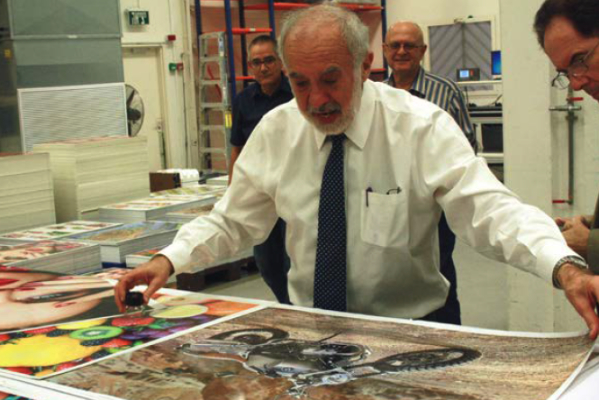
A quick recap. Landa describes nanography as “a completely new way of printing, producing very high quality and capable of very high speed onto any substrate”. He demonstrates this at the Landa factory in Israel by printing an image on a range of materials including skin and tissue paper. The image will stick to anything.
“It is always the same quality because the image is formed prior to marking the substrate, unlike inkjet where what matters is the substrate. This technology is not just for commercial printing and cartons, but is suited to any industry that prints on a substrate,” he says. It is a crucial feature of the process, perhaps key to all kinds of future directions.
This vast scope is achieved by using inkjet heads to fire water based inks to an imaging belt. The image is formed with the inks held in a carrier material that Landa has likened to a hot melt adhesive. The belt is heated to drive off the water in the ink to leave nano particles of pigment. At the point of transfer the belt is heated a little more to facilitate transfer to the paper in the nip between the blanket and impression rollers of an offset press.
The belt is then cleaned ready for the next circuit. A lot of energy and investment has been needed to ensure that this simple sounding process achieves what it sets out to. Currently the press prints 6,500sph of B1 format paper and board, an output which is equivalent to 13,000 B2 sheets or twice that for a standard format digital press. This is the calculation that makes the Landa the most productive digital press available.
“It can replace all processes that require high quality and high speed and have the economics to justify replacing existing mechanical processes. I would not be surprised to see Landa Digital Printing delivering different sizes of products in different industries and with different substrates,” says Landa.
“Label printing will benefit, metal printing will certainly benefit; corrugated packaging would benefit, textile printing will benefit – virtually all products that are printed by mechanical processes. But we are unlikely to go into newspapers, it’s a declining market and one marked by very long run lengths. Likewise very long run magazines are not for us, but wherever there are short or medium runs of anything, production can benefit from nanography.”
In 2012 Landa was looking for partners to accelerate the roll out of the technology and was able to disclose discussions with Heidelberg, Manroland and Komori. Only the latter was pursued. Manroland was on the verge of upheaval caused by bankruptcy and new ownership, Heidelberg also had reorganisation problems to cope with. They needed to understand the technology if only to ensure it would not be a threat.
“As a result only Komori took a licence. We produce the printing engine for them,” says Landa. This is core to the NS40, a B1 press with an identical configuration to the Landa S10 machines, though with a different front end and quality control system. “Over time Komori will produce more and more of their own sub systems for that press,” he says.
“But all the inks and consumables will continue to come from Landa.”
Komori also produces the sheet transport for the Landa press, one of the few components that is not directly produced by the company in Israel. There is also the specially commissioned Fiery front end from EFI and Fujifilm’s Samba inkjet heads. “We are dependent only on a very few outside developers,” says Landa, and then only when absolutely needed. He explains: “There is no point in us developing the sheet handling technology for printing at very high speed when this has been perfected over decades by press manufacturers. This is not our expertise. And we are currently using Fujifilm Samba printheads, but the nature of the technology means that we can use other print heads as well.”
In 2022 the focus remains very much on the current products and ramping up production. “The inflexion point comes next year when we really ramp up production. It has taken us quite a while to get the quality with the reliability to stabilise the presses. We are now at the point where we have a solid, robust reliable press with consistent quality which can run 24/7 and which gets the approval of users.
“Our customers are now employing the technology widely. With Indigo the focus was on niche applications because it was not about high speed, high volume 24/7 production. It was not suited to mainstream production where the competition was the most advanced Heidelberg presses. So the bar is very high and we are getting to that level. It has taken quite a while but we are there now.”

It will not be resting there. Landa has been eyeing other markets and opportunities. He has been granted patents for a method for printing on 3D objects like beverage cans and cylinders, though the patent also covers conical shapes, coffee cups for example.
Currently most cans are printed using a dry litho process, accumulating the image on a blanket before transfer to the can itself. The process is repeatable and can support print speeds up to 3,000 a minute as part of a filling line. However, the inks cannot be overlaid one on another, limiting any decoration to solid colours, and it is a process optimised for long runs. Companies wanting short runs, either customised or personalised have had to use an offline process, digitally printed shrink sleeves for example. There are digital presses for cylinders on the market, Tonejet’s Cyclone or an inkjet approach from Hinterkopf for example, but these target only the shortest of runs. Landa wants to replace current machinery with similar speeds accompanied by far greater flexibility.
The most recent of the relevant patents declares: “Since the market is demanding ever short(er) run lengths, even [for] the customised and personalised packaging, the need to change printing plates and to re-adjust the press for every decoration change is becoming an increasingly important economic burden and is a barrier to fulfilling market requirements.”
The opportunity is delivery of printed cans that tie in with special events, sporting finals, weddings, product launches and so on. There are hundreds of artisan brewers and bars that want bespoke branded ales that only they can sell. All these are ripe for the digital transformation.
“There are 400 billion beverage cans produced a year,” says Landa, “and little more than 1,000 metal decorators able to print them.” The most widely used systems are either to mount the cans on a mandrel and rotate this against the blanket, described as an indexing system and able to operate at 600 cans a minute or a continuous system flowing at 3,000 cans a minute.
Printing for both requires up to eight printing plates to be imaged, processed and registered, with an impact on makeready times and on quality as each colour has to remain separate. Occasionally different methods have been used to produce a four-colour halftone image (Tennents lager, for example), but without catching on. The success of Share a Coke campaigns changed everything.
“Sales rocketed and people would fight for a bottle with their name on it,” he says. “The appeal of mass customisation was tremendous and it sent a message through the entire marketing world affecting everything, not just food and drink. It has changed Nike sports shoes, clothing, consumer electronics: everyone understands that customisation strikes a chord with consumers, Landa explains.
“It can be producing crisps for a football game with both teams on it and if there’s a beer can customised for the game, consumers may buy two, one for drinking and the other to take home as a momento.”
The patent describes how the nanographic printing process can be used effectively for cans. The image is printed to the transfer belt by inkjet and dried before being applied to the can mounted on a mandrel or as the can is rotated against the belt in a continuous system.
There is discussion about how images can be placed in close proximity to each other to maximise throughput speeds and of course about the advantages of being able to print a four-colour halftone image over the existing methods that cannot do this.
The patent description opens the way to use inks with solvents or which are energy cured as well as water based inks. Different applications will require different ink types, perhaps requiring Landa to offer different print heads. All is open to discussion as the technology is tested. Regardless, it is essential that the ink, once applied to the can, is colourfast, scratch resistant and can withstand any treatment to ensure that the contents of the can remain in good condition. This means time spent in a hot water bath to pasteurise the contents, perhaps with salt or other chemicals to test its metal, so to speak.
Then the decoration has to survive the necking process which distorts the aluminium to provide something that is good to hold and can withstand the pressures that build up internally. Landa admits that this remains to be tackled.
But this is early days. It works under test rig conditions in the labs in Israel. It is some way still from a product that will see the light of day. There will be nothing to see at the 2024 Drupa. The work will be going on however.
Landa will be building any press that results rather than trying to licence the technology to a company that may have the contacts, but which will also have an existing business to support. The company prefers now to retain control over its own destiny, having failed with the licence approach.
Talks with the limited number of can decorators in the world will get underway and also with the can filling companies about how this technology might be incorporated into a line that can cost $30 million or more to set up. The print system may be separate to filling, coming ahead of the cleaning, filling, capping, necking and pasteurising stages. This is industrialised printing and it can consume vast quantities of the nano graphic ink and consumables that underpin Landa’s business model.
Can printing is not, however, a completely new segment for Landa himself. At Drupa 95 Indigo demonstrated that using the transfer belt concept it could print on aluminium cans, pre pressurised to present the best possible surface for decoration. Some of those cans, containing fizzy pop, have been kept as souvenirs by visitors to the show. “We have been in this mindset for a long time,” he says. “It opens entire realms of conversations.
“For the company this is an attractive market where the potential for the ink alone is into $ billions. No other technology can come close to the quality requirements, the robustness and the economics. And that’s the reason for this development.”