
Both markets and market sectors show the tremendous impact of Covid across all industries and countries. Just as the rings of a tree will show the effects of a drought hit summer for hundreds of years later, so company figures will show how badly printing was damaged by the pandemic and the accompanying lockdowns.
This is so too for the printing industry as a whole. In the UK the BPIF says that there was a 19% impact on industry revenues in the first year of pandemic and that numbers are only now recovering. This is born out by Prodcom data that we have already used in the Print Business Index as we look at developments in different product sectors as a whole: which products are growing and which are shrinking. It provides a background to strategic thinking and where printers might plan future investments.
In this issue we take the financial results of typical companies in six key sectors for print and by looking at their sales and operating profit, try to understand how the sectors they operate in are developing.
First though we take a look at three markets in Europe. Germany is the largest market for print in Europe with revenue of €18.6 billion according to Eurostat. The same methodology puts UK revenue at €12 billion a year. The BPIF, drawing data from a broader set of criteria, puts UK print revenue at £13.7 billion.
The German market was hit by Covid, reporting a drop in revenue to €15.7 billion and a 4% fall in the numbers employed in print in the country. Recent years have been marked by a steep decline in gravure printing, eliminating almost all gravure plants in the country and now followed by consolidation and closure among web offset printers. There are fewer than 50 plants for what was once the powerhouse of the German print landscape. German printers have also been hit harder by the rise on online printers with a number of the largest operations based in the country.
Despite this Germany still accounts for 22.4% of the overall European market for print. The UK accounts for 13.5% and France for 9.8%. the french print market also suffered a drop in 2020 compared to 2019, hardly surprising as this was the year of lockdowns across the continent.
The French market generate €8.4 billion in revenues according to Eurostat in a normal year, falling to €6.9 billion in 2020. Employment also fell, but down to 62,681 compared to around 65,000 in previous years. This was faster than the drop in revenue suggesting a productivity gain of some kind. Data for 2021 is not year available so it is impossible to say to what extent French print has recovered since.
The Polish print market is one of the smaller markets in Europe, valued at €4.1 billion in revenue terms for 2020. Uniquely though this was an increase on the €3.85 billion reported the previous and despite a dip in headcount.
The Polish market has shown steady growth from the base year of 2016 (the last Drupa and also the year the UK voted to leave the EU). The Polish economy has been growing, but there is also work printed in Poland for export to other European countries thanks to its location in the centre of the continent and to a lower cost base perhaps.
Coming away from country by country comparisons, the BPIF issues its own set of statistics for the UK printing industry a few weeks ago. The core data are that the industry generates a turnover of £13.7 billion, employs 98,000 and has 7,200 companies. This is 200 fewer than the last publication of statistics by the federation, pointing to the closure of two companies a week over the period. Companies House data suggests a higher attrition rate, but the overall figure may be bolstered by start up businesses joining the printing industry.
The BPIF carves the UK print pie into advertising literature and business stationery; books, magazines and newspapers; security printing; packaging print; printing on textiles, glass, metal wood and ceramics; and other printing.
The largest sector is packaging print with 27% share of the overall market. Publication print has a 20% share, security printing a 4% portion. Publication print accounts for 23%, textiles and others for 13% and 13% is from sectors other than those listed.
This is a snapshot and does not explain the dynamic within those sectors, whether each is growing to shrinking nor whether companies in those sectors are performing well or otherwise. This is what the next charts try to do, picking six sectors and typical medium sized businesses within those sectors. The companies need to be large enough to be able to report accounts to Companies House and to not be overly swayed by the loss or gain of a customer however significant.
The figures used are real, but are indexed to start in 2016 as the base year and the rate or growth or decline taken from this. In this way the identity of each company is masked. The individual company is taken to be representative of that sector. Some businesses will have produced better results, many will have worse figures. The movement is the important factor to look out for.
The figures may also show the impact of acquisitions, process change or diversification and strategic change. Book printing for example will almost certainly include investment in digital printing and a change to a business model based around print on demand to minimise stock holdings if not a full zero inventory model for publishers.
Label print will most probably indicate investment in digital production in some way, likewise direct mail, while digital print is self explanatory.
Magazine printing shows the decline of the sector as a whole. A number of companies have pulled out, closed or have been acquired, Pensord Press being the stand out example. In very long run magazine printing, supplements for example, the impact of the closure of Prinovis does not show up for our typical company. Covid however does, showing a drop of 25% compared to 2016 in 2020 and a further fall in 2021 before recovery in the latest set of results. Operating profit levels have also been hit by the impact of the pandemic. But the business remains profitable.
The typical book printer shows a steady progression in revenues since 2016, but with a poor impact on operating profits. This is perhaps indicative of an investment programme because by 2202 profits have jumped forwards. Sales in 2020 dipped from the previous year but were still above 2016 levels. They had fallen almost 10% in the next year, perhaps as publishers adjusting to stock levels cut back on orders. Whatever the case, orders bounced back and revenues in the last financial year show at the best level for the period under review.
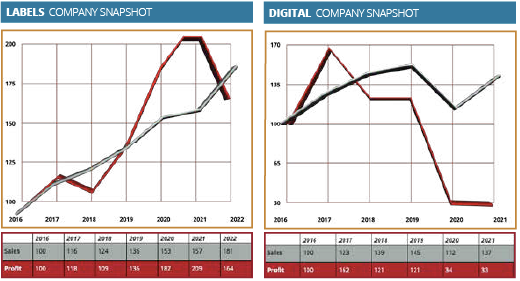
Digital print, typified by the company chosen here, also suffered a Covid impact, though revenues remained above 2016 levels. In 2021, the last year where revenues are known, sales had recovered much lost ground and were close to 2018 levels. This chimes with public comments from photo product specialists who said that the start of lockdown led to a splurge of orders as people had nothing better to do, followed by a dearth of orders as there were so few opportunities to capture memories with a camera. Against this home shopping has produced plentiful opportunities for sales of personalised products, for personalised cards or literature to go with an unboxing experience – all printed digitally.
Direct mail also shows a steady growth, almost unaffected by lockdowns. This is scarcely surprising as the product is delivered to the recipient’s door. Sales have surged ahead in 2022, perhaps showing the renewed interest in the print channel.
Cartons and labels are both sectors that have done well from the period. Our carton printer moved from a loss making position and meagre profits to a very healthy margin and from strong growth to a further sharp leap in the last reporting year.
Labels has also generated strong top line and bottom line growth as brands and retailers are using packaging as a marketing tool to gain the attention of shoppers. The rate of growth slowed for 20021, reflecting a lock down impact on shops, but has since recovered. Operating profits have grown sharply over the period. It is clear that packaging is currently a more lucrative place to be than magazine or book printing.

Print Business Index 2023: Manufacturers
Print Business Index 2023: Printers’ locations
MORE FROM THE MAGAZINE