
One of the great advertising slogans of all time – We try harder – put Avis rental cars on the map, turning the disadvantage of being second in the market into a positive. The long running marketing message was a warning about complacency, stressing the importance of service and customer satisfaction to a company that wants to challenge the market leader. For Avis, the technology being sold was irrelevant because any car rental company is dependent on the vehicles available to it.
In print this is not the case. The technology as well as the customer service matters, particularly if you are trying to challenge a clear market leader. Particularly, therefore, if you are Tecnau trying, not necessarily to take existing market share from the market leader but to ensure that in future you offer an alternative deserving of serious consideration for printers planning to invest in industrial strength finishing for digital printing.
Tecnau is the family owned Italian company that designs, develops and manufactures automated finishing technology that will be part of the inkjet revolution, running in either inline or nearline configurations. It has been a provider to the traditional volume digital print sector, for transactional documents, then more recently books and direct mail and now it is ready for the step into commercial printing. There are unwind and rewind reelstands, dynamic perforation units, folders and sheeters to satisfy customers in Europe, Asia and in particular North America.
This territory accounts for half the company’s revenues, says CEO Stefano De Marco. He took on this role in 2022 when his father stepped up to become chairman. He had joined the business in 2001, then a purely Italian affair, working his way through several departments before moving into the CEO chair. When he started Tecnau was very much a bespoke engineering company, not unlike many family owned companies that are scattered across northern Italy. Some expand to become global businesses (think Ferrari), others remain highly specialist. Tecnau wants to move from the second to the first category.
Its chance came in 2011 when Tecnau bought Lasermax and with it a substantial presence in the US as well as a smaller one in Sweden because Lasermax had itself acquired Stralfors subsidiary Roll Systems. De Marco became European sales and marketing director in 2012 and then managing director in 2020. Two of his three sisters work in the business: Manuela in R&D and Francesca in finance and administration. Like its Swiss rival, Tecnau is a family affair.
Today the head office, factory and customer experience centre, as showrooms are now known, are in Ivrea in Northern Italy part of a vast site that was once occupied by Olivetti. Gradually the buildings on the complex are being revived by different companies, Tecnau being one of them. It has taken on a further 1,000m2 building to cope with expansion plans and expectations in the next couple of years.
These are built on bullish expectations that inkjet printing is in a rapid growth phase and is approaching widespread adoption by the commercial printing industry. This is born out by attendance at a specialist show earlier this year, one that Tecnau could not attend.
Instead it brings either existing customers, almost customers, prospects or those with an interest in the technology to the Piedmont region. There a showroom area is laid out to be able to demonstrate technology for book of one production, either at volume or in small quantities, for continuous feed and sheetfed printing. This will be inkjet for the most part, but is not exclusively so. “We try to follow all the digital print applications whatever the printer partners try to use. Our job is to anticipate what those partners are developing,” says De Marco.
He quotes figures from IT Strategies to say that currently inkjet accounts for 6% of printed pages and that will increase to 11% by 2028, across books, magazines, and catalogues. By that point inkjet could account for 24% of the printed pages in print. Those are pages that need converting into products and which will also drive demand for print engines. With every inkjet engine sold there is a need for a finishing line and an opportunity for Tecnau. Nor is it simply about webfed finishing any longer. “Now sheetfed printing has become important and is getting a lot of interest, especially for B2 formats because there is only a very limited number of presses available,” he adds.
There is little shortage of digital finishing options in B3 cutsheet, led by more conventional toner presses and suited to short run work where throughput is limited. While this is the case, those that have focused on equipment for the webfed market bring a more industrial approach to cut sheet finishing. This results in a flush of innovation and automation for printers, giving them options on flexibility, speed and automation at different price points.
To this Tecnau can add Connect, its cloud platform to collect data, analyse the numbers and help with maintenance and ideas about gaining efficiency through end to end communication. “There is a lot of demand for automation to reduce the touch points during a job changeover for example,” says De Marco. “We are also dealing with requests to go faster and wider, from 20 inches to 22 and to 22.7 inches, moves that can deliver the gains in productivity that inkjet users need. And we using the experience centre to validate new applications. There’s a lot more cooperation between printers, printing partners and finishing partners on new projects.”
Currently many of theses are about jobs that have high ink coverage and are using coated media, a challenge for high speed finishing as much as printing. At the same time there is a drive to provide the data which can be pored over to achieve greater productivity by identifying where the time sapping errors occur. “There’s a lot of demand to reduce touch points and move from traditional manual handling into robotics and providing digital information into shipping and back to digital print at some point,” says De Marco.
The zero speed splicer typifies this and is a product where Tecnau is ahead of the competition. It addresses a key point of contention for commercial printers of how they can maximise the operational window for a press. According to Tecnau’s data, the time from printing the last page on one reel and the first acceptable page on a new reel can be more than 15 minutes thanks to the time needed to remove one reel, load with the new reel, feed the web through the press and into the new rewind and to download job and paper profiles. During this time the press moves its printheads into a safe and capped position, but also cools down so needs to be brought to temperature before starting again. The physical change of paper may only take a few minutes, but the time lost can be many times greater.
The reel change unit alters this. The physical change between one reel of paper and the next is a matter of seconds. There is no time for ink temperatures to fall nor time for the heads to be withdrawn.
However, printheads do need to be clear of the splice, meaning that this level of automation may not be available on all presses, at least not yet. “We know through using our remote software that the time between reels is averaging close to 20 minutes. That’s a massive amount of down time and lost productivity. We can cut 70-80% of that down time,” says Harm Jan Hulleman, head of sales for Europe.
Where the press does support the automated splicer, the print company gains a vast amount of flexibility. The press can run one paper type for the first job, switching to a second paper for the next job and to a third paper for the next. In reality this would not happen: already production workflow batches jobs by substrate to minimise time lost. The exception being if a rush job needs to be slotted in before the job on press is finished. The reel change can also cope with a longer job where more than one reel of paper is required.
This is where the customer experience centre comes in. Customers can come in and put any unit through it paces on their job types to ensure that it is suited to the type of work and materials used. “We do a lot of testing,” says Hulleman, “and we are getting new requests all the time. We encourage customers to send us their printed reels and customers can see and measure the impact on their jobs.” Tecnau aims to be as accommodating as possible, something necessary to establish itself.
In a book of one set up the splicer may be running material for one type of book, a different paper for others. This can enable production in customer order rather than a printer needing to print books and hold them temporarily to get maximise use out of a reel before it is changed. Instead the customer order can be fulfilled in a single batch (assuming all are to be bound in the same way).
It also ties in nicely with Sitma’s ecommerce wrapping technology. Tecnau bought fellow Italian company Sitma in July thereby adding wrapping expertise to the portfolio. Both businesses share a vision of highly automated production with the involvement of robots. It is not impossible to conceive of books rolling along a conveyor to a Sitma wrapping machine with no manual involvement. Robots are already in evidence in the customer experience centre to manage some handling tasks to keep production following. It is the same concept as the reel change unit but at the end rather than the start of production.
This level of automation is a feature of continuous feed inkjet and will be the key to open the door to commercial print applications where the printer may need to switch between substrates several times a day.
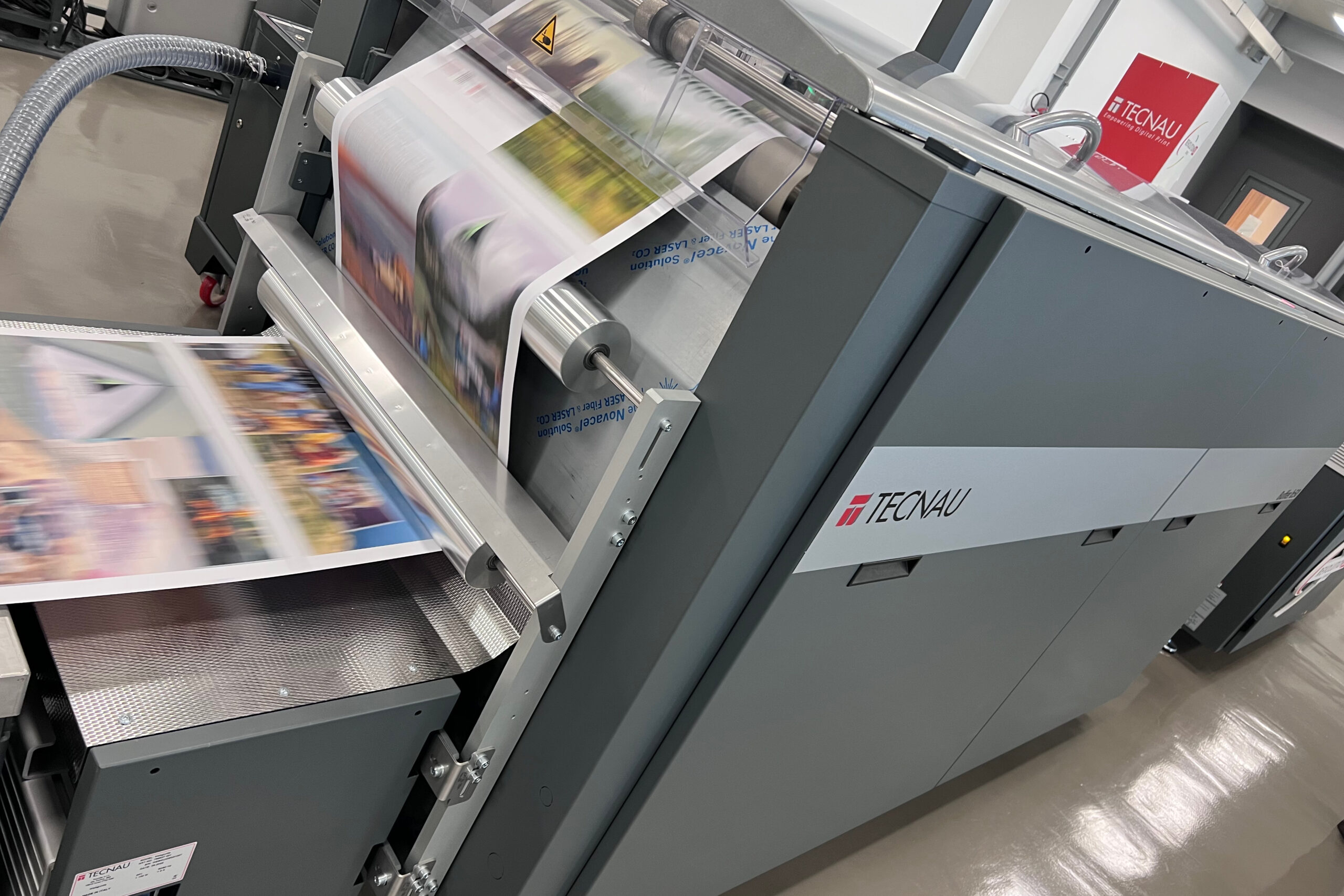
The showroom is dominated by a Libra 800 Bookline, currently Tecnau’s flagship product, from a R50 unwind through festoon buffers into an automatically adjusting stream folder, edge gluer and cross cutter to an accumulator and a four clamp binder with cover feed, cooling conveyor, three-knife trimmer and exit conveyor.
It amounts to a line built for continuous running and to deliver up to 800 books an hour. Again in reality the figure will be adjusted downwards by book thickness and format, but still amounts to a production line for digitally printed and finished books. The top paper speed is 200m/min, faster than the majority of inkjet presses on the market and in use currently. Installations at book printers across the globe point to the robustness of the engineering.
The Libra assembles the book from a number of inputs. This can be the standard unwind or the splicer for rollfed, as well as a hand fed option for sheets or book blocks. There are two cover stations for matching the printed covers with the book blocks via matrix codes. The code carries production data for that book, so can also trigger any adjustment needed on the folder and cutters.
The binder is a four-clamp unit taking a 2mm-60mm spine using PUR or PVA adhesive, the speed of the clamps being dependent on the individual books being finished and dwell times needed as the covers are drawn on. Once assembled the book heads for an automatically adjustable trimmer for top, bottom and fore edge finishing.
The Libra is designed to work with the R50 Revolution range of reel handling, which in contrast to the loose feed established in transactional print, operates with the web under tension. The web is fed from the reel into the Streamfolder to create the four-, six- or eight-page folded signatures. These are gathered and with spots of glue form the book block ahead of the binding section.
These can be delivered for offline binding with the stacks staggered fore and aft rather than side to side because of the speed of the line to keep products separate and for ease of handling into an offline binding line or casing in line.
At the other extreme for Tecnau is the Book Ready, for automated production of book blocks from a Canon Gemini cut sheet mono press running its Prisma workflow. Other press suppliers are, as they say, available. Production details are passed from the press to the Book Ready moving knives and stacking unit into the correct position automatically. There is no folder instead sheets are delivered in sequence, perhaps changing size according to the final book format. As the block is completed, it is trimmed at top and bottom with a single blade, rotating for trim on the fore edge.
The Book Ready will also connect inline to a Canon iX inkjet press for minimal batch or book of one colour books. As the population of this highly productive press increases, automated finishing must follow to capitalise on that performance.
Not all production will be to books. The portfolio includes both cut sheet finishing and reel to sheet cut and stack finishing. Typical is the Stack 1212 as a B2 format slitter/trimmer to eliminate the need to guillotine the sheet into flyer, business cards and so on. It scores with a throughput of 6,000sph on paper from 70-350gsm. This becomes the Stack 2020 with the addition of a roll fed input, either inline or offline. In short, Tecnau’s products match the market leader’s on paper at least. Like Avis, it needs to let the market know where it stands.

MORE FROM THE MAGAZINE
MORE ON TECNAU