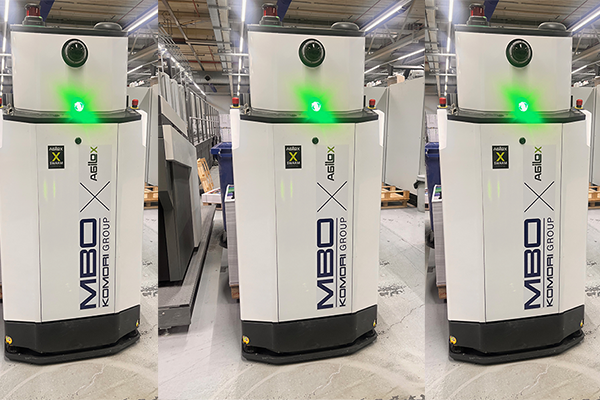
Veldhuis Media is that rare thing among printing companies today in that it has no digital press. All its production capacity is tied up in four long perfecting Komoris and a straight five-colour machine used for covers. It is unusual too, for Europe at least, because it uses an autonomous robot to move work in progress from the end of the presses to the finishing area and from boxed pallets of finished work to dispatch.
Tobias, as staff have named the device, has scarcely missed a beat since arriving in September 2024 and is likely to be joined by brothers or sisters in the not too distant future as the company explores the joy of robots. The robot comes from Agilox which is not a traditional logistics company in the mould of business steeped in fork lift trucks.
Instead it is a software developer that, working with a clean sheet, has been able to develop a very versatile materials handling system without reference to a legacy business. For Raul Heininger, business development manager at MBO Postpress Solutions, this has been important to the speed that the unit at Veldhuis has been conceived, tested and released into the wild.
The print company occupies a spacious 9,000m2 modern factory in Meppel in the north east of the Netherlands. It moved here from a much smaller plant 50km away three years ago, gaining space and two new presses in the process, and losing almost no staff. The presses are lined up in one hall, paper fed in at one end and delivered at the other where the Agilox AMR picks up the pallet and delivers it to a taped out cell in the next hall which houses the MBO folders, two Muller Martini Prima Plus stitchers, a green era Muller stitching line and a Kolbus perfect binding line.
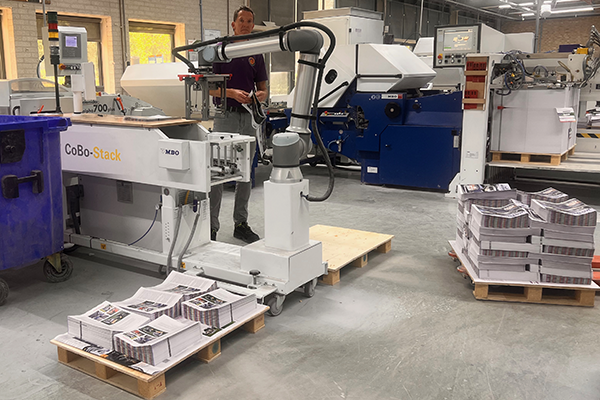
CoBo Stack robots are in use here to take folded sections and load pallets for the next process step, either stitching or binding. This step is not robotised as yet, though Heininger has been thinking about it.
Everything about Veldhuis suits automation. The company produces magazines and books, standardising on A4 formats, with minimal paper types and the ability to switch between presses to achieve the greatest flexibility possible. Should a machine be lost, usually because of a minder calling in sick, the production schedule can be completely reconfigured in seconds. Likewise there is no trouble from late running jobs, missing files and so on as the company can easily shuffle jobs according to the priority it has set: delivery date, paper type, format, finishing requirements, all to maximise efficiency and minimise time-sapping changes on press without adding stress to the operators.
Veldhuis has become a show piece for Komori for not only does it have the biggest line up of long perfecters, two of the latest specification, in Europe, and has MBO folders, it is a committed user of KP-Connect, Komori’s automation suite and the corner stone of the Smart Factory concept. Veldhuis has the full Komori technology stack enabling a bi-directional link to the MIS, JDF job data transfer between production steps and on to the folders. Tobias has become a very visible part of this network as have the display screens showing realtime job progress that are dotted around the plant.
When the press is running, the operator inserts identity tags with the job number into the stack. As the company specialises in short runs, several tags are visible on each pallet of printed sheets. The job number of each always ends with the same figure on each pallet, used to identify the cell the pallet will be delivered to. All those ending in ‘2’ go to cell Number 2 for example. There are ten cells in use. When the stack in the delivery is complete, the operator presses a button on the control desk to summon Tobias and the pallet is moved to an assigned pick up point on the edge of the aisle. It would be possible to automate this, the press calling the robot as the pallet fills up for example. “Right now it makes more sense for the printer to move the stack into position himself,” says Heininger. “We showed at Drupa that this can be done with the order coming from the press.”
The AMR rolls up, checks where the centre point on the pallet is and adjusts its forks to ensure the pile is centred on the robot even if it has not been centred properly on the pallet. The robot that Veldhuis uses has the capacity for 1 tonne per pallet, larger versions are available but are not necessary here.
The pallet is picked up and with a warning light flashing, the AMR moves away to deliver the pallet to the appropriate cell in the finishing hall. The floor here is taped out into a series of numbered cells for the benefit of the human crews not the technology which has each location mapped in its set up configuration. The printed sheets end up in the cell corresponding to the job number on the tabs. When the folder operator calls up his next job, they know where to find the right pallet.
Pick up from the cells and transport the short distance to the folders uses a conventional pallet truck and flesh and blood power, but a robot is an obvious future development. Likewise an AMR to move move paper from its store to the feeder end of each press is also a consideration. Then there is a means to automate movement of plates from the four Agfa Avalon platesetters to the appropriate press. Veldhuis can comfortably consume 1,500 plates a day, so there is a need to move a lot of aluminium. Each set of plates is offset left or right to make it simpler for each press operator to collect the right number of plates for each job changeover. Ink is fed by link lines to the presses. The printer’s task is to focus on running the press.
The ethos is about standardisation wherever possible. That standardisation is necessary as a prelude to automation according to managing director Oscar Jager who started the company with Erwin de Lange in 2002. Given the capacity of the factory and options on finishing to include lamination, perfect binding and saddle stitching, Veldhuis has restricted what it does to 60 possible workflows at the press and printing stage.
That drive for standardisation led logically to the arrival of Tobias. The printer partnered with MBO for the project based on its experience with the CoBo Stack pallet loading robot. That meant an initial sit down between the two sides, Heininger and the manager in charge of automation, with a quick win as the target. Using a robot to link the presses to the finishing hall was the low hanging fruit of robotics, simple and highly effective. It would, and has, eliminated the battery powered pallet trucks that kept a staff member constantly busy, but adding no value.
The factory was mapped and the path for the robot laid out on an iPad. A joystick, like those used on gaming computers, is used to drive the AMR on its selected route. Unlike an AGV robot which traces the same path every time, perhaps following a track embedded in the floor, the AMR can select its own route and there is no track. It needs a starting point, in this case the pick up point beside each press and a destination point, the cells marked out by tape on the floor, and instructions about where to go. Taping the floor is purely to help the humans as the robot does not need this to make an accurate placement.
Once this is done, the pallet position is logged both with the system’s software and passed to the KP-Connect. Should a pallet be moved, the robot no longer knows which pallet it is. Its sensors can see that there is a pallet in a location, but not what is on that pallet. In this case the pallet is shown in grey on the operator’s tablet. An identified pallet in the correct position is shown in red. The robot will also note that a pallet position is available when the previous stack is taken to the folder, so the now empty space can be filled with a new pallet.
The interface also records movements on the robot both as a graphic and via a dashboard. The route map shows where the robot was forced to stop, either by proximity to a human or by an unexpected item in the packaging area so to speak. If the stoppage recurs frequently, the cause ought to be investigated and remedial action taken. Veldhuis has a smooth concrete floor which now shows marks from the wheels as the robot, always choosing the shortest route, accumulate on top of each other. It is not wearing grooves in the floor. In any case, it’s simple enough to program Tobias to move a foot left or right to avoid making the marks.
Whenever time allows the robot returns to its charging station, amounting to copper strips in the floor that connect with terminals on the base of the robot. Three or four minutes charging provides enough power to run for three or four hours. When first installed this proved to the most troublesome part of the set up. Agilox has since changed the design of the connectors.
The experience six months in is positive. “It’s way more productive that Veldhuis thought it would be,” says Heininger, who leads on robot projects, including this. There is an appetite for more.
The approach with the CoBo Stack has been as a collaborative robot that operates alongside its human. This places a safety restriction on the speed of the arm as if there is contact between man and machine, it should not result in injury. The first application has been to load sections on to pallets, arranging the stacks for maximum stability.
Now comes a faster robot where instead of a cage to prevent that accidental contact, MBO uses radar to slow the arm to a crawl, accelerating when there is nobody close. Each of the new robots can pick up a load of 30kg. It answers a need for higher speed loading or loading from two folders simultaneously.
The carrying mechanism on the CoBo Stack, a ‘hand’ that holds the stack from above, means that stacks cannot be pushed against each other so some loading capacity may be lost. On the other hand MBO’s approach means that the robot arm can pick up a wide style of products and can pick up a stack from the pallet and move it elsewhere. This opens up tremendous possibilities says Heininger. It would for example enable the robot arm to load the feeders on the stitching lines and binder. This has been automated already, but using log feeders of sections taken from web offset or gravure presses. There has been no solution for short or medium run work.
Further AMR movement will come before then: pallets to folders, paper and plates to presses.
No wonder Veldhuis already describes its operation as ‘high tech litho’.