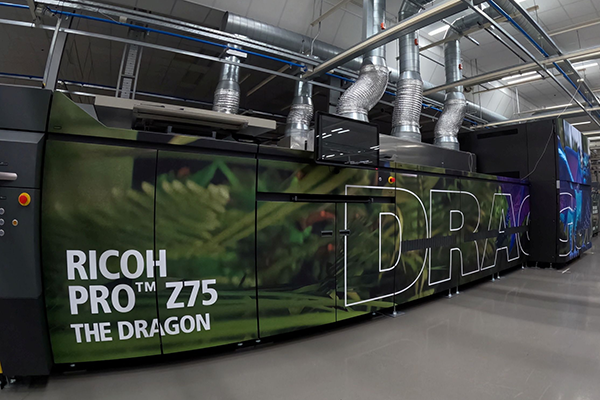
The Ricoh Z75, its dragon press, is a B2 sheetfed press using aqueous inks and which duplexes automatically. This, says Ricoh, makes it unique because while others have been announced, none is as tried and tested and mature as the Z75. Early installations are starting to spring up around Europe to follow on from the global beta site at a company in the US called Heeters.
The gestation period of dragons is not known, but this one has been a long time coming and Ricoh has learned a lot along the way about drying, inks, and the behaviour of paper. Teaser promotional videos have been promising the arrival of the Z75 for around two years. Then it really did arrive at Drupa, though without the pallet feeder in operation (because of a late delivery) and as a late prototype. It was enough though to whet the appetite and to demonstrate its potential.
Since then the press has been on show at the Customer Experience Centre in Telford ready to be put through its paces and some prospects have been to the US to see the machine working in anger. The need to do this has eased as machines are appearing in Europe, many at online businesses either for trade printing or perhaps in businesses for online gifting where packaging and print is highly bespoke and personalised.
The press begins with the Heidelberg pallet feeder or one of four high capacity feed drawers. There is no question about the suitability of the pallet feeder to cope with whatever papers need to be handled.
The drawers use a vacuum feed system to separate and lift papers up to 400gsm. With a second optional feed unit and up to four drawers, capacity increases to a maximum of 10,000 sheets. The format is a maximum of B2+, viz 585x750mm. This drops through to a minimum of 420x594mm covering six formats in all.
The proven swing and shift gripper system used on the ProC9500 introduces the sheet to the press. This registers the sheet before the undercoat unit. This applies a water based coating to the paper to provide a consistent surface for the ink to adhere to. This is an option says Ricoh, but in effect will be essential on some papers and for the highest quality. The coating is not necessary for inkjet optimised papers for example so can be turned off if not required.
The coater sits ahead of the imaging drum itself. This is a large diameter vacuum drum holding four sheets at a time to avoid stressing the paper too much before reaching the Ricoh piezo printheads. These are capable of 1,200×1,200dpi with variable droplet sizes.
The water based inks, as with other inkjet technologies, have a wider gamut than standard litho inks. However, this imposes a slight restriction on what can be printed. The dragon feeds only on paper and lightweight cartonboards; it cannot print synthetics because the ink cannot be absorbed.
The drum will hold four sheets simultaneously delivering them once printed to be held by grippers through the drying section and around for the reverse side to be printed. Drying is split in three sections using IR and hot air to drive off the water from the ink, fix and solidify the ink without creating waviness or cockling on the paper, keeping temperature to a maximum of 80ºC. A cooling section follows immediately to return the paper to its original condition before turning and printing on the reverse side. There will be a calculation to understand the characteristics of each paper and the effect of ink coverage on drying and cooling.
The press brims with scanners and sensors to spot and compensate for nozzle failures, to assess quality of the print and reject any that fail on colour, fit or sheets that have registration issues. The sensors also track the position of each sheet in the press without the need for bar code or similar technology to ensure that the right image is laid down on the reverse of the sheet.
Once completely printed the sheet arrives at the delivery stacker, or stackers because there is an option to have two stackers each capable of holding 7,200 sheets. A job can also be delivered to a proofing tray which has a 100 sheet capacity.
The dragon does this at a rate of 4,500 sheets an hour for single-sided printing, half this when both sides of the sheet are printed. The press also slows down when printing above 300sgm up to 600 microns when throughout falls to 3,000 and 1,500 sheets respectively, though few will want to turn this material.
A coating unit is another possible option along with a separate operator console or proofing table.
The press is controlled through a Fiery FS500 Pro DFE. This gives continuity and familiarity for those used to digital presses. But it is a Fiery Rip on steroids. The speed, resolution and format mean that the amount of data flowing to the press for ripping on the fly is somewhat greater than for a two-page toner press. To solve this Ricoh has added additional CPU blades to the Rip.
Integrating the Z75 into existing workflows should be straightforwards because of this. Some offset knowledge will help shorten learning curves though this is far short of the knowledge needed to run a conventional litho press.
Ahead of the DFE, Ricoh BatchBuilder or ProcessDirector will act as traffic controller for the flow of jobs to the press, optimises the use of each sheet and sorting jobs by the choice of substrate and delivery time. It includes strong support for JDF and JMF to collect job data entered at an earlier stage, including via a web portal. This can lead to a hands off workflow, explaining the interest from online print businesses.
In theory it is possible to connect finishing technology inline, but beyond a coater for those running cartons, such a set up may limit its versatility.
The dragon is demanding. Of space that is. The drying section requires a lengthy tail to the machine and operators will be all the fitter for taming the beast.