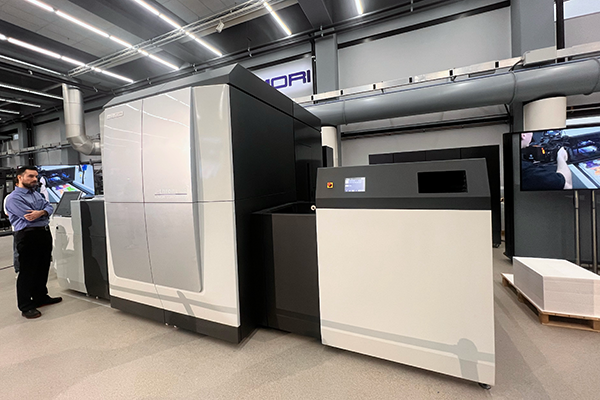
The Komori J-Throne 29 takes its design cues from the company’s sheetfed Lithrone presses. It is rather more compact than many other B2 inkjet presses thanks to its use of UV inks and curing. There is no need for lengthy and perhaps complex drying sections as two blasts of UV from LED arrays result in first frozen ink droplets and then fully dry sheets arriving in the delivery and without any heat built up in the paper or in the stack. The stack is not going to be high enough for any worries about blocking, but it can comprise synthetic materials, sheets of plastic for example, as well as paper.
This is a second generation inkjet press from Komori, following on from the iS29. That is still available and is a joint venture with Konica Minolta. Komori provided the sheet transport, including the sheet turning system, the feeder and delivery. The inkjet heads and the ink came from Konica Minolta. While Komori has certainly sold machines, but it did not mark a transformation for the Japanese litho press manufacturer.
For commercial printers used to litho presses, the 3,000sph throughout of the iS29 was rather too stately. Just one was sold in the UK, to Lexon, a company which has since closed. No-one is blaming its technology choice.
Komori has learned from its experience of the first press to develop the new press. This was unveiled at Drupa in 2024, installed at a US site at the start of last year followed by a Chinese printer and has now arrived in Komori’s Utrecht showroom.
First, the basics. The J-Throne prints to a maximum sheet of 585x750mm at a throughput of 6,000 single-sided sheets an hour, on paper from 0.06 to 0.6mm thick. It still uses a large vacuum drum to hold three sheets around for printing and has the same sheet tumbling system. The sheets are moved from feeder to delivery by grippers rather than belts. The imaging system is still piezo inkjet with UV ink, but these are now Fujifim Samba printheads and an ink that Komori has developed. Production of the ink is handled by an outside producer, but to Komori’s specifications.
The printheads deliver a 1200x600dpi resolution rather than the 1200x1200dpi that Samba heads are capable of. In label printing that resolution has become standard: in commercial printing very few would be able to distinguish between this and the 1200x600dpi that enables the press to run faster.
The ink results in a wider colour gamut than standard CMYK litho inks. This means Komori reckons that it can hit 85% of the Pantone colour range. When running a ganged up sheet of say six cartons for different skus, this will be a substantial advantage over switching between spot colours. The whole is built with the same sort of approach as a B1 litho press running at 18,000sph.
The feeder is from a standard litho press, eliminating any concerns that it may not be robust enough to handle light weight sheets at one end of the spectrum or carton boards at the other. It can accommodate a pile 900mm deep. The feed table uses vacuum tapes and there are familiar side lays and grippers to pull the sheet into position. The precision of this system is necessary for post printing processes, including guillotining and especially die cutting, which will have their roots in finishing litho sheets.
The sheet is fed on the short edge, something that used to raise concern for register on a small format litho press as the tail edge is not under control. On this press the vacuum holds the whole of the sheet firmly in position. The decision to offer a portrait design results in a narrower press design the company says, helping with what is already a much smaller footprint than others.
There is a limitation with the vacuum approach as only four paper sizes can be accommodated. These are decided in the negotiation stage to suit the customer, but are not absolute.
Komori can supply the vacuum shells which enable a second set of four paper formats if reassurance is needed, though in practice those companies that have specified this additional formats have not used them.
There is no application of a primer, another benefit of UV, as the ink is not absorbed into the substrate, but is cured on its surface. The ink is applied through 56 Samba printheads using different droplet sizes to produce the high quality printed image. A 1200x600dpi resolution along with drop control is adequate for any job.
The ink is pinned immediately it hits the sheet to hold droplets in position and then given a deeper cure by a second set of LEDs. It is a cold process that Komori has learned about through its conventional litho presses. There is no risk of distortion of the paper and, thanks also to the sheet handling system, front to back register is spot on.
The UV technology may limit the press in terms of some food contact applications, but has a striking benefit in terms of energy consumption. This Komori says is 40% less than a comparable B2 inkjet using water based inks.
There is also less maintenance required as there is no risk of ink drying in the orifice of the nozzles and there is no need for chemistry to clean the heads. Immediately on printing the sheet passes an inspection unit with spectrophotometer to identify and correct any colour shift before it becomes noticeable. This will also pick up any issues caused by misfiring or blocked nozzles and compensate for the issue.
A key difference to the first inkjet machine is that the Fiery Rip is now water cooled and data is transferred into and around the press not with standard RJ45 cables, but by fibre optic cables. The Rip on the first iS29 dates from 2011, which at the time the machine was first conceived was more than adequate. Demands have advanced since then.
This may be overkill, but will also prepare the platform for future developments when faster and perhaps higher resolution machines demand even more data. The pilot installation in the US is being used for variable data applications.
The set up can work with either preRipped files or can Rip on the fly. As experience is limited this will be a suck it and see operation to begin with, but as experience grows, it will be possible to understand which approach works best for what types of job. With the shift to a press with greater capacity, there is additional memory on hand to cope.
Once printing is complete the sheet arrives either in the delivery, again built on litho press experience, or for very short runs, diverted to a sample tray above the standard delivery. This can accommodate 70 sheets. It might also be used to check a pass sheet or to collect a reject sheet.
The press is controlled by a touch screen DFE which for operators used to Komori’s Lithrone presses will be familiar. However, litho press experience is not needed to run this press. Training requirements are minimal.
The press requires only 20 minutes warm up time before beginning to print: the first generation machine needed a 40 minute wait for the inks to come up to temperature. In a situation where the press is not running constantly, this means that a machine can start almost immediately when required again. Ink saving modes, GCR for example, are supported in the front end.
As the ink is completely dry on exit from the press, finishing processes can begin immediately, even in line if required. There is no restriction in the types of finishing that can be applied, no limitations with any kind of coating or lamination for example. Inline finishing will be possible, but for many jobs either impractical or limited. It would be possible to conceive of delivery to a conveyor to apply a coating to a sheet of cartons and with a die cutting inline.