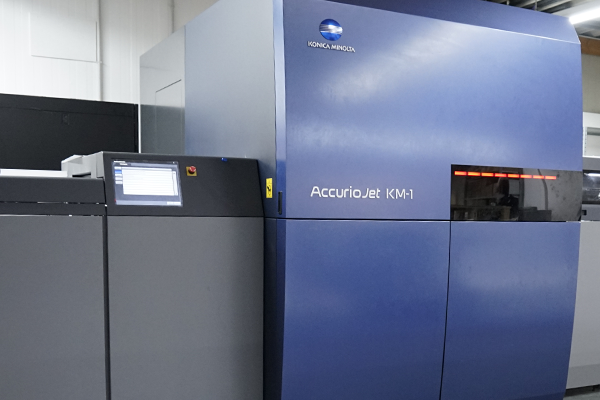
Konica Minolta’s AccurioJet 30000 is the latest version of the B2 inkjet press that was launched as the KM1 more than a decade ago. Its first public appearance was in 2014 at the ill-fated Ipex that took place at the Exel Centre in London.
The exhibition all but disappeared after that and the press fared little better, at least in the UK. An early installation was, Konica Minolta admits, with the wrong customer at the wrong time. Now though it has an example of the new version at 8Group which is very much the right sort of customer for the supplier to be able to work with and to showcase its capabilities.
The press began as a collaboration between Konica Minolta and Komori, which calls the press the iS29. Konica Minolta provided the inkjet heads and the ink, Komori provided the sheet transport and the all important perfecting mechanism. While the portfolio of both companies continues to include this press, both have moved on.
A key feature of this press is its use not of aqueous inks as every other supplier has chosen, but of UV inks. There is therefore no need for an extended drying section, resulting in what is the B2 press with the smallest footprint currently available.
Nor is this a standard UV ink. Konica Minolta developed what is called Dot Freeze for the machine. This is an ink which is heated in the head to become less viscous and when fired immediately begins to coagulate before striking the substrate where LED UV arrays complete the curing process. The ink does not penetrate the sheet, nor will it run into adjacent droplets, which contributes to very sharp reproduction of text and brighter colours.
The AJ30000 prints this at 3,000 B2 sheets an hour, halved when perfecting, and at a resolution of 1200dpi. The operator can adjust the settings on quality, so managing the amount of what is a costly ink to apply.
Konica Minolta is continuing to use Dot Freeze on the upcoming AccurioJet 60000 which was introduced at Drupa in 2024 but is not yet available on the market.
Because Konica Minolta is using UV inks, there is no priming fluid and no restrictions on what material can be printed. There is almost no heat generation in the paper requiring additional cooling, and thanks to Komori’s offset experience, no question of back to back registration issues. It adds up to a much lower power requirement for operation than the aqueous inkjet equivalent.
The specification for the press gives a maximum sheet size of 585x740mm, fed on the short edge from a Komori feeder, and with media from 0.06mm to 0.6 mm, though this is capped at 0.45mm when both sides are printed. This opens the way to printing lightweight cartons, synthetics, including canvas and film materials, which aqueous inkjet presses will struggle with at best.
Paper is fed from a 900mm stack using an offset feeder and side lays to feed the sheet onto a drum where a vacuum holds the sheet in place during printing and curing. There is no drawer system to hold additional sheets or different papers.
The three cylinders used to turn the sheet like an offset perfecting unit are at the base of the press. If perfecting is not used, the sheet can be allowed to travel to the delivery and a 680mm pile height. And optional tabbing device will indicate the start of the next jobs in a sequence.
The AJ30000 is the third incarnation of the technology. The KM1 became the KM1E in 2020 and a high definition version followed in 2022. This targeted the photo products sector where an expanded gamut is more helpful than in commercial print where the aim is to replicate the gamut a four-colour litho press can achieve.
There is shared technology with its toner presses, the inkjet machine using colour management and inline quality assessment tools from these presses to manage the colour consistency on longer runs and to download the profiles for the different substrates that the press can handle.
These will include synthetic materials like films, canvas and Tyvec type sheets as well as papers and card boards, coated or uncoated.
There is also an interface for connection to finishing systems, which again is more suited to a photobook application where the product is consistent even if the content varies on every sheet.
Waiting in the aisles in the AccurioJet 60000, a version of the technology able to print at twice the speed, that is 6,000 sheets an hour. This was announced at Drupa and is expected to come to market some time this year. This will not be a joint venture with Komori which is taking a different direction with its new incarnation of the press, though aspects of that partnership will remain.