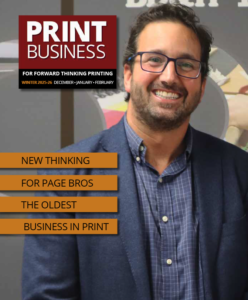
Alex Tuya has a background with Hewlett Packard, the technology company that owns Indigo digital presses as well as a host of inkjet machines. A path from corporate executive on the print side to running a business like Page Bros is conceivable. But Tuya’s time at HP was about looking after large customers with large IT projects. Printing simply did not factor.
He did well at HP, moving from Spain to take on a wider role in the UK as global account director in 2010. He might have stayed in the corporate world, navigating his way through international positions, even if not with HP. Instead he has chosen a completely different career path.
“I was a tech engineer, nothing to do with print beyond the home printer, and running large server projects,” he says. That brought him to London 15 years ago where he has settled in with a family and is unlikely to return to Spain. “I still have a very Spanish heart, but I live like a true Brit – I take holidays in Spain,” he says.
Corporate life within a large organisation began to pall. “I have always had an entrepreneurial streak,” he says. “I had started my own business at university.” He had made some small investments in small and start up businesses while still employed, awakening that independent entrepreneurial spirit.
He explains: “A good corporate career has stability, but I realised I wanted to run my own business, though I wasn’t brave enough to start from scratch.” Instead he gathered some financial backers who would be happy to stay in the background and began to look for a business to buy.
It would perhaps be a little behind the times but would respond to his experience in the larger business world, as well as perhaps to his IT knowledge.
He was not looking to buy a print business, let alone one of the oldest in the country, let alone a business located in Norwich, more than 100 miles from London.
“I wanted to buy who knows what business, who knows where,” he says. That was not entirely the case. He had some parameters in mind. Something with some protected revenue as well as scope for growth.
He unearthed Page Bros, a printer with a history dating back 280 years as a business and 200 years as a printer. It too had been part of a large corporate world in the past having been owned by Lonhro, the diverse business empire that also included the Observer newspaper and stamp printer Harrisons.
Page Bros had regained its independence when Lonhro, headed by flamboyant tycoon Tony Rowland, sold the print businesses in 1992.
Page Brothers was at that point a business steeped in book printing and in sophisticated typesetting, often with automated pagination compiled from computer data. That led in one direction into colour printing for books, many for educational publishers, and then to commercial printing, and using typesetting skills to structure and manage exam papers. Page Brothers has become one of the key producers of exam papers for GCSEs and A Levels, in the UK and internationally. It is a business that goes beyond printing into fulfilment, security, and for customers that demand high service levels.
Exams had become around 50% of the £13 million turnover by 2019. And this is the aspect that whetted Tuya’s interest.
He says: “It was complex to convince the business owner that we would be able to look after his business, especially as I wasn’t then a business owner and knew nothing about print.”
Discussions lasted the best part of a year after the initial approach. But by the end of 2019 the ducks were lined up and heads of terms were signed in February.
At that point Tuya had overcome an initial reluctance to invest in print. “Printing is a very, very different industry. It is capital and labour intensive and needs highly skilled labour and you don’t have the advantage of a manufacturing business in the sense that you can produce something ahead of its sale. With print you have to sell the capacity and may not know what you will be printing in two or three weeks’ time. It’s not a great industry to be in in general, especially for a youngish and inexperienced CEO.
“But I was excited by the exam printing side. Most successful print businesses have a niche. Yes, there are some pure commercial businesses that are successful, but for that you need to be very efficient and very good at being able to juggle lots of things. What made Page Bros attractive was its secure printing and fulfilment and the range of services around examinations.”
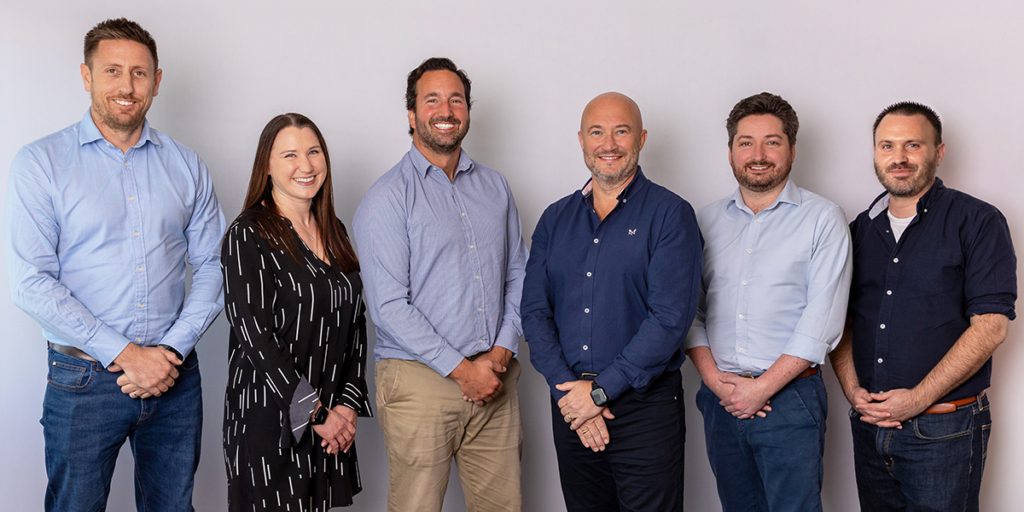
However, almost immediately the plan hit a brick wall when as Prime Minister Boris Johnson announced the first lockdown and that school exams that year would be cancelled. Tuya might have walked away, but didn’t. “We had been working on this deal for a year and a half. We had the right company and the right deal: everything was lined up and suddenly the world stopped,” he says.
The optimism of the entrepreneur kicked in. The lockdown would surely last for two or three months after which Covid would pass and exams would then continue as before, especially given the uncertainty and dissatisfaction surrounding teacher assessed grades which had been promoted by Johnson and education minister Gavin Williamson. The government also promised that GCSE and A Levels would be back.
Some minor changes were made to the contract and in December 2020 “we did the deal and were happy when we broke for Christmas. We were thinking that 2021 would be a great year as exams would come back.
“Then on 4 January Johnson announced that the exams could not go ahead as we would like. I will never forget that day. All our work would disappear over night, less than a month into owning the business and with no experience of print and no time to win the trust of the people in the company. There was debt in the business and the cash had gone and the business was going to lose a massive amount money. We anticipated we would lose £1 million that year.”
As it happened the loss quite didn’t reach that extent and Tuya survived his baptism by fire. He managed to keep the people together. The easy option he explains would have been to restructure the business to reduce the losses, but the downside -– that the company would have to break up an experienced team was too costly.
Underpinning this was the faith that exams would definitely come back.
That happened in 2022. And while the disruption continued, Page Bros reported a £600,000 profit. “That wasn’t really good enough,” he explains. “Then 2023 was the best year in the company’s history rising to £1.3 million, then £1.7 million and in the year ended in September we produced a £2.5 million profit on sales of £20 million. We have doubled turnover and more than doubled from the profit point of view.
“It has taken a lot of hard work from everyone.”
On the way the business acquired Art Angels and then at the end of last year BD&H Tullford, a large format specialist. These fit the strategy of doing more that applying ink to paper. Art Angels publishes greetings cards, one of the few types of print which can be produced like a manufacturing business using sometimes idle capacity to print greetings cards that can be stored until needed. “In print,” Tuya says, “People like to fill the factory with work. They sweat the assets and task sales people with filling the presses. This is the commercial print model and it is always price led. There is always a company that is struggling and that is dropping their prices and that is understandable. We didn’t want to do that because you have to be very careful with the work that you do take on: will it contribute and help?
“As an industry we shouldn’t work like this. If you charge below costs and if you can’t recover that, the business is short lived. All the companies that are failing work just like this.”
His strategy instead is about vertical integration with customers, doing more than simply printing and identifying sectors that have growth opportunities. “We want printing to be the in-house resource that enables us to sell other services,” he says. “I am not a visionary, but I am opportunistic.”
At first this approach rubbed up against years of the traditional sales approach. “I had to ask the team if we should sell any spare computing capacity we might have on our servers. They would answer No because computer processing is a commodity’. I would then ask ‘why is it we sell print capacity like that?’.”
The message began to get through. It is about finding the opportunities where there might be complexity, he explains. “Somewhere where we can help solve a problem, where print is only one element of the value chain.” Exam printing typifies this. Firstly there is a high degree of security because the exams themselves have a value until the moment a student sits down to have their knowledge assessed.
The papers need to be tracked to identify each one so that should there be a problem each paper can be traced back in the distribution, storage, wrapping, gathering and the printing process.
Printing takes place on a Canon ColorStream inkjet press. This used to run inline to a Hunkeler and then a Hohner saddle stitcher but now runs roll to roll with printed rolls fed into the finishing system. The change came because any stoppage on one half of the line would force the other half of production to stop. Now if one part stops, the other does not need to. The 37-metre-long operation is housed in its own part of the factory.
The finished stitched papers are fed into a wrapping line where the individual barcodes are applied, the papers collected in set batches, weighed to check that the expected number of pages is present and wrapped in opaque film which is double sealed and has its own identifying barcode. The signed and sealed envelopes can now be boxed and sent off to the warehouse, with the location always logged within the database. As the papers are delivered to their destination, the database is updated. The exam papers are never out of digital sight.
“It’s about making sure that every section is in the right box and is sent to the right address. That’s the complexity,” he says. That’s what these customers pay for, not for a 16pp A4 stitched product.
This has given Page Bros huge experience and knowledge about warehouse technology, which can be leveraged in other areas. The company is using its IT and typesetting skills to build e-commerce web sites for smaller companies that want to work through Shopify. That is now linked into the warehouse technology so that any order creates the pick list that results in items being sent out to the end customer. “Our message to these customers is that ‘we look after the supply side so that you can concentrate on selling it’. We handle stock replenishment, the incoming orders and delivery so they don’t have to worry about these aspects.”
It may not be as whizzy as a robot powered warehouse that some businesses have, but says Tuya it is every bit as sophisticated.
Art Angels benefits from this. The company is a small scale publisher of greetings cards, note pads and similar items. “It is very niche, very stable. We can handle all the manufacturing. That brings a measure of stability to the print business by giving the presses work they might not otherwise have,” says Tuya. And as Art Angels expands, there is an immediate impact on print and fulfilment.
Having made that acquisition, Tuya became a marked man, receiving all manner of propositions from print businesses that have wanted to be acquired for any number of reasons. That is of no interest. “Don’t bring me a company that sells print,” he says. “Bring me a business that buys print.”
It is also about identifying the sectors where demand for print is still healthy rather than chasing markets in decline. “For example, demand for print in primary education is going up with more print needed year on year. On the other printed advertising is going down, though point of sale and display for retail is increasing,” Tuya says. This underpins the acquisition of BD&H towards the end of last year. Its Agfa Jeti Tauro and other equipment has been moved into a unit that Page Bros has close to its Mile Cross factory.
The deal opens access to a new set of customers that can be approached with other styles of print, while existing customers can be provided with large format print. Demand is buoyed by changes in retail as a result of increased online shopping.
Tuya explains: “Retail on the high street is moving from selling to displaying.” That is the shops are more about showing the product in an appealing setting, achieved through print, and encouraging the actual purchase to take place via a website or an app.
“What is happening along Regent Street say is about raising awareness of the brand. There’s lots of point of sale print that now needs to be done. It’s an area where we can grow.”
Online retail has also spurred demand for packaging, another of the growth areas that Tuya identifies and one where Page Bros is not yet active. But it is involved. Online retail needs fulfilment he explains and Page Bros has that experience which can be passed on to improve the experience that end customers have when their purchase arrives.

The XL106-5-L that the company has just installed is able to print thicker substrates including carton stocks. There is die cutting on site, but no folder gluer. Page Bros is not about to become a packaging printer Tuya says, “but we do want to have a foot in that market.”
The new press replaces an old CX102 and sits alongside another five-colour plus coat CX102 installed in 2014. There is also a two-colour perfector for book work. Ahead of the presses are three Agfa platesetters exposing its plates and an MIS system. This started as a standard Imprint set up, but with the scope of the Page Bros business has led to change. “We have invested quite a bit to make it suit our needs,” says Tuya.
The presses are surrounded by guillotines and folders with Muller Martini Primera and Bravo Plus stitching lines. Canon toner presses and HP Indigos (7800 and 1200) provide the digital print along with the Canon ColorStream. While not Canon’s flagship press for commercial work, the Colorstream is the Chroma version and and is perfectly capable of printing commercial print work Tuya says.
Page Bros already works with local carton printing Castle Colour, but a smaller acquisition of its own to bring in knowledge of the packaging sector cannot be ruled out.
The strategy he repeats “is about vertical integration, being able to provide an in-house solution that allows us to understand our customers so much better.
“As CEO a lot of my time is looking at these potential deals while day to day operation is in the hands of the team led by Spencer Armes as operations director.” Time is spent in conversation with other print business leaders. Tuya has invited long standing competitors to Norwich and these invitations have been accepted. In turn he has visited other industry leading plants
His background in setting up complex enterprise IT instilled the idea that you can compete against someone on one order while working alongside them in another business. It’s not about disclosing secrets but sharing the sort of ideas and best practice that will make life better for all.
It is working for Tuya. Sales he says have doubled since 2019 and profits have more than doubled in that time. He is now at the head of a £23 million business.
“I’m excited about doing new things, about growing the business. But I’m not driven by sales or profit targets or any metric in particular. I’m not trying to run a £100 million business. It is about trying to be better every day.”