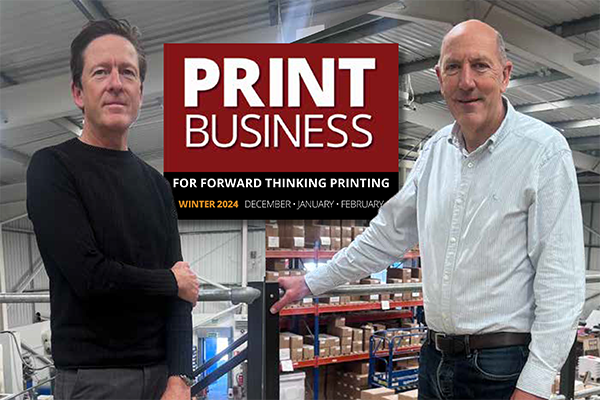
There’s a story behind every finished sample that Ian Mountjoy picks up: this was for an artist that Mountjoy first met 30 years ago; this for the Martin Parr photography festival in Bristol; this was a photographer’s book which was being crowd sourced when Mountjoy first saw it. Taylors helped out and three further projects have followed.
The sales and marketing director of Taylors, unquestionably the oldest printer in Bristol and one of the handful in the UK that is more than 175 years old, can call on a lot of samples and a lot of stories, each adding to the deep patina that the business has accumulated over the decades.
The company is now in its fourth home. It was bombed out of its second premises by Luftwaffe action in one of the last daylight raids of the second world war and moved from its third home only when developers offered the kind of money that only comes along once in a century and one that the owners – the fifth generation of the Taylor family – could not refuse.
That precipitated a management buyout in 2018 and the third move to the standalone factory that had previously served as a bonded warehouse and which is now a well organised print factory. To describe it as ideal for the business is something of an under statement. The company had resigned itself to having to find a home towards the edge of the city, perhaps in one of the more established industrial areas close to the docks or one of the motorways leading to London and Wales, Birmingham and the South West. However, good fortune intervened and Taylors was introduced to a building that has a high roof, smooth concrete floor and office space and within a few minutes of the city centre.
The Wilder Street factory on the other hand was cobbled together from a hodge-podge of 1950s and 1960s buildings. One had been a pub, with a cellar where on leaving, a rusting hand operated Eagle letterpress machine was found in pieces scattered across the floor. An indoor carp pond added an unusual feature to fill a space in the directors’ offices. The press room, housing a Speedmaster CD74 and XL75, was connected to the finishing department by concrete slope. High efficiency could not be expected. It had served since the 1940s and was home for the transition from letterpress to litho, at the time Roland Rekords. At this time the company installed a six-colour machine in order to print Hexachrome, a process which never quite took off.
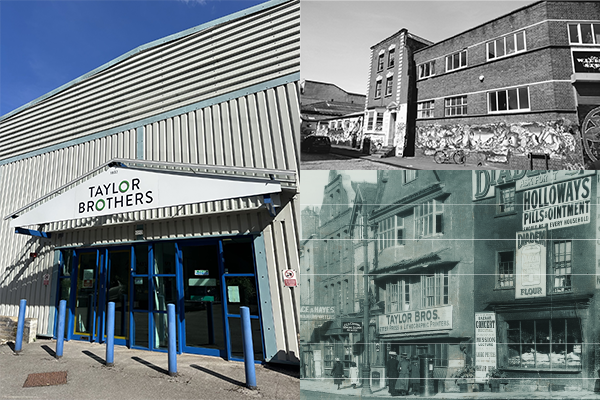
But Wilder Street was in the cosmopolitan St Paul’s area, a district housing creative businesses and noted for graffiti artists. One large graffito decorated a wall to the street by well known street artist Paris. This will feature in the book that Mountjoy is compiling about the history of the company and by extension about the expansion of industry in Bristol.
There are plenty of other stories to fill the pages: there was the sound system that occupied the carpark during the St Paul’s carnival, the collection of parking tickets accumulated by staff and visitors parking on the streets and its brief role in television history.
The street was used in one of the Only Fools and Horses Christmas specials – the one where Del and Rodney in full fancy dress run out of the mist as Batman and Robin. Wilder Street doubled as Peckham. Producers paid the company a few hundred pounds to turn off the presses during the shoot.
Life in a well organised factory is quiet by comparison and while the idiosyncracies of the old site are missed, says Mountjoy, the reality is that today’s factory is much better suited to running the business.
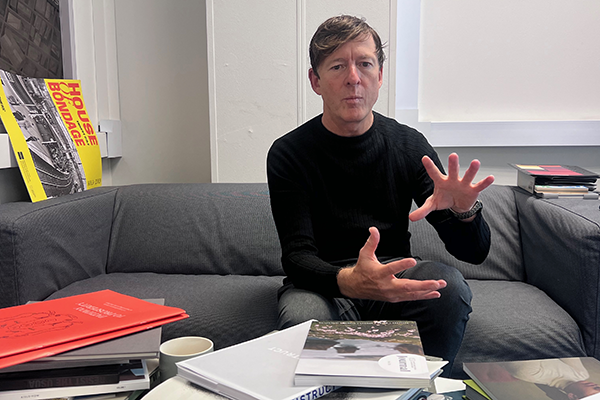
“When we saw this space we realised it was perfect. We could plan where we wanted to place all the machines and there was a lot of height,” says Mountjoy.
Finishing equipment was first to be moved over, followed by the five-colour plus coater XL75 which needed more power than had been available, just one of the niggles that every factory move comes up against. Today the press sits along one wall of the factory, a central area of racked storage and pallets of work in progress divide this from the pair of guillotines, folder, die cutting Cylinder, Duplo booklet makers and perfect binder and the various long paid for items, drills and hand stitching that most printers will have.
There is a mezzanine with office area and boardroom above the digital print area. Digital print production has been the biggest beneficiary of investment since the move. A JWei Titanium 2516 flatbed cutting table is only the most recent addition. An HP Latex printer was installed last year and two Heidelberg Versafire machines arrived at the start of 2023. A Matrix foiling laminator is on order.
The shopping list will next take in a flatbed inkjet printer, which will require some reorganisation of the area and potentially a B2 digital press. This had been a focus of a visit to Drupa. Just because the company has been in business for 175 years, there’s recognition that this does not guarantee success for a further century or more.
Nigel Millen is managing director and led the trip to Dusseldorf this year. “We have to be very adaptable to a market that’s constantly changing,” he says, pointing to the investment that has been made in digital printing and large format as evidence of a willingness to adapt as necessary. The Drupa visit was highly energising he adds.
Taylor’s core market is for the moment litho printing of high quality commercial printing with a strong emphasis on photography books, often for photographers and others that have little or no experience of printing.
“Our main business is about offering a bespoke service to customers that need that,” Millen continues. “This means a lot of hand holding, a lot of discussion of the papers that can be used and the different bindings that are possible. We are good at what we produce.
“The way that we work makes quite a lot of difference. We want customers to know that every job is so important to us.”
These days that job can be cartons and stickers printed on the large format press as much as an illustrated book, magazine or tourism brochure.
Each of the directors involved in the management buyout looks after their own customers resulting in the mix of products Taylors supplies. Mountjoy’s specialisms are in books.
This is a long way from the online trade printer model of filling every sheet passing through a press with as many jobs as possible and pushing as many sheets through the press as possible. When a job at Taylors hits the press, it has been proofed (often on the press), has been discussed thoroughly with the team so that everyone understands what is expected, client included. Some will come to pass on press, others have learned to trust that the printer will deliver work to their standards thanks to a long standing relationship, in some cases dating back 20 and 30 years. This even includes paint companies that use Taylors for their colour charts.
“It makes us a very straightforward business,” says Millen. The company is unencumbered by debts, the money borrowed for the MBO has been repaid and the company is in the happy position of being able to buy equipment without further loans. It reduces the pressure on the business. Nevertheless the company works around the clock from Monday to Thursday, closing down for the weekend on Friday afternoon.
“We have to be something of an all-rounder these days producing as much of what’s wanted as we can. That means a lot of magazines, catalogues, mailings, labels printed on the large format press, and books,” says Millen.
There are also leaflets advertising local events and pizza boxes for another of Bristol’s artisan businesses. The boxes need only two colour printing: black text on a different Pantone coloured board according to the flavour of the pizza. Exactly which colour for a Margherita pizza and which for a Quattore Stagione being decided in collaboration between the pizza business and printer.
It’s regular work that can be slotted in as necessary, but it’s also about the relationship. Mountjoy recalls getting a call from the customer asking for a small job with a short delivery time and could they pay with pizza?
“We have gained a couple of customers in the past year from companies where they were considered too small or were not treated well elsewhere,” says Mountjoy. “People like relationship based working relationships. Every job matters to us.”
A lot of the smaller jobs are now printed on the Versafire digital presses, some of which is ordered through portals that have been created for the purpose. The result is that around a third of the company’s £4 million turnover is generated by digital printing.
The company is serious about digital print. It is not considered second rate to litho or something for cheap and cheerful jobs. The presses are calibrated every day to ensure absolute consistency across the two, from day to day and to match litho as closely as possible. The litho press gets its finger printing through an annual service contract with Heidelberg.
The variety of work, papers, formats and technology in all its combinations is beyond the capacity of current MIS (Taylors uses Accura MIS). Instead there is a conventional planning board with T-cards to identify the jobs in the factory. It means, Millen points out, that anybody can take the job card and know what is needed. The open plan nature of the factory helps in this regard; everything is on view.
“It’s a collaborative way to work,” says Millen. “And it works for us.”
A lot of work requires hand finishing in some way which is beyond the scope of digital workflows. It provides an extra measure of quality control as every job is handled and checked in the process.
The hand bench sits alongside more conventional folders, Duplo booklet makers, foiling and cutting and creasing on a Heidelberg Cylinder. A library of dies rises up the wall behind the machine. “Whenever we bring students around, this is the machine that they want to see,” says Mountjoy.
The digital version of this is the newest machine in the arsenal. A JWei Titanium is a flatbed cutting table where a belt advances a roll fed job into the correct position before the cutting action.
At this point the job will have been printed on an HP Latex machine, but James Shield who runs the digital department is eyeing a flat bed inkjet press. One issue is that there is not enough space with the configuration of the floor as it is. Changes will be needed.
As well as large format, the responsibility spreads across to the two Versafire small format digital presses. While the value of each digital job may be relatively low, Taylors has its standards and the toner presses are calibrated each day to ensure predictability. Every paper used is profiled before printing.
A Vivid foiling laminator will provide a further function for adding value to digital print jobs. This will apply especially to small packaging jobs. The company is exploring this area with runs of 50-100 pieces, suited to some of the local customer base. It will enable value add for items that cannot be done at present. “We have a full set of tools ready to produce cartons, for samples or very short runs,” he says.
The transit of digital work can be very different to that for litho. Mountjoy explains that this workflow requires the job to be checked in prepress, frequently producing hard copy proofs. These can be produced on the XL75 for the ultimate in accuracy.
“The client will spend a great deal of money on photography, so a little more on making sure that the print matches the photography makes sense.” This culminates in passing on press. Mountjoy remembers one photographer that had worked for six years on his first book, his life’s work to that point, that he had become so wrapped in that he spent all week signing off sections.
That book became a success and Taylors has printed subsequent books and exhibition catalogues for the same photographer but with the trust that the printer will do its job rather than signing off every section.
“We have a lot of long standing relationships with agencies that first came to us saying ‘we have this project, can you help us with this?’ We have always been seen as the go-to company whenever they have something a little out of the ordinary,” says Mountjoy. “We always say can we come and talk the project through, often with the result that their design becomes better through suggestions that we make. We understand the materials we can use and the limitations of those materials and the finishes that are possible.”
The gallery of work that Mountjoy refers to throughout, picking up a sample here to trigger another story, or another to explain the challenge that the business had to overcome to come up with the end product, is on desks, the board room table, coffee table and shelves. Anything Taylors has printed can have a story for Mountjoy to tell.
He does this too with students. Bristol has a number of universities, the University of the West of England springs to mind with its book design course, that educate the next generation of designers. The reach extends across the Severn Bridge into Wales where the company has a relationship with institutions in Newport and Cardiff.
“We go to the universities and their students come to us. We show them the different print processes. We want to reach them in their second or third year because that sets them on a path of understanding that print can make a lot of difference.
“We have developed a nice reputation for openness and a collaborative approach to working on their projects. We think that it is incumbent on us to suggest ways to improve their project. In photographic books for example we may suggest using a duotone which many have never heard about.
“We hold their hand through the process because few understand the complexities of print and what is available to show off their images.”
The company will also take part in the Bristol Photography Fair as well as a sponsor for local student design awards organised by Proctor + Stevenson. This year it has printed a short run tabloid newspaper, Turbo, to promote Turbo Island, a focus of creativity in central Bristol, from designer Danny Stewart to great acclaim.
Then there was the call from “someone from Portishead”. Nothing unusual in that as this is part of the city, except on this occasion it was someone from the band Portishead. The call led to an order.
“The message we give from this activity is come and talk to us,” says Mountjoy. “The reaching out to people is really important. It’s about reaching people early and steering them in the right direction. We get a lot of repeat business and recommendations through doing this and the customer ends up with a beautiful book that hopefully they can sell.”
Taylors does not have extensive in house finishing for high end book work. But it does have strong links to Folio just down the road and Diamond at the far end of the M4 and around the North Circular Road. The job is folded in house before being sent out as this ensures that Taylors is responsible for as much of the job as possible.
The company’s own reputation is stretching towards London though word of mouth recommendation or via the natural movement of designers it has had contact with. Taylors can offer London levels of innovation and creativity but perhaps with a more provincial cost base. Nor do the customers stop in London: there is a photographic magazine produced for a Swiss customer. That too came via word of mouth recommendation Mountjoy says. “We get more work this way than by going out selling. It means we have a nice stable of work so we are not printing the same type of jobs day after day. It’s nice to be involved in projects that have a budget and a bit of creativity with that. These are not straightforward jobs.”
It means that the company is printing on GF Smith and Fedrigoni papers, requiring frequent profiling on the digital presses and on press proofing for the litho jobs. “Because these are bespoke projects, customers like to come and have a one to one relationship with us as the printer. It means that they will get the best possible product,” he says. “We think that we have the formula correct.”
Going forward the investment is going to come from the digital side rather than litho. That might mean B2 digital to mirror the B2 litho press. “We are going to invest in more machinery and people. Not litho. That can take care of itself over the next five to seven years. We’ll be looking at developments in B2 digital over the next three or four years. That’s just a blink of an eye for a business that started in the 1830s.”