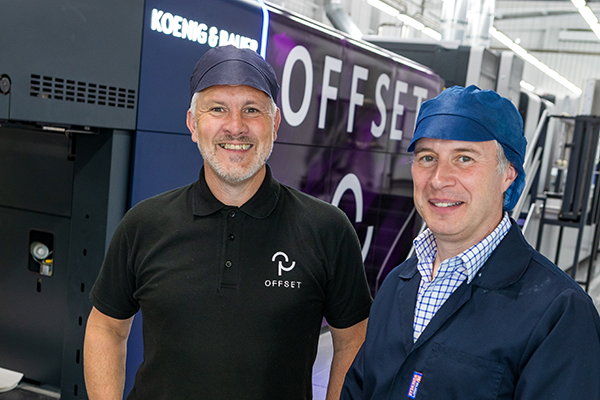
The Beast of Aylesford slumbers peacefully in its quarters, lying on a deep bed of reinforced concrete waiting to consume whatever is presented to it on a flow of pallets. The Beast resides at Offset Print & Packaging and rather than local maidens, the Beast, a seven-colour Koenig & Bauer 145, consumes pallets of cartonboard, perhaps seven full pallets an hour, all day long. There is no valiant knight waiting to slay this Beast, but a team of operators overseen by joint managing directors Vince Brearey, in charge of operations, and Edward Bone, in charge of sales, to harness its power.
And power it has. The press prints 16,000 1,450mmx1,060mm sheets of carton board an hour, printing six colours, then applying an anilox coating, followed by two drying units, a further print unit and a coating tower before a final drying section. It is the first of the latest generation VLF carton presses from the German manufacturer to reach the UK and has every feature possible from automatic pallet change logistics, through side lay free feeder, the printing units, inline inspection and delivery.
The control desk is dominated by a vast flat panel display that can show the job, ink settings, how print is fluctuating (very little) before corrective action, and any combination of the six cameras positioned throughout the press to enable whoever is controlling the Beast to watch sheets travel from one end to the other and to make adjustments for any unwanted movement, at the tail edge for example.
The Beast fills the accommodation prepared for it. A mezzanine was removed and the two cutting and creasing platens and laminator moved to another part of the factory complex. A deep pit was dug. And then because the excavation work revealed that the site straddled two soil types, was dug even deeper. The hole was filled with rebar steel, concrete, and then more rebar and concrete until ground level was reached. Offset Print & Packaging was then ready to receive the Beast. It arrived two or three trucks at a time to what is a logistically imperfect site, the crates offloaded and the Beast assembled and connected to power, water and eight extraction chimneys and the team given weeks of instruction in the fine art of Beast management. By the third week in June, the press is ready to start in full production on a wide variety of different cartons for a demanding set of customers.
Offset Print & Packaging remains an independent printer of cartons, which was started 50 years ago by Hugh Jarvis, who is still chairman and a shareholder, and his father. That entrepreneurial ethos remains instilled in the culture of the business. Over the years it employed different machines and different people, including, briefly, Vince Brearey as a machine minder. Brearey returned in 2010 as operations director having worked for Nampak, teaming up with Edward Bone who was at the time sales and marketing director.
At this point the company had recently installed a Koenig & Bauer Rapida 142. It was followed five years ago by a six-colour plus coater Rapida 106 replacing an older Rapida 105 and a B2 Speedmaster. Both Rapidas are blue generation presses with curved side frames and technology that remains state of the art. The technology on the B1 press was a step forward from that on the larger machine. Offset Print & Packaging harnessed this to earn KBA’s print production award for the performance the company squeezed out of the press. It is poised to do the same with the Beast.

The technology on the new machine is a stride forward again enabling further savings on make ready waste and energy used and enabling short makereadies despite the larger format. “We are a business that is selling time,” says Bone. The technology is housed behind black glass side panels and deep grey paint. Brearey has enhanced this with a vinyl wrap on the delivery with Offset Print & Packaging’s purple corporate colours and logo. This is in line with his policy of applying the company’s purple logo to personalise every item of equipment around the factory, including the new faster Screen platesetter that is essential to cope with the slightly larger format plates. Fujifilm provided the platesetter and will continue to supply the plates used.
There is a lot riding on this press. It is a big investment for an independent packaging printer and will push Offset Print & Packaging (OP&P) up the output league table. Most other family owned companies in its position have stayed with a B1 format whereas the VLF sector is dominated by the groups which seek the longer runs of food and beverage packaging to minimise job changes and to serve larger customers. This is not what OP&P is intending to do. The conventional wisdom is that B1 is a more responsive format and better suited to production of premium packaging. The “plus one” six-colour press in B1 has been chosen by Simply Cartons and Oriel Packaging in recent months for this type of customer. However, OP&P does not follow conventional thinking. The 145 will be used for fast turnarounds, shorter runs and luxury cartons.
“We are the first independent company in the UK to use such a piece of kit,” says Bone. “It was a big investment for any business, and is part of the plan for expansion of the company.”
It was no automatic decision. “We spent a lot of time planning for this,” says Brearey. “The specification started off as a six-colour plus coater, then became a double-coater press, then we decided to go for the seven-colour with the two coater configuration we have now.”
Bone adds: “We wanted something that could do everything for anyone. We are investing for what customers might want in two, five or ten years’ time.” That others have also chosen this configuration will help spread an appreciation of what will be possible with print and coatings, Bone believes.
The project encountered problems around lockdowns. While OP&P escaped Covid restrictions because it prints food packaging, restrictions prevented the purchasing process following its normal course. The company had seen the press at its launch, well before any decision to buy it. “We probably would have waited another year, but the Super Deduction on offer from the government was so attractive, we took advantage of that,” says Brearey.
At that point travel restrictions meant the team could not visit Germany to check the press nor the rival option from Manroland Sheetfed. As soon as Germany lifted the restrictions, Brearey, Bone and Hugh Jarvis were on a plane. “Once we saw it out minds were pretty much made up,” says Brearey.
In an ideal world, OP&P would also have been comparing options from Heidelberg, but that company is no longer producing a VLF press. “Everybody makes a good machine these days,” he says. “But we have a long relationship with Koenig & Bauer. This is our fifth machine over 20 years and we had a Planeta before that. We have also bought a platen and carton gluer from them.”
That relationship ensured that the manufacturer, despite its own production backlog, was able to deliver to the time table set by the Super Deduction. Now with the press in place, the company has to make it work.
“This has been our biggest ever investment and stands us in good stead for the future,” Brearey says.
That future will continue to be about packaging across a number of sectors, food and home entertainment being primary areas, but also personal care, electronics and homeware.
“We want to produce large format packaging, but also high end premium packaging with a larger choice over the number of colours and varnishes we can be using. We want to be able to offer something over and above what others have,” says Bone. ”We have some fantastic customers that need the format that the 145 provides and also want really nice print quality, the spot colours and varnish effects that the new press provides. So if we were to step back in size, it would be a retrograde step. We do not want to be a me-too company. There is demand for good quality large format print.”
“If we were to step back to B1, we would no longer be niche,” Brearey adds.
The company’s average run is currently around 15,000 units, quite short in packaging terms, and although the economics and productivity of the new press may push this up, it will also be highly competitive on the shorter fast turnaround work that is part of OP&P’s niche and will extend the lower limit of production.
Makereadies are much faster and the press is in colour with fewer waste sheets, the anilox coating roller is easily swapped out in minutes, and there is no need to make adjustments on feed or delivery. The ease with which the anilox can be changed removes any temptation to leave in place a cylinder that needs to be craned in and out of position. This will be used for different coatings and varnish effects, something that will be a requirement in future the company believes as printed packaging becomes more influential in marketing terms.
As soon as the ink had dried on the order, OP&P has been keeping customers aware of progress with the project. It is now working on a samples pack to demonstrate the colours and effects that the machine can deliver. “Customers today want more than four colours and an emulsion coating,” Bone explains.
Customers also want to see their suppliers acting on the environment, “wanting us to be as green as possible” as Brearey puts it. The press delivers in the this sense. Faster makeready means less waste, the Varidry system is 40% more efficient than on the 142. At a corporate level the business has ISO 14001, recycles what plastic is used and sends nothing to landfill. It is investing in a low impact cooling system to reduce temperatures in the factory.
The pallets it uses are made from heavy duty plastic, but need to be because they need a precision for the logistics system that wooden pallets do not have.

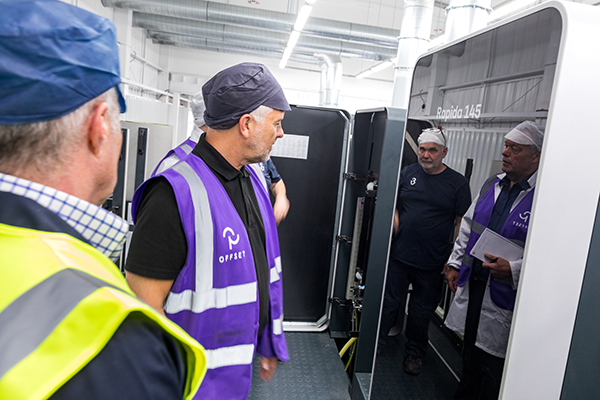
There will be a challenge in maintaining a flow of these pallets to the press because it will not take the press long to eat through the average 2,000 sheets in a stack. This will need stronger collaboration between the press room using the pallets and the warehouse providing them. The Beast cannot wait to be fed.
The stack is moved to the conveyor which moves the pallet towards the press, using a ram to line it up correctly for the feeder. Empty pallets are moved to the other side of the machine for collection A faster more automated Baumann pile turner has been part of the project.
There is a challenge too in managing the flow of printed work from press to platens and onward. Like many companies, the layout is not ideal.
Over the 40 years since it moved to the site, the company has added extra factory space, connecting the buildings up by bridging over roadways. The presses have been kept together, the three cutting and creasing platens are now in the same space, likewise its three folder gluers. Once boxed and palleted, goods are either stored for imminent pick up in the dispatch area or returned to a warehouse.
The relative lack of space means OP&P has become adept at print, cut, glue and out, as Brearey puts it. This has also had an effect on the type of work that the company has specialised in. It did not set its stall to be a shorter to medium run printer, but has built a reputation in this area. Again this is this fortuitous as with the experience of extended supply chains over the last few years, brands are less willing to take the risk of long distance production, let alone any questions that may touch on ESG policies.
“Covid exposed the weaknesses of a just in time supply chain and of a ‘beyond Europe’ supply chain,” says Bone. “This has brought supply back to the UK, It will not go back to how it was before.” OP&P can benefit. “We have a two-week turnaround time for regular work,” he adds. “You can’t get that from other parts of the world.”
The company has also specialised in the types of customer it works with. There is frequently a challenging aspect to it. Bone points to some paper wine bottles on its samples table. Packaging of this sort is better for the environment than shifting heavy glass bottles and is generating interest. This design had been printed previously in Germany but with an extended lead time. OP&P, he says, was the only UK company willing to take the job on. There are tea packs which are printed in single colours to denote the different skus in the brand. Hundreds of PMS tins are lined up on shelves close to a two-colour Komori Lithrone that was installed for just this job. “It’s a 35-year-old press,” says Brearey, “but perfect for this work.”
There is a diversity to the work that means the company will stay busy for much of the year, the peaks for different customers coming at different times. The majority also call on OP&P’s design services. Bone explains: “We score in terms of customer service, excelling at the consultative sell.” This can include sourcing and managing work from third-party suppliers, a company producing thermoformed pulp trays and dividers for example. This is indicative of a level of trust across the customer base. He explains: “We provide a turnkey service with advice on materials, how to replace plastic and structural design. It’s part and parcel of what we do: we are a solutions provider, not simply a box supplier.”
This is also reflective of changes across the packaging sector where fewer procurement people have experience in specifying packaging and there is a high churn rate. Experienced professional buyers are as rare as hen’s teeth.
To counter this OP&P runs carton school open days to show new recruits what print is all about. “The idea is to show them what is involved in print production – many think a printer is like something on their desktop. They have never seen heavy production machinery before. We get requests to attend from customers, even from people working in a repro house.” The morning is spent talking about the concepts, the processes and theory before heading to the production floor in the afternoon to see what they have learned being put into practice. “We want to show them why they can’t have their boxes in two days,” Brearey says.
Part of those days will now be about visiting the Beast, 180 tonnes of high performance printing machine that Offset Print & Packaging is immensely proud of. “It’s a marquee signing,” says Brearey. “We absolutely had to be the first. It’s what we are all about.”