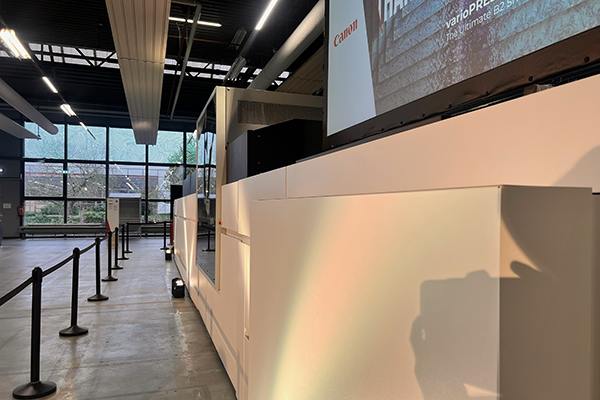
Canon is planning to repeat the unquestionable success of the VarioPrint iX3200 with the iV7, its B2 sheetfed inkjet press. The press is installed in the Venlo customer experience centre where prospects have been able to put the press through its paces on their jobs, to check out its quality and to engage in the critical questions about the cost of operation and how it fits into the printing picture.
For Canon the answer to this is simple. The Japanese company aims to be dominant in the inkjet age. It has been a leader in continuous feed inkjet since introducing the JetStream, based on Miyakoshi technology, in 2008. Since then Canon has switched to its own machine designs in the ColorStream and ProSteam. In sheetfed inkjet the iX300 engine and then the iX3200 has become the unquestioned leader in SRA3 sheetfed printing. This paves the way for larger format sheetfed inkjet presses and other applications.
The iV7 was announced at Drupa last year along with the iX1700 which is to be its entry level SRA3 press. Since then the iC has been presented as a machine for corrugated packaging and there is a concept for a B1 press intended for carton printing. Canon also has inkjet for label printing under development as well as for all touch points in the large format sector.
Despite the success of the iX3200, the B2 press is not a scaled up version of this machine, but a new design that will be echoed across the portfolio of sheetfed presses.
All are using Canon 1200dpi piezo printheads, applying Canon’s polymer water based inks and transporting the substrate along a flat path from feeder to delivery through zones with hot air drying.
The B2 press feeds either from paper drawers like most digital presses or from a more litho like pallet feeder. The drawers can hold 590mm of paper while the pallet feeder works from a 900mm stack. Each substrate can be profiled and the details logged for recall when needed.
The feeder head is a version of the BDT long sheet feeder used on its toner presses. The three headed vacuum technology units lift the sheet and advance it into the presses adjusting for skew and positioning to ensure it is presented accurately. This can deliver sheets to the press at 8,700 B2 landscape sheets an hour, making this the fastest B2 inkjet press on, or about to be on, the market.
The maximum format is actually what is being dubbed B2++, 750x640mm. This can accommodate 6 A4 pages to view, another dimension to its productivity says Canon.
Conventional side lays position the sheet with consistency before passing beneath the Media Deformation Unit. This will check that the paper is completely flat and if not, with a crease say, will alert the print unit. Further sensors and adjustments are possible to ensure the sheet is precisely registered ahead of printing on either the first or second side.
Canon’s ColorGrip priming fluid is used to create a consistent surface for the ink to adhere to on coated substrates. It is not necessary on uncoated or inkjet optimised paper. ColorGrip will generally only be applied beneath where ink is to be applied.
The inkjet array itself is housed above the vacuum belt that holds the sheet in place. The heads are raised when not in use and lowered into position for printing. They will also be raised if the Media Deformation Unit raises an alert that the coming sheet is not up to standard and might crash against the nozzle plate and damage the heads.
The Canon piezo printheads offer four droplet sizes across 150,000 nozzles firing in the YMCK sequence. This is a change from the iX3200 where the heads came from a third-party supplier, namely Kyocera.
The heads are heated on the iV7 to keep inkflow consistent and to help prevent partial or full blocking of any nozzle if ink is allowed to dry. The ink is constantly circulated inside the printhead to keep its condition optimised and to help prevent firing problems. This will also minimise the need for cleaning and other maintenance routines. Canon has developed a ribbon which is used to clean the heads when necessary.
The heads have a 1200x1200dpi resolution giving 50,000 nozzles to fire at speed. This is controlled though a DFE based on the Canon Prisma technology used on its ColorStream and ProStream continuous feed presses. The workflow will batch jobs to minimise changes in paper type and format to keep it running as much as possible. This also enables operators to adjust ink levels for more economic running according to the needs of a job or the end customer.
Printhead performance is closely monitored so that any blocked nozzles are noted and adjacent nozzles used to compensate. The heads are capped when not in use and during the warm up routine before printing. Canon fits the inkjet heads into carbon fibre frames to ensure stability as the material is not affected by heat. This also enables a rapid changeover when a head needs to be replaced.
The drying process is split into three sections. The first heats the sheet via forced hot air to 75ºC. This removes water from the ink and the water vapour is ducted away. The next stage introduced measured amounts of steam and combined with heat, ensures that the polymer around the pigment is melted onto the paper or the ColorGrip. The polymer surrounds the pigment, providing protection against scuffing or scratching. The final stage is cooling to prepare the sheet for printing on its reverse side.
The turning system diverts the sheet down a slide into a stop and then moves off towards the print section with what was the tail as the leading edge. As it comes back into the print section, the sheet is now reversed.
When both sides of the sheet have been printed, the final step is delivery to a Mabeg style stacker with access at the side as well as end of the unit. Like the feeder, this has a 900mm stack height. Sheets can also be directed to a tray on top of the delivery for proofing or for very short run jobs.
There are no immediate plans for inline finishing though this is possible should companies come up with suitable equipment, a coater for example would help production of packaging. As yet inline options for B2 inkjet sheets are sparse. As Canon and other expand sales, this will surely change.