Inkjet printing is different. Perhaps not so different for continuous feed inkjet where most machines have been installed for a clearly identifiable purpose, perhaps replacing another technology in transactional printing, printing books or photobook. But for sheetfed commercial printing, inkjet is different. It is comfortably more productive than toner presses even at a two-page format, though not so productive as a litho press.
Inkjet clearly occupies a space in between these two distinct technologies. This though is a space that overlaps with the short run and variable data capabilities of the toner press and also with the quality and versatility of the litho press. Then there is B2 inkjet.
As B2 inkjet rolls out this duality will be ever more apparent. Does B2 inkjet replace digital printing that we have known to date, or does it pose an existential threat to litho printing in this format? Will B2 inkjet be a niche as some suppliers believe or will it be a mainstream product as others think? Or will it become an evolutionary dead end that will fail to recoup the massive investments that have been made over the last decade?
Time will tell, though Smithers Pira seems to think that B2 inkjet printing has a vibrant future with better than average growth predicted for the next few years.
What is certain is that to make the best of the technology requires a different way of thinking. If it was possible to clearly segment digital printing to date as something for the smaller jobs, the ones that require a degree of personalisation or those needed today, while litho is good for multi-section jobs, runs requiring more than say 500 sheets, or ganged up work and when top quality is demanded, B2 inkjet blurs these distinctions. It can do all the above its developers believe.
Inkjet printing can deliver single copies with fast turnaround and close to zero waste, but it can also be competitive on numbers well into litho territory and there is absolutely no question about the level of quality. For sure there will be some papers that prove beyond inkjet printing, but there are plenty of papers that only the foolhardy or brave will run though a litho press.
For sure there will be questions about the cost of the ink, but as suppliers are all too keen to point out never mind this, consider the overall cost of ownership and lower costs of operation because expensive skilled operators are not needed.
Inkjet does not require plates, blankets or other consumables, the waste levels are absolutely minimal, machines do not require a highly skilled dedicated operator and they suit further automation in a way that litho does not. Press availability is closer, if not better, than a litho press and certainly well ahead of even the best behaved toner box.
This is without considering the workflow and data flow and the opportunities that the ‘no penalty’ technology offers. Because there are no penalties to printing single or minimal quantities, no penalties in printing solids in challenging colours, no penalties in having to wait overnight before finishing. The inks achieve a higher colour gamut than standard offset inks, potentially rendering spot colours unnecessary.
The time is right for the transformation to inkjet printing suppliers will say because of a number of factors. The skill level of the industry is reducing as press operators retire leaving a skills vacuum in their wake, the growth in the number of short run fast turnaround jobs has reached tsunami proportions with ‘automate everything’ as the practical way out and demands for sustainability and minimal carbon footprints favours a digital way of thinking and printing.
Hitherto B2 inkjet printing has most definitely been a niche play, or one that very few print businesses have joined in with. There have not been many options, leaving the Fujifilm Jetpress, initially the Jetpress 720 and latterly the Jetpress 750, as the only machine to buy. It operates like a litho press from feeder to delivery, has conventional side lays and grippers and is built on a sheet transport from RMGT. Because it runs stack to stack, there have always been questions (not least from those selling rival technologies) about backing up the front side with the correct sheet on the second side. This is a digital machine that does not duplex rather than a straight litho press where piles always need to be turned. Despite Fujifilm’s best efforts, this has certainly hampered up take up.
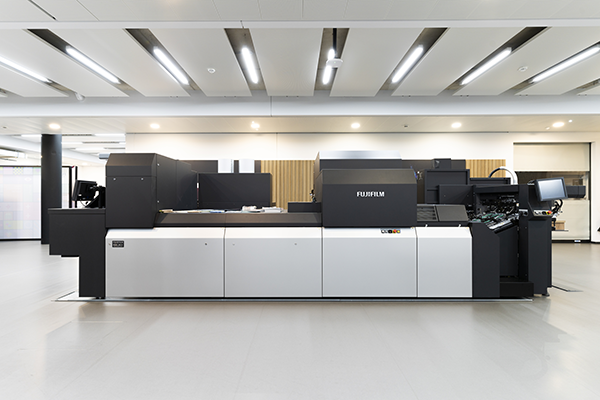
This has reached the point that Fujifilm has announced that it will discontinue new sales of the press in European markets due to “ongoing profitability issues”. It is the case that Fujifilm has struggled to position the machine as suited to commercial printing and its decision may be a warning to other companies that are taking steps or strides into the market with B2 inkjet presses.
However, where the technology has been installed, there have been fans. It is being used successfully in photo book applications, and gallery quality photography and art books; it is being used for book cover printing by both CPI Books and Clays in the UK; it is being used for general commercial work and it is increasingly being considered for cartons.
At Drupa Fujifilm demonstrated the Jetpress inline with a Kompac coater. This was its Phoenix model, a flood coater suitable for protection and varnishing, but not for cartons where the trick is to avoid coating the areas where glue will be applied.
This has been corrected with the switch to the Onyx coater which takes a flexo plate and so controls where the coating is applied. This coating may be UV or an aqueous fluid. Changeover between the two takes a couple of minutes rather than the previous 15 makeready thanks to a vacuum pump to suck up any remnants of the previous product. A full changeover is carried out in five to ten minutes explains a spokesperson for Fujifilm Europe.
“Packaging is where we are receiving renewed interest,” says the spokesman, “especially from commercial printers wanting to diversify. Most people have now seen the output from the Jetpress and have been really impressed. Run lengths are coming down and there is a demand for packaging that includes elements of variable data.” There have been installations at carton printers, ousting other digital presses as a consequence.
The jobs can be packaging for artisan businesses where among a batch of products sales in one area may be strong at one time while sales for another iteration may be subdued only for a change on the next period. This might apply to scented candles or reed diffusers where spicy aromas may feature around winter time while fresher grassier notes come into their own in spring. These businesses run from minimal stock levels, ordering almost on demand every week or month to avoid having scarce cash tied up in pallets of stock. Larger brands driven by the ‘cost at all costs’ procurement departments will still tend to order a year ahead to call off when necessary in order to achieve a minimal unit price, accepting the risk of having stock that is paid for rather than using digital print to manage stock levels.
Fujifilm also has dedicated carton printers on the user base where inkjet is a complement to litho printing with the technologies profiled so that jobs can be switched between the two without compromise. Other users have shifted to B2 inkjet having struggled with other digital print technologies.
“We believe that B2 inkjet is not a replacement for offset printing but that it can sit alongside it. It will handle work that is simply not viable for offset, and that is a segment that is getting bigger,” says Fujifilm.
In the inkjet timeline, Konica Minolta and partner Komori are not far behind. UK success has been limited to one machine each and neither company is still around to talk about their choice. The KM1 B2 inkjet press made its debut at Ipex in 2014 at the Exel in London. It is a 3,000 sheets an hour machine, printing on both sides of the sheet using UV inks. Because of this the press is relatively compact; it does not need the lengthy drying tunnel that those using aqueous inks have. Also because of this, there are no restrictions on the types of paper used, synthetics, canvasses and even films are possible.
In mainland Europe and especially North America there are multiple installations. A Basildon company, Colourfast, was the only installation in the UK. Konica Minolta admits the choice of this company was a mistake. The business was a long time user of Konica Minolta’s toner presses for overnight printing of reports for the City. Quality is not essential, reliability speed is and the confidential nature of the work restricted Konica Minolta’s ability to use the company as a reference site.
Several years later, the KM1 has evolved into the AccurioJet 30000 and the pilot installation at 8Group is everything that Konica Minolta could wish for. The press has bedded in nicely, it is producing good quality commercial print and the customer is happy. It is printing work that would otherwise have been sent out for litho printing, inevitably taking a day or so with the loss of margin that this entails. Now this work and margin is kept in-house. Inkjet has enabled digital printers to break free from the constraints of toner printing. It is a development that Konica Minolta is taking seriously, appreciating that selling a machine that costs three quarters of a million pounds or more is rather different in terms of risk from a £100,000 press. Mark Bladon, a former litho printer, has joined the business to take charge of major accounts. His background covers BfS, PrintIQ, Heidelberg and KBA having first been trained at Broglia Press.
“Industrial printing has become a key focus for us,” says production and industrial print channel manager Richard Kilduff. “Previously it was not a priority for us. There is now a team in the division looking after the B2 press, embellishment and our label presses. It is a core product area that is now a strategic focus.” There will be engineers trained on the press and to look after customers backed by the larger network of those looking after its toner machines. The reliability record of inkjet presses suggests though that this is a technology that does not require the same level of looking after as a toner machine.
Nor does it need the same level of training. When installed operators receive four-and-a-half days training to kick off with. And once running the press, thanks to its network of sensors to check nozzles, colour registration and so on, can be left to itself. There is effectively no likelihood of the colour wandering, tracking issues or ink starvation. An operator can be working on a data file for the next job at a computer alongside the press while the machine is running itself. Alternately, one operator can comfortably manage two presses.
The simplicity of operation means that several members of staff can operate it, ensuring cover for illness or holidays which might not be the case for a litho press.
Konica Minolta is now looking for its next crop of users: perhaps companies with variable data and working with high colour coverage sheets, whether businesses from a digital print background or from commercial litho printing.
The key question for Kilduff is how to get existing litho printers to consider all the options when it is time to replace an existing press. “It depends on what else is in the factory. People should not be buying this thinking it can do everything. However, when the time comes to replace a litho press, people should consider other options instead of adding more of the same capacity in order to complement the capacity that they already have and to expand the range of products and services that they can sell. And if they choose digital, there can be no loss of quality.” B2 inkjet delivers on all counts. “There are no concerns about the type of stock you can put through it, no consumables to become out of date. It’s as close to a green, or we prefer blue because that’s our brand, button operation as it is possible to get.”
The inkjet technology is unique to Konica Minolta. The viscous UV ink is heated to reduce viscosity for firing by piezo action then the droplets rapidly regain viscosity before hitting the substrate where LED UV arrays complete the curing. There is no additional priming fluid and thanks to the instant dry nature of UV printing, no ink to be absorbed into the paper causing a deadening effect on the image. This also opens up the potential to print on non standard substrates “which no other inkjet process can offer” Kilduff explains. “This like coming to the car market with a simple electric motor compared to the complexity of the internal combustion engine.”
The UV means too that this B2 press requires 30% less energy than an equivalent machine where water has to be removed from the paper he points out.
Kilduff wants printers to consider the full running costs of a press, from staff to consumables, including the space that the machine covers. “It’s part of looking at the bigger picture,” he says.
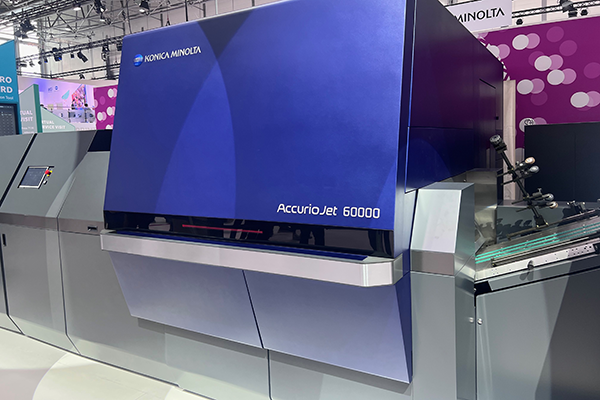
For Konica Minolta the AccurioJet 30000 is the main plank in the inkjet portfolio. The KM1 remains on the books, though is notably less appealing than this machine and the AccurioJet 60000, a 6,000 sheets an hour machine is on the horizon. It was shown at Drupa but with only vague specifications. This remains the case. It will continue to use the DotFreeze UV ink technology and has double the speed, but detailed specifications are as yet unknown. The expectation is that these are released towards the end of this year when first machines are installed.
Komori will be hoping to be ahead of this and already has users for its next generation inkjet press, the J-Throne 29. It is outwardly similar to the iS29, Komori’s name for the press, jointly developed with Konica Minolta, but inside there are significant changes.
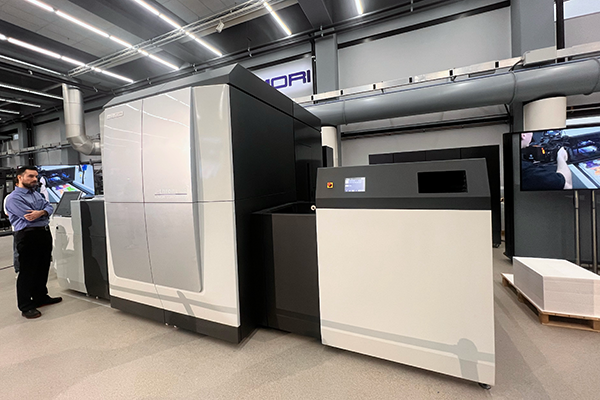
The imaging unit is using Fujifilm Samba heads and while this is still using UV cured ink, the ink is formulated by Komori and is more conventional than Konica Minolta’s DotFreeze technology. Other aspects, from feeder to delivery were of Komori’s design and remain the same. The big difference is a doubling of maximum throughput to 6,000 B2 sheets an hour, the result of offering a 1200 x600dpi resolution.
“It looks like a Komori,” says Peter Minis, Komori Europe marketing director. “And builds on our 100 years experience in building sheet transport and feeders. We are experts at turning sheets, so we know how to achieve a very tight fit for front to back registration.” Another sales benefit will be a 40% reduction in energy to dry each sheet compared to a press using water based inks. The UV inks though, containing as they do photoinitiators, are more expensive than an ink dowsed in water.
“Importantly it operates like a Komori though a touch screen that has the feel of the interface for our litho presses,” he says.
The company acknowledges that having an appreciation of litho printing will help in training to run this machine, but even from ground up, less training will be required. Komori reckons it will take two weeks to transition from litho to inkjet.
During demonstrations at the European showroom in Utrecht, the J-Throne was put through its paces producing a six-up carton job where the mix of skus within the same product range was changing and a calendar where the image associated with each month changed during the run. Switch from one to another was a matter of minutes and there was no run up waste.
Komori has user sites in the US and China, the US company running the press, 1Vision in Houston, has commented that it is 10-15% more productive than the other digital presses it has used.
Now the first European customer has been announced following negotiations underway since the open house introduction. It is heading to Imprimerie Edgar, already a long term Komori customer, on the outskirts of Paris. The company also has large format inkjet and Xerox Versant printers and offers an express print service.
Komori is confident that this will be followed by others, perhaps even replicating the success it had in France with H-UV when competing printers needed to offer the same technology and advantages as their rivals. The company certainly wants to “drill down and check how it responds on European papers and conditions”.
Speed of data handling will not be one of the issues it faces. Where others are updating or adapting existing technologies, Komori has completely reengineered the technology that was on the first press. Fibre optic cables, additional memory and water cooled processors will ensure that data handling will not be a bottleneck. There will be extensive testing to understand how to handle both Rip on the fly and preRipped files.
Like others in the market, Komori has been noting a decrease in run lengths and cites figures from Smithers Pira to the effect that sales of B2 digital presses will grow by 16% by 2029 with inkjet responsible for almost all of that increase. Its target is to position inkjet alongside offset as a means to tackle shorter print runs and so free up capacity on the litho press.
This is almost opposite how those with a digital print background approach the development of B2 sheetfed inkjet presses. For the likes of Canon, Konica Minolta and Ricoh, inkjet is a means to keep longer runs than are comfortable on toner presses and to capture work that would otherwise be printed on litho presses, the so called litho to inkjet transformation.
This has spurred Canon and Ricoh into introducing new presses for this opportunity. Ricoh has long trailed the arrival of the Z75 calling it the first B2 aqueous inkjet press capable of duplexing to reach the market.
“It has been under development for some time,” says Ricoh UK national sales manager Tim Carter. “And we have had a couple of false starts. There has been a lot of background work to make it viable.” The challenge and innovation required to bring a machine of this scale to market is of a different scale to working on a new electrophotographic technology where Ricoh has had decades of experience.
That work has been finished and through a number of installations around the world, just not yet in the UK, experience has been gained. Ricoh is ready to reap the rewards. “We see offset migration as the big opportunity,” says Carter. “The Z75 is now a mature product.”
The company has a strong and long inkjet background: Ricoh produces its own piezo inkjet heads and through the acquisition of IBM’s printing press division has extensive know how from a continuous feed perspective. That is evident in the VC80000 which is currently the flagship press and capable of glorious print.
But the continuous feed press is both expensive and a hungry beast. The company needed to appeal not only to the largest litho printers, but also more family owned businesses and companies that are steeped in cut sheet digital printing. Some of these are finding that they are losing share to digital alternatives to print and need to move upscale says Ricoh Europe’s director of commercial print sales Sander Sondaal
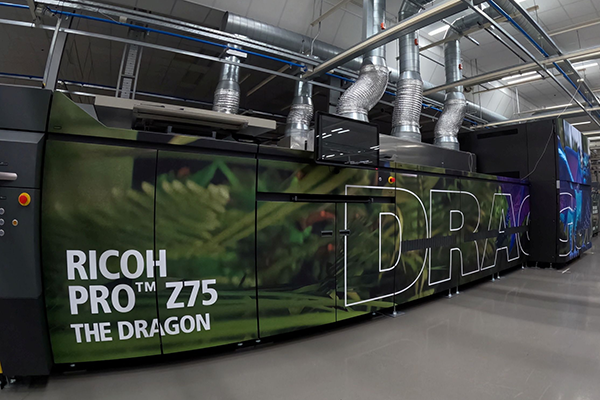
The consequence, as they say in films, is Enter the Dragon. The Z75 made its public debut at Drupa in 2024 and has notched a number of installations, including at the Customer Experience Centre in Telford. The official beta site was US company Heeters and this has been followed by sites in Europe, at Lavigne for printing calendars as the first announced and at other online print organisations.
The first impression is the size of the press. It is a big machine that many digital only printers would struggle to accommodate, many litho printers too. This is necessary to accommodate a drying section to remove water from the ink using IR and hot air without stressing the paper so that it shrinks. Large exhausts duct water laden air to the outside atmosphere.
While the press is positioned as a machine to eat litho printed pages, Ricoh is stressing that it is not for everyone. If a business needs to print on synthetic substrates or high value papers, Ricoh will point the user in the direction of the C9500 toner press which has this capability. If it is higher volume multi section work, the VC80000 is the better option, Sondaal says.
If it is about lightweight cartons however, the B2 press is the answer. “We have had a lot of interest from packaging,” says Carter. “It’s about delivering high impact short runs that is consistent with the quality and appearance of the longer run litho printed cartons; it suits online gifting where there is a demand for personalisation; it suits test runs for product launches.
“We are seeing how brands are putting pressure on converters and print service providers to come up with different types of packaging that has a higher impact. We think the use of personalisation on packaging will become more prominent over this year and beyond and that this becomes a big opportunity.”
Inkjet inks have a wider colour gamut than offset inks meaning it is possible to reach more of the PMS range from four colours. Testing has shown it s possible to hit most corporate colours, at least to the satisfaction of many brands.
“Much more of the development of the applications that suit inkjet is driven by the brands rather than the carton converters or commercial printers,” says Carter.
Commercial printers will be engaged by the versatility of the press. At the showcase event at the end of last year, attendees received a sample pack of the types of work that can be produced on the Z75. One comment received was that an entire marketing campaign could be produced on the one press, eliminating the need to outsource work and so retaining the margin in house.
Success will be about proving the business case, Carter explains. “That will mean a huge amount of consultancy and open mindedness on the part of the end user,” he says.
The end result might be about toner, continuous feed presses or cut sheet inkjet.
“In some cases we are talking about replacing a Speedmaster with the Z75.” The consultancy will be about how to manage a huge increase in the number of jobs and the tool like Batch Builder that Ricoh has to manage the workflow and make if more efficient and automated.
The advent of inkjet printing will remove the emphasis on the capabilities of the press, because for the future of the industry rather than its past, the actual printing press becomes a digital output engine and the workflow automation and scheduling, will take centre stage. There will need to be some adjustments in order to achieve this automation nirvana. Sondaal explains that efficiency will mean streamlining choice. “How many papers does a company need to offer? Commercial printers need to be able to print whatever job comes through the door.” With fewer choices, there are fewer changeovers and therefore less lost waste or lost time.
While Ricoh is continuing to use the same Fiery Rip for continuity from other digital presses, its hardware includes additional processing blades to ensure that it can keep up with the data demands of a larger sheet and variable data that might be used.
While the installations are taking place, and Carter is sure there will be a number in the UK this year, it is still relatively early days for the supplier. “We are the new kids on the block.”
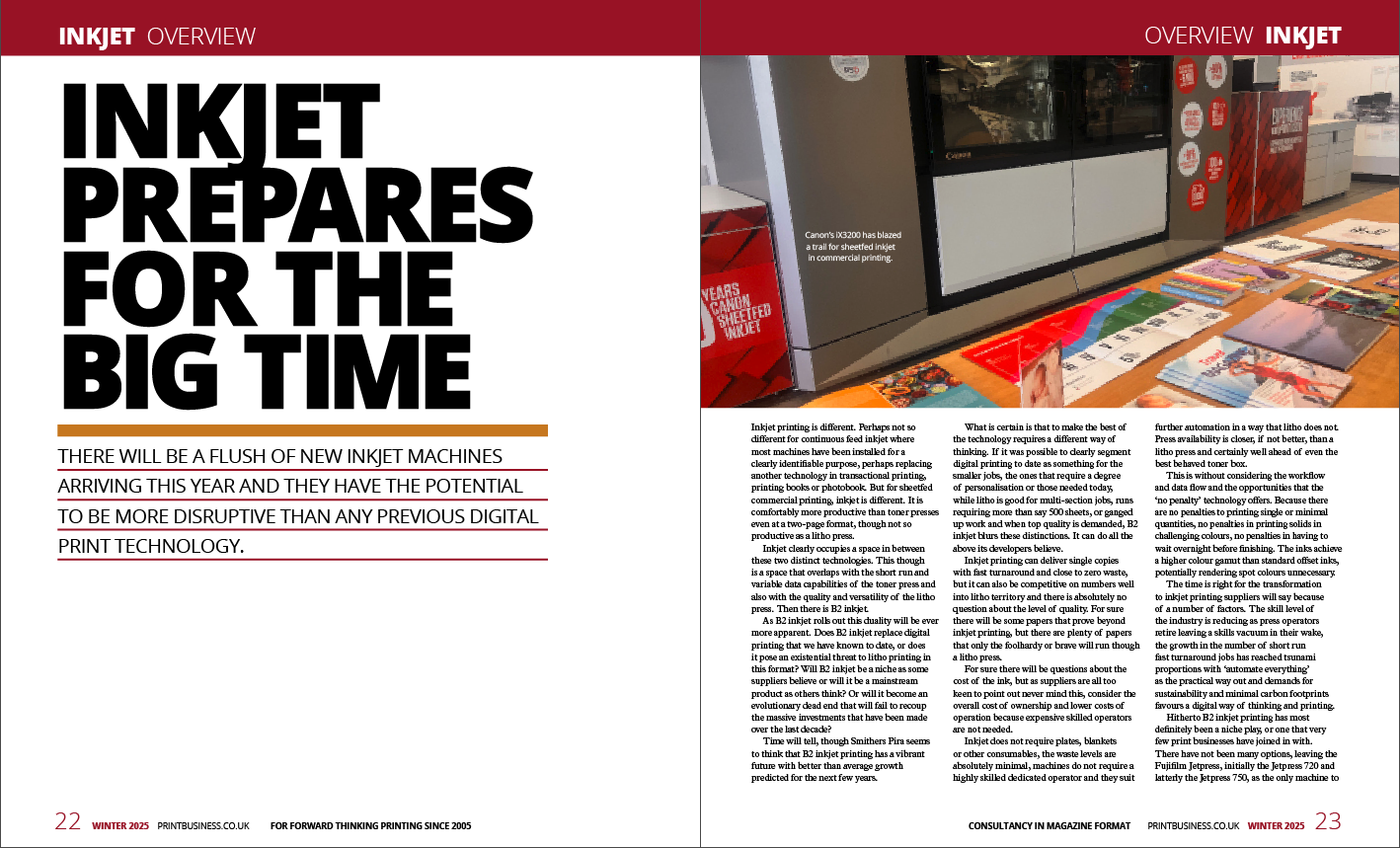
Canon cannot claim this. While its B2 sheetfed inkjet press, the iV7, is not quite ready for commercial installation, it has scores of B3 inkjet presses in operation around the world. More than anything else the success of the iX3200 in particular is convincing printers that inkjet printing is the future. The equal success that it has enjoyed with continuous feed inkjet is less relevant to a commercial printer that knows and understands paper, folio style. And as Canon has struck an OEM deal with Heidelberg, its influence on development of inkjet printing can only increase.
The challenge for all is about the commercial model underpinning inkjet. For all suppliers inkjet is about purchasing the ink, the machine and the service. How these factors are carved up is part of the calculation: a company willing to pay more on the capital cost of the press may pay less for the ink than a company that wants to structure a payment by use deal. Either way this is not a click charge model.
The key role played by the cost of the ink is underlined by the effort that suppliers go to assess the sorts of products that a prospect has, running calculations to show the cost and how much ink is required. These negotiations might also throw up the fact that the machines can have a number of settings for ink coverage. Just as reducing the resolution in one direction will increase throughput, so changing ink settings can help the finances. In many instances few buyers will spot a difference between a premium and a standard mode, and even the economy mode may not be noticeable – depending on the artwork, the substrate and the product. This can have a considerable impact on overall cost of ownership.
Heidelberg has three ink settings for the Jetfire 50, its name for the iX3200, and plans to have two for the Jetfire 75 when that arrives later this year. By then there will be some half a dozen B2 sheetfed inkjet presses fighting to attract the eye of printers alongside B2 options from the electrophotographic market from Xeikon and HP Indigo and the traditional litho machine.

All seem convinced that B2 digital has a strong future, but nobody is quite sure if this is in a series of niches or whether B2 inkjet is for the mainstream.