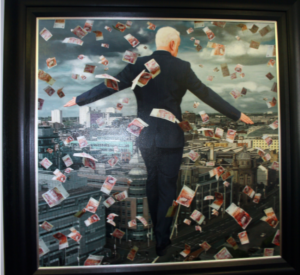
Stephen Docherty is walking a tightrope high above the streets of central Glasgow. They glisten in the evening light after rain earlier in the day while dark clouds fill the sky above. Docherty’s arms are outstretched for balance while all around him money is floating in the air. It is unclear whether these notes are falling or rising.
This image is not a dream. It is a picture that has been painted by well known Scottish artist Gerard Burns and it hangs on the wall of the chairman’s office opposite the desk where Docherty sits to work.
He is not one to sit for long, leaping up to walk around the factory on the floor beneath or into the adjacent office shared by others in the management team, including Bell & Bain managing director Karen Baillie. She has her own portrait by the same artist in which she is wearing leopard pattern shoes and is unfurling an umbrella having emerged from one of those Glasgow buildings or is furling it because she is going inside out of the rain.
Both portraits came about after a chance meeting with the artist at Parkhead, home to Celtic FC. Docherty is an enthusiastic Celtic supporter, following the team around Europe being one of his few indulgences. And it turns out the artist is just as committed a fan. Says Docherty: “He explained that he would like to get a book printed. So we offered to print it for him.” That led to the start of the Bell & Bain art collection, he laughs. It may not collect art, but Bell & Bain certainly prints books.
The factory is testament to that. It is not a distinguished building with welcoming reception with comfortable seating and samples to engage visitors. Instead a narrow passage leads upstairs to a series of offices, including the chairman’s, and through a door into the hectically busy factory beyond. In the run up to Christmas this is to be expected, and it is compounded this year by the need to hold as much paper on site as possible.
Consequently pallets of paper enclose every press at Bell & Bain. It is a necessity. The book printer has a vast appetite for paper particularly at this time of year. The company buys directly from the mills, paying on the nail and gets what it needs as a result, even if this can lead to storage issues.
The variety of work flowing through the Glasgow factory covers the education and academic books that Bell & Bain has long specialised in, but also children’s literature, illustrated trade and specialist titles, sectors where its reputation is growing fast. Many of these books will find their way to homes across the country as presents to be wrapped and placed beneath the Christmas tree.
Most are perfect bound, many are case bound and there are those that are section sewn. The cases are made in house: there is foiling and laminating in place. In short it is the total package for an expanding roster of publishers, many recent converts to printing in Glasgow.
“The shape of the business has changed so much. We have now worked for every major publisher in the UK and US,” says Docherty, “and are printing for them. And we hope we will be doing this for a long time to come. We have taken on so many new customers in the past year we must have impressed a few of them.”
When lockdown first hit, like others, Bell & Bain was faced with cancelled orders, quickly turning into a glut of business. “We had a slow start, a huge middle and a reasonable end to 2020,” he says. Sales for the year were around the same level as the £17.3 million achieved in 2019. This year the company is on course to record sales of £20 million, currently recording sales above £2 million a month. With the investments in 2020, the company has capacity for £25 million in sales and should achieve that in 2022.
At peak demand, Bell & Bain was sending some work to J Thomson Colour, the quality commercial printer that was acquired in 2019. At that time Thomson’s work had vanished so the overspill was welcome. Commercial work is now returning. But the tie is still strong. “We use Thomson’s for printing coffee table books,” says Docherty.
It is a long way from printing for academic publishers where Bell & Bain built its reputation. “That is our DNA,” he continues. “I never thought I would ever print a book with a bird on the spine.” Yet Penguin Random House is there among the other majors along with the full set of academic publishers and the specialist publishers like the UK Hydrographic Office.
These sorts of heavy pagination academic and austere information based tomes were what Bell & Bain cut its teeth on in the modern era. Runs are too short to send the work overseas and a premium is placed on their binding because of the paginations.
Then came installation of a first long perfecting press, and the move into colour printing, initially for its existing customers and gradually for trade illustrated titles. A book on pop sensations One Direction was followed by thousands of copies of Tom Kerridge’s cook book and the Dogman series of children’s titles.
“We do lots of the Dogman books,” says Docherty. There will be an inevitable spike for Christmas. Alongside there are the red covers of casebound children’s titles produced for Simon & Schuster ready for packing.
This year Bell & Bain is printing the tie in title for the BBC’s Countryfile show (and the programme’s calendar). There is also an illustrated history of England’s football team, which gets a hard cover and will surely be a present opened by grandsons and daughters, nephews and nieces on 25 December. It is the sort of work that, in its heyday, Butler & Tanner would print.
“Bell & Bain is a true book printer,” says Docherty. “Perhaps the UK’s only remaining true book printer. We have the large format presses, the different binding styles, the foiling, the lamination, the embossing all in house and we produce everything quickly.”
Compared to a turnaround and delivery time of several weeks for books printed in the Far East, even before recent supply chain disruptions, this is welcome news to publishers having to manage demand and inventory.
Docherty reckons that production of a book will take three days, start to finish in the factory.
This is as much a practicality as a strategy, because there simply isn’t the space for work in progress, for pallets that have to wait their turn on the folders or binding lines. A big reason for the company’s success is that no machine is ever left waiting, whether for plates or for work, Docherty points out.
As soon as one job is finished, the plates and paper are ready for the next job while the printed sheets are on their way to the folders. At the same time covers will be printed on the ten-colour Heidelberg Speedmaster XL75 – the only non Koenig & Bauer press in the plant -– and any cases will be produced ready to run when needed. Bell & Bain cuts its own grey board for cases, thanks to a serendipitous decision to invest in a board cutter. At first it seemed an indulgence, now with grey board of any kind, let alone sheets cut to size, like hens’ teeth, that spontaneous decision seems far sighted. “I’ve found that I’m cutting sheets of board when others can’t get boards delivered,” he says.
Part of the success is about the policy of continuous investment. Two new Koenig & Bauer Rapida 145s arrived last year. It might have postponed the installation, citing the uncertainty caused by pandemic. Not for Bell & Bain.
Any delay was more about the logistics of installation and the location for the presses than concern about the future. Docherty had wanted the machines installed in a new 6,000m2 factory. The deal had been agreed with the agent, but a late change of direction meant that the sale was no longer in the agent’s hands. Hence the new presses are installed where they could be fitted in in the Thornliebank plant. The eight-colour replaced the first colour press, a Rapida 130, the four-unit machine, configured as a two-colour perfector, is additional capacity and sits behind its wall of paper in an extension to the main plant reached via a ramp from it.
Funding for the investment was arranged through Close Brothers Asset Finance which had been involved in the previous investment round. Close’s senior relationship manager Nick Aust says: “Given our strong working relationship, it made sense for us to work together with them on acquiring these two new presses. They know what they want to achieve, and have clear goals; being their financial partner continues to be exciting, and dealing with them remains a pleasure.”
The new presses bring a big leap in productivity. “We are getting a 30% jump in productivity with the Rapida 145 over the Rapida 142, thanks to a six-minute makeready and faster running speed,” he says. It amounts to 10,000 32pp sheets on the floor an hour he continues, which when combined with other presses on site, gives Bell & Bain the capacity for 1 million A4 pages an hour.
Docherty points out that the machine is ecologically sensible too: it draws the same power as a B1 press with the same number of units, but delivers twice the number of pages per sheet for that power.
The company can print litho down to 200 sheets very economically thanks to the large format and automation it offers. Below that it has a Ricoh VC60000 continuous feed inkjet press. “The Ricoh is doing fantastic work,” he says. This was not always his view of earlier experiences with digital printing. He is not in a hurry to expand digital print capacity, unless a next investment becomes a wider and thus more productive inkjet web press. It would be something that puts more blue water between Bell & Bain and other printers. A litho web press, however, has been a consideration to take Bell & Bain into the market for longer runs.
Last year’s investment is already pointing in this direction. The speed, the level of automation and control that the new long perfector offers opens the way to longer run jobs, at a time that publishers are considering repatriation of some of this type of work from China. It is one reason for the company’s rise in popularity with the big publishing groups.
“We are still looking at other premises,” Docherty explains. “We had hoped these new presses would go to a new site. It did not happen but that might not be too far away. A new binder is not too far away either, and we are looking at high capacity folding.”
Bell & Bain had hoped to migrate to digital-only job tickets this year, though that will now take place with further automation next year. “That will take us to the next level. We have already filled this factory a year earlier than anticipated,” he adds.
“We have to learn how to cope with longer runs,” Karen Baillie adds. “It means more work in progress, and means more automation.”
It will put further pressure on the structures at the business. “We have a fantastic management team,” she adds. Many, like Baillie and Docherty, have grown with the business, starting as apprentices. The company has an enviable reputation for taking on and training youngsters and providing youth with opportunities to run the latest technology.
Five youngsters have just started and will be joined by 15-20 more apprentices over the next 12 months. A teenager is running the new Kolbus DA270 case maker, another is in charge of the casing in line. The youngsters are trained well and are given responsibility and respond as a consequence. It means too that there is constant interest from other printers trying to poach staff. “Others are always trying to take people from me,” says Docherty. It is a practice that he does not condone.
On a lightning tour around the plant staff react positively to the arrival of the chairman and his unasked for advice. They have learned to keep everything in its right place. If not, it will be pointed out. “During the pandemic we fed everybody with a roll and hot drink every morning,” he says. Then in July everyone received a £500 bonus with the same amount promised before the end of the year.
The accountant might wince, but Docherty prefers to reward the staff rather than spend on a yacht or membership of a top golf club. It’s not his style. “It’s not the way we were brought up,” Docherty says, mentioning Baillie. “This was a big decision, but it was the right thing to do.” There will be a drink, perhaps with his son who works at the business, on a Friday night, but little more extravagance – Celtic football excepted.
“I only took two days off in the last year,” he says. “Where would I go?”
Instead the focus is on developing the business, ensuring that the people and equipment are performing to their peak. When the existing Hoerauf case makers started to cause production problems, Docherty was fast to act.
The Kolbus DA270 was purchased without the benefit of a factory visit or even to see one in operation at a customer site. Instead Greg Bird, who in charge of sales at Kolbus had for years tried to interest Bell & Bain in a perfect binder, found himself supplying a case maker that was needed fast. Within a week of it arriving the machine was commissioned and training underway. “It has been a game changer,” says Docherty.
That applies to the new presses. Arriving mid year there has been no chance to judge their longer term impact. “With them in place for the whole of next year we will finally find out what this plant can do,” he continues.
Capacity can be increased if necessary by changes to shift patterns, not by overtime. This year the company has coped well and despite supply chain issues and Covid it is only a few days behind schedules, which compares extremely favourably with book printers shipping from the far east or even from mainland Europe, both hit by distribution challenges.
“This is a well oiled machine,” he says. It means that waste rates are microscopically small. “There were 21,000 sheets spoiled through the whole of last year, a rate of 0.01%. That is our traditional level of waste.”
It is helped by the honesty that the whole team lives by. If the company cannot deliver it says so. Though the additional capacity means says Docherty “that we are more in charge of what we do than ever before. We do feel really guilt at saying No to a customer, but we will if we know we can’t deliver.
“We have given money back to customers because we have found a better way to do things that saves us time and money. The customer should benefit. we don’t want to be making lots of money at the customers’ expense.”
However, even a well oiled machine can become gummed up on occasions. “And if we have a fault, it’s about communications with customers when it’s not going correctly. We have to realise that somebody at the other end just wants to know what’s happening.”
What is happening for Bell & Bain in the next year or two will be more of the same in terms of continuing investment as the company looks to tap into the potential for longer run and bigger jobs.
“There will be investment next year for sure,” he says. Exactly what that is, Docherty is not disclosing. It is part of the constant search for performance and to make Bell & Bain and its people secure.
The chairman himself is thinking about that legacy. “I want to be out of here when I’m 60,” he says. “I will definitely leave people with a lot of room to make improvements.” He doesn’t say if his portrait will be coming with him.