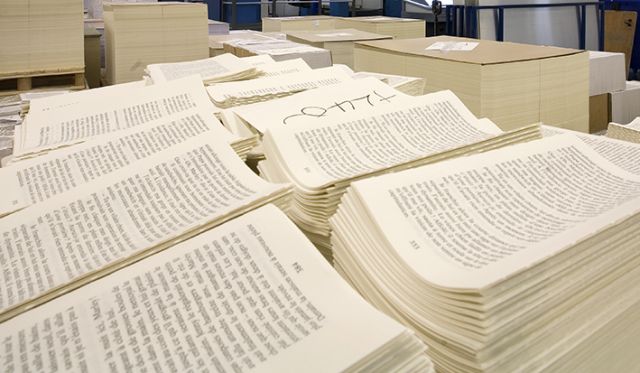
Boy wizard Harry Potter played a key role in the publishing industry’s first step into sustainability. In 2008, author JK Rowling refused permission for a Finnish version of the final Harry Potter book because it would not be printed on FSC paper. She had insisted on the chain of custody certification in all territories where the book would appear, leading to the 16,700 tonnes of paper ordered for the US edition to be certified FSC, at the time the largest purchase of FSC to be used in a single print job.
Roll on almost 15 years and there is no Harry Potter story to insist that every book should be assessed for its carbon content, but every publisher is taking further steps on the sustainability journey. The industry’s trade body, the Publishers’ Association, has issued Publishing Declares, a statement of intent highlighting how members can support the global effort to keep warming to 1.5ºC, “to achieve net zero as soon as possible and by 2050 at the latest”.
The five-clause pledge follows the establishment of a working group embracing 30 business along the publishing supply chain in February 2020, guided by work from environmental consultancy Carnstone Partners.
Other parts of the pledge commit those signing it to using sustainable materials and processes, making use of recycled materials; to translate the climate aspirations and commitments into tangible action; to empower colleagues to become climate literate and to “use our expertise, platform and voice to raise awareness and drive positive climate change wherever we can”.
It has been signed by 39 businesses at the point of launch, including CPI Books and Clays, and now has 64 signatories from the largest publishers, including the likes of Thames & Hudson, Nosy Crow, Hachette, Bloomsbury and Simon & Schuster. All will need to rethink commercial decisions to print in China if they wish to reduce the carbon footprint on books sold in the UK.
CarbonQuota has done some work on measuring the carbon footprint of books, comparing production in the UK with China, the US and Poland. This measured the impact of paper, ink, printing, glue, distribution, storage and end of life. It concluded that the carbon footprint of a book produced in China is 50% higher than one printed and sold in the UK. While distribution is a factor, the major impact is in printing, where the UK leads against its three rivals. China and Poland have the same impact, while the US is below these two, but above the UK. Paper used in China has a higher carbon footprint than the grades used in the West which, being the same papers, have the same impact.
The pressure will be on publishers to cut emissions associated with their books: according to a YouGov survey commissioned by The Carbon Trust, 67% of consumers think that carbon labelling is a good idea, and 64% think more positively of a brand if it reduces the carbon footprint of a product.
The pressure from consumers has prompted the major publishers to make their own commitments to decarbonise and to announce sustainability policies. Simon & Schuster declare: “Simon & Schuster UK Ltd recognises our environmental and ethical responsibilities and we are committed to safeguarding a healthy and sustainable environment for future generations, as well as ensuring human rights violations do not exist within our supply chains.”
In today’s business climate the consequences of being found to be supporting business with poor human rights records are not worth considering. The emphasis with reference to book production is on responsible sourcing of paper, stressing its participation in the Book Chain Project, which has its emphasis on employee standards and, secondly, environmental performance. Carbon is not mentioned.
In contrast, Penguin Random House has been open about carbon objectives, aiming to be climate neutral by 2030, it says. In its 2019 Creative Responsibility report, the publisher pledged to reduce its carbon footprint during 2020, having cut the 2018 figure during 2019. This was thanks in part to a key printer switching to renewable energy sources, so cutting the carbon footprint by 11%. Print accounts for 33% of the total footprint of the publisher.
Earlier this year, Penguin Random House published a more detailed sustainability report with declarations from the lofty (“We will use the power of our brand, books and authors to amplify the climate emergency and encourage positive behaviour change”) to the more specific, such as creation of a sustainable production toolkit that will be rolled out through seminars to all relevant staff by the end of this year.
It also promises to publish a verified carbon footprint by the end of this year. By 2023 it will be working with only best practice printers and will target a 25% reduction on carbon footprint from print and paper by 2025. Its mono papers are sourced through Holmen, which, thanks to the energy mix in Sweden, has a lower carbon impact than using recycled papers.