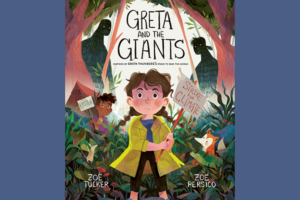
Children’s books have been one of the most active sectors of the book market in recent years, but also a sector where Chinese printers dominate. In some parts of the sector there is little choice – popup books and board books for example – but in other parts there appears little reason why books should not be produced closer to home, especially when those are stories with an ecological theme or are about climate change.
“I feel there is some hypocrisy in that,” says Gracie Corr, director of Dorset publisher and bookseller Little Toller Books. “We need to a call to arms to change attitudes.” She created a minor storm through reports in the Bookseller at the end of the summer when she called for children’s books intended for the UK market to be printed in the UK. She gained support from other small publishers, but not from the majors nor from authors, perhaps because, she says, that would put them in an awkward position. They want to sell books.
“But nobody is looking at the bigger picture. Publishers should take some form of responsibility in the communications that have with their authors. If it means that books are a little more expensive, that’s a decision between the author and publisher.”
The challenge will be finding the capacity in the UK. It exists for narrative books for older cohorts of youngsters. Clays, for example, delivers thousands of books and was printer of the Harry Potter titles for Bloomsbury Publishing; Bell & Bain prints the hugely popular Dogman titles. “If Bell & Bain can print thousands of books in the UK at a suitable cost, why can’t others do the same?” says Corr.
There is, however, a problem with colour and interactive books. Popup books used to be a speciality of Carvajal, a printer in Colombia, with some production of these by Artia in Czechoslovakia during a period lasting into the 1980s. But the hand work required has forced production to lower cost economies, particularly China. There is no capacity in Europe now. Nor is there capacity or inclination to produce board books for very young children that are more inclined to eat the book than to mentally digest what’s written on its pages.
Intergraf wants these books to be produced in Europe and is investigating how this might happen. “Board books involve lots of hand work, so are produced in China,” says Intergraf director Beatrice Klose. “We think there’s some capacity to print them in Italy and perhaps some in Germany. We met one printer at the Frankfurt Book Fair, but he said he didn’t have the necessary machinery and that customers will not pay to have the books produced in Europe.”
Then there are some of safety regulations around this type of book that don’t exist for other publications, which are needed when the target audience is too young to comprehend the purpose of the book.
While robotics and smart machinery might overcome some of the hand work issues, the health and safety aspects will act as a further barrier because these books are treated as toys.
This was simply too much for one printer that Klose spoke to. Intergraf is trying to encourage European authorities to fund research into the application of robotics and digital production to these books. The lever would be mitigating the carbon footprint incurred when printing in China, though there is currently scant data about carbon footprints of any book, let alone specific types of book or individual titles.
The environmental policy statements that the major publishers have issued do not outline plans to change how and where they print. Rising costs in China and delivery issues may have as great an impact.
This was driven home earlier this year when the Evergreen container ship became wedged in the Suez Canal. Among the thousands of containers on board was one with the latest children’s book from illustrator Oliver Jeffers’ There’s a Ghost in the House, published by Harper Collins Children’s Books.
The book was scheduled for publication on 14 September, but missed its slot because of the delay. It was intended as a tie in for Halloween, having ghosts printed on translucent paper to appear and disappear as a young reader turned its pages. Fortunately the title reached bookshops for a launch at the start of October, in time for the sales slot. It was a close run thing. Could the book have been printed in Europe to avoid these risks? Harper Collins Children’s Books has not commented.
The major publishers will find it difficult to bring all production, especially of colour books, back to Europe. Text heavy titles for older children can and are produced by the likes of Clays and Bell & Bain, where chairman Stephen Docherty points to the capacity challenges that the industry faces in this sector. “Trying to case bind a 64pp book is very hard,” he says. “Thirty years ago we would have had the machinery set up. Today we are just starting again – expectations are higher and we can’t do all of it.”
Thirty years ago the UK had a plant that was indeed dedicated to this style of book: the Lutterworth Press, which specialised in Ladybird Books. Lack of investment and a change in fashion as this style of book was no longer in demand put paid to the business.
Other childrens’ titles are being printed in the UK, led by new styles of independent publisher, some from the book trade as executives with larger businesses or as booksellers, some from people who feel that they can write and illustrate a new The Very Hungry Caterpillar. Corr is among these and has used TJ Books for books published by Little Toller Books.
If the independents can do this, why can’t the large publishers? “Many of the latest children’s books are about cleaning up the environment. I feel that there is some hypocrisy in printing these in China. This is why I issued a call to arms for UK publishers in the Bookseller. There is support, but not from the bigger publishers.
“I feel that publishers should take some form of responsibility in communicating with their authors to ask them if they would prefer their books to be printed in Europe. It might make the books a bit more expensive, but this is a decision that publisher and author should take together.”
Typical in this regard is a book that was shortlisted at the recent British Book Design & Production Awards, Look What I Found in the Woods by Moira Butterfield and Jesús Verona. What makes this a little more galling, certainly to Corr, is that it is published by Nosy Crow and carries the endorsement of the National Trust. “Books that are about climate change ought to be printed here. Some have travelled way too far. The big publishers should be investing and supporting the UK printing houses.”
All book printers have been investing in recent years, many in digital print technology. From the west, TJ Books has installed additional Canon Colorstream and cut sheet Varioprint IX320 inkjet presses; Short Run Colour has a new Komori, Henry Ling has installed the UK’s first Canon Prostream 1000, Severn has both a Canon Colorstream and two sheetfed Canons; CPI Books has a new facility at Bognor with Canon Colorstream; Hobbs the Printers has a new Screen TruepressJet 520HD; Halstan Press is another with the IX300; Bonacia has recently installed the same machine and Clays has ordered a Manroland Web Lithoman for installation next year. Add in two large format Koenig & Bauer machines at Bell & Bain, expanded perfect binding capacity and a greater commitment to book printing from commercial printers. The precise line up of capacity for printing books inside Amazon is not publicised. It amounts to ongoing investment in UK book production capacity.
This is all about providing a print on demand capacity for publishers, based on minimising the risk of substantial remaindered and unsold books each year and the cost of keeping these in a warehouse. As supply chains from China become more uncertain and expensive (the cost of a shipping container has risen five fold in only a few months) and as Chinese printers face increasing wage bills, there is greater inclination to keep production close to the point of need. The gap in the cost of printing is narrowing, quality is not a decisive factor.
Another factor that has had an impact is Covid itself. Mike Heaton, the managing director of Ex Why Zed in Colchester, says: “We have picked up a lot of work that had been printed in China because of concerns about the health risk. And because people want to keep production in this country.” This includes requests for board books, which are not feasible. Other children’s titles are though, both self published types and those for corporate clients. The company offers more than just print from PDF for these customers. He relates how the company stepped in to assist a tech start up that had a conference in Manhattan and had sent the job to a printer that had let typos slip through. Ex Why Zed did not. “We are 100% accurate,” Heaton says. “Our largest children’s book publisher was printing in China and we have now printed close to 100,000 copies for him because we can respond faster.”
Meat and drink, however, are the smaller businesses “who are excited to get their work into print. It’s about treating these customers with respect. A lot of the industry is antiquated in customer relations. We take a different approach and always have,” he says.
Flexpress has a similar approach. Managing director Steve Wenlock says that with the start of pandemic and lockdowns when it put staff on furlough, there was time to consider its future. “During the pandemic we pretty much put all our eggs into the books basket. We looked long and hard at everything we did. Before the pandemic, saddle stitched booklets was the fastest growing sector, but that almost fell off a cliff, while demand for perfect bound books was more stable.
“Books have been through the ebook and digital phase and are still growing. We realised it was something that we could do at a decent price.”
The company had invested in the UK’s first BQ500 perfect binder and is in the process of upgrading its case making equipment, having come through the steep learning curve. “And we are still a minnow in the books market compared to those that have been in it for a long time. It took time to appreciate the size of the book market, for example. It is huge. And we have come to appreciate that the bigger the printer, the less interest they have in the small jobs. There is a market about the large volume jobs and the market that consisted of the one-off jobs.”
It is the latter that Flexpress is targeting. With B2 Indigo, SRA1 RMGT litho presses and the scope of its finishing options, Flexpress can tackle most styles of book. Many are coming from new customers that have little or no experience of specifying print for a book. “It’s people that are writing books about their experiences or their expertise – perhaps cook books, perhaps stories about travel. It’s about leaving a legacy, telling their story with a book that’s nice to pass on. It’s the JR Hartley effect,” says Wenlock.
“When a book is nicely done and nicely presented that applies to us too, especially for case bound books. We can feel pride in what we do and we know that the customer will also feel proud because it’s their book.”
When Wenlock considers a next investment for the Leicester company it will be with book production in mind. Short Run Press in Exeter did the same earlier this year with investment in a five-colour Komori Lithrone G540. “We have seen some children’s books coming back from China,” says managing director Ron Gliddon. “These are the more straightforward books – those with extra features are still difficult for UK printers.” Those are the titles that require difficult substrates or hand finishing, which are labour intensive.
However, with the push to buy local, Gliddon expects that the trend to repatriate book printing will continue. “It’s been flowing for quite a few years as run lengths have come down and the cost savings in China are no longer as dramatic as they might have been,” he says. The tendency for publishers to decide on run lengths later in the day will also play to the advantage of the UK printers able to turnaround a book faster than a Chinese supplier. Conversations about projects for 2022 are already underway he says.
The rapid response that is possible from domestic production is becoming increasingly important to publishers. Bloomsbury Publishing’s chief executive Nigel Newton reporting on the interim results, said: “During the first half, we successfully mitigated print supply chain challenges. This included earlier printing, well in advance of our usual peaks in the run up to Christmas and the beginning of the academic year in the autumn. Other measures taken included agility about where we print.
“During the first half, these measures enabled us to make earlier print sales to customers, well in advance of our historical peaks in the run up to Christmas and at the beginning of the academic year in the autumn. Retailers and online booksellers significantly increased stock levels over previous years to ensure they have sufficient stock for Christmas given the supply chain problems.”
Bloomsbury had also decided not to delay the launch of a new title for Super Thursday events in October, when books for the Christmas season have, by tradition, been launched. This helps with the publisher’s cash flow, and also eases pressure on its supply chain.
That is becoming increasingly digital, at least for books outside the trade publishing operations, children’s titles included. This is where digital printing has a major role to play, and has driven investment across the UK. And increasingly this is including colour as well as mono pages as sheetfed and continuous feed inkjet improves in quality, if not as yet cost.
Halstan Press has noted that its Canon IX300 enables colour and text to be combined on the same page, opening the way to different styles of book without litho printed colour plate sections that need to be produced separately from digitally printed text.
Henry Ling concurs, having added the UK’s first Canon Prostream 1000 this year. One of the key reasons for the investment, says managing director Helen Kennett, was that “existing customers were looking for a higher quality and wider substrate choice for lower run work and we knew it would enable us to enter some new markets and we have used it for some more commercial type of work.
“We are talking to book publishers and many are looking at the feasibility of reshoring.”
The quality and ability to cope with a mix of work is also there for Hobbs the Printers. It has installed the Screen Truepress 520 HD for both book and commercial print. “We have seen some work coming back from the far east,” says Graham Bromley. “Suppliers out there are not as competitive as they once were and with the supply chain disruption we have printed work that was due to be printed overseas and we have produced work that would have been printed in Europe because of paper supply issues.”
The company is careful to spread its risk across multiple publishers, and has struck a partnership deal with TJ Books. It is not a formal arrangement but a way to increase the scope of what each can offer. “We are both companies that have great experience in their business and have been doing it for a very long time. We have complementary skills that we can combine. There is not much of an overlap between us. It is working very well and we are sharing technologies and knowledge: they do some things differently to us, some things perhaps better than us. There’s value in the partnership beyond any disaster recovery.”
TJ has long been a Canon house with cut sheet mono and now colour and continuous feed inkjet. Hobbs had tested the inkjet water before deciding that for colour Screen was the solution. “We work in a variety of markets so we had to have a solution that would print on a variety of papers, litho and digital. It is a fifth generation machine – and the best installation we’ve had by nine miles.
“We have tracked their offering for quite a few years, running tests that didn’t quite meet our requirements – we are very cautious as a company. Now we are very happy with what this has done.”
Printondemand Worldwide is equally happy with the choice of its Screen Truepress 520 HD. It runs inline to a Hunkeler with binding and trimming on a Muller Martini Vareo and Infinitrim.
Managing director Andy Cork says that the past year and a half has “been a bit of a roller coaster. Turnover fell by half for three months, and we reduced the staff by half. Then as turnover has increased to where it had been we haven’t needed to replace all the staff.” The technology has been revised to automate job handling still further.
And for publishers that are interested in sustainability, Printondemand Worldwide has a carbon calculator which can produce a precise calculation for the carbon content of every book and how many trees have been planted to offset that carbon. “And publishers can actually see their trees growing,” he adds. Publishers are asked for a 25% contribution to the cost, “just pennies”, says Cork, with the printer funding the remainder. “We are carbon neutral as a business, from shipping paper to use, to dispatch, currently recycling 95% of waste we produce and using solar panels for one third of the electricity we use.”
But speed and digital print is what is driving the business. An order placed by 2pm can be out of the door by 7pm he says. “We are also producing more personalised books,” he says. “I never thought we would be able to handle the number of orders that we get for personalised books where the book has to be shipped on the same day.”
The personalised book of this nature has become a growth sector for the children’s book sector, led by Wonderbly’s Lost My Name, keeping digital presses at Charlesworth and Pureprint busy. Other publishers have come into the market for children’s books as well as expanding the concept into different types of title.
This style of publication simply cannot be printed in China. In many respects this is where photobooks and literature cross over, hence plans by Precision Proco to make its Dagenham factory a site specialising in book production.
For equipment manufacturers the interest in book production has led to steady investment in perfect binders, case making and automation. Traditional suppliers like Muller Martini have benefitted, alongside Hunkeler, Technau and Horizon. At a recent open house in Japan the latter showed several instances of automated book production linked to cut sheet as well as to continuous feed presses.
Many were technology showcases, but like the Hunkeler Horizon set up at the new CPI Books plant in Bognor, these point the way to making it practical to bring more book work back to the UK, children’s books included. It is the sustainable approach.
Gracie Corr is about to publish the first Little Roller children’s book. It will be four-colour throughout. It is about the West Country, she says, “and it will probably be printed in the West Country.”