The transformation of Xaar is continuing with the second printhead introduced under the ImagineX rebrand now shipping.
This is the Nitrox, offering greater speed and uniformity across the head and consequently across printhead arrays, than the 1003 head that it succeeds. The 1003 remains as a legacy product and continues in manufacture.
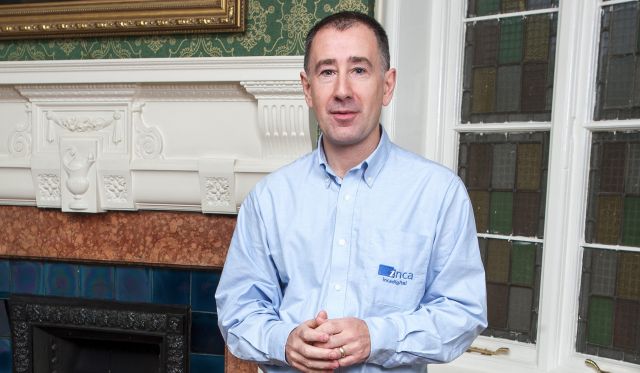
“The progress and the restructure of Xaar is going extremely well,” says CEO John Mills. “The financial results demonstrate very strong cash generation and keeps a strong cash balance and we are Ebitda positive.”
The change to a model supply OEMs and what Xaar cals Unique Developer Integrators, and eliminating the confusion caused by indirect distribution, is paying off. And the Nitrox printhead is set to reap the benefits of this shift.
The new printhead is the first to adopt a new naming convention based on the elements of the periodic table rather than a family of numbers. This would have made the new printhead the 2003, which as Mills points out, suggests a technology that is 18 years old.
As well as a step up in speed and consistency, amounting to a 40% increase in productivity, the Nitrox head is designed to be switched out and in quickly and for ease offend service. “The better uniformity and fast set up will make a massive improvement,” says Mills.
“It retains all the higher viscosity attributes and offers backwards compatibility to the 1003 for straightforward transition. It has benefitted from all the IP we have accumulated from bulk inkjet heads and from the thin film project.”
The head is already being used in large format graphics applications having been on beta trials for a while. Its ability to handle high viscosity fluids will result in combination applications where a Xaar head is used to lay down a white on a label press inline with other CMYK inkjet heads and perhaps a Nitrox for varnish application. “We can also see it being used to decorate building materials where there is some really interesting space and because the head has shown an ability to cope with rapid acceleration to be used in robot arms, to replace spray painting in the automobile industry for example.”
It is too soon to see any impact from Nitrox on the Xaar results. During 2020 revenue dropped from £49.4 million to £48.0 million, with Ebitda of £100,000 rather than a £4.9 million loss in 2019. After other costs, the company reported a pretax loss of £4.3 million compared to a loss of £110.9 million on continuing operations, which became of a loss of £14.4 million (£71.7 million loss) for total operations.
Printhead sales increased during the year, rising 56% in Asia and China, but the Xaar 3D business struggled to cope during lockdowns, both with staff unable to work in offices and with delays to the beta testing programme. As a result, Xaar has reached agreement to sell its remaining shares in the start up business to partner Stratasys. This brings forward Xaar’s exit from the business at a lower rate than had the company stayed with the business.
Mills points out, however, that the availability of the funds and cost of cash is better directed to core r&d investment. And right at the centre of this is an aqueous print head, able to address requirements in textiles, packaging and even the ceramic tiles business that had been the main driver for Xaar’s past success. “The ability to fire high viscosity means we can run inks with fewer humectants which means less energy required for drying,” he says.
The UDI model, with Xaar providing a full system combining printheads with electronics and ink systems for industrial companies to add inkjet printing and decoration on manufacturing lines spread around the globe. “We are trying to be a one stop shop provider, we can provide everything you want,” says Mills.
There will be further cost savings as Xaar quits its plant on the Cambridge Business Park for premises on the Cambridge Innovation Park, saving £700,000 a year.