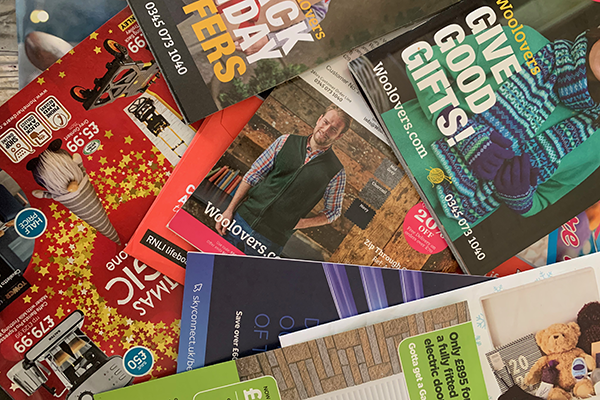
Royal Mail has inadvertently stoked controversy among the print and mailing community with the introduction of environmental guidelines for the bulk post that it handles.
In an attempt to ensure that what goes through the post can be recycled after use, it is urging customers to follow the guidelines which include a series of recommendations and requirements which specify how jobs are printed and packaged for the post. This applies to customers that receive postal discounts under publishing mail, subscription mail, business mail and advertising mail schemes and so includes direct mail, transactional mail, magazines and door drops, whether fully or only partially addressed.
And because Royal Mail wants these to be fully recyclable, it began by ruling out much inkjet print and anything printed on an HP Indigo. The guidelines have since been amended following communications between Royal Mail and HP and this clause has been removed as a provision.
These are currently only guidelines and there is no mention of penalties for customers that do not comply. However, Royal Mail is itself aiming to be more sustainable as a business and to reach net zero. What are currently recommendations may easily become regulations. Customers might then lose all or part of their bulk mail discount for failure to comply.
The revised strategy came into force at the start of this year, having been first published without fanfare in the summer. Certainly HP was not aware and had not been contacted by Royal Mail. “We want our customers to mail sustainably so we have created new Environmental Guidance that we are encouraging customers using our Advertising Mail, Business Mail, Publishing Mail and Subscription Mail products to follow from 4 January 2022,” the business says.
The guidance sets out a series of dos and don’ts in order to encourage customers to create products that can be recycled and will not cause problems in waste streams or which are excluded from kerbside collections. This includes almost all film wraps, flexo and aqueous inkjet print and anything that has been printed with ElectroInks using an HP Indigo press. A spokesman for Royal Mail says this is because “HP Indigo (Electroink) is a problem in the deinking process as even in small amounts it can cause visible optical defects (dirt specks in recycled paper).”
This reflects findings by Ingede, the association for the de-inking industry which is one of the organisations that was engaged when producing the guidance.
However, HP Indigo, following queries from Print Business, has since been in contact with Royal Mail. A spokesman says: “As a leading printing equipment and supplies company, HP Indigo cares a great deal about the ease of recycling paper and print media. HP Indigo prints can be recycled into many useful fibre based materials. Some recycling applications also require de-inking, and HP Indigo prints can be de-inked in relevant recycling applications that require ink removal. We have been in touch with Royal Mail and have made them aware of our certifications and standards.”
Two days after publication by Print Business, the guidance was amended to say “Provisional removal of [5c] (Electroinks/HP Indigo inks are not permitted)”. Conversations are said to be ongoing.
Ingede, the organisation that represents the paper recycling mills in Europe, has pointed out that according to its Method 11 process, heavy coverage HP Indigo prints are not suitable for recycling into graphics papers. In 2010 seven 20-tonne reels of recycled paper were rendered unsuitable when the recycling mill failed to prevent a large influx of paper with heavy ElectroInk coverage from a major photobook printer and causing significant damage, says Ingede. Since then no further incidents have been recorded.
As well as consulting Ingede, its spokesman says: “Royal Mail’s product team engaged with a number of suppliers to develop the guidance which promotes recycling (kerbside collections) and the use of sustainable and recyclable materials.” These are listed as Wrap, the On-Pack Recycling Logo, Confederation of Paper Industries, the British Plastic Federation, British Sealants and Adhesives Association. The likes of the PPA’s Sustainability Action Group, Wholesale Access Group, the PPA, and Strategic Mailing Partnership also contributed.
Royal Mail’s Environmental Guidance draws extensively on the PPA’s Deinking and Recycling guidelines for magazines, published in July 2019 with similar warnings about Indigo and the use of water based inkjet inks which it points out can cause ‘red sock syndrome’, and hard to recycle finishes like lamination and UV coatings.
A growing number of PPA publishers are members of the On Pack Recycling scheme, using a logo on the film carrier to show whether the plastic wrap can be recycled and if so, how.
The Royal Mail wants to encourage customers away from the use of plastic film wrap, excessive use of foil and to eliminate cover mounts from magazines and which are frequently discarded to landfill and cannot be recycled because they comprise multiple materials – a pen with plastic and metal components for example. In the guidelines there are recommendations on which glues are acceptable and which varnishes are encouraged. Pressure sensitive hot melt adhesives are not deinkable and are consequently banned, likewise water soluble glues. PUR and conventional hot melts receive a green light.
Foil should be less than 30% of the area of a page and lamination is restricted to single sided applications, though discouraged overall.
Indigo’s ElectroInk toner is not the only printing technology mentioned. Water based flexo and aqueous inkjet inks using either dyes or pigments are ruled out, because these can contaminate the de-inking process like a coloured sock in a white wash – the red sock syndrome.
Inkjet inks are only allowed if “evidence can be provided that they can be de-inked in standard de-inking plants”. There is little hard information about this and while many inkjet press suppliers have certified papers for their presses this relates to printability rather than recyclability. Fujifilm is an exception having qualified papers printed on its Jetpress 720/750 as on a par with offset inks using the Ingede tests.
Film wraps are not banned but a polywrap needs to be easily identifiable as recyclable and can be recycled by citizens through normal kerbside waste collections. Currently this could rule out LDPE which is not extensively collected for recycling by local authorities.
The rules permit the use of non biodegradable plastics and both bio derived and fossil fuel derived conventional plastics. “All plastics whether fossil or bio based which are designed to biodegrade or be compostable are excluded because of the restricted opportunity for citizens to recycle and propensity for these plastics to enter, and contaminate, standard plastic recycling streams,” says the guidance.
This means a veto on plastics that are described as biodegradable, non-biodegradable but compostable plastics and other starch derived plastics that are designed to biodegrade.
A wrapper needs to carry clear information that the wrap can be recycled using commonly understood and used logotypes, deemed to be from members of the On Pack Recycling scheme.
Paper used in envelopes and wraps needs to come from certified sources and from a mill with a recognised environmental management system. Papers with a protective laminated PLA layer are banned. Paper production must not use a chlorinated bleach. This requirement at least is not onerous. Almost all papers available in Europe will be compliant and meet the requirements too in terms of sourced from certified forests.
However, non traditional fibre sources, ‘bagasse, palm fibre, rice straw, wheat straw, barley straw, oats straw and other plant fibres”, are not permitted in production.
Royal Mail does stress that this is guidance, at least for the moment. The guidance was first published in August last year and subsequently discussed by the Strategic Mailing Partnership where chair Judith Donovan has welcomed the introduction. “I believe the new Royal Mail environmental guidance highlights a logical step forward for the print industry in their efforts to become more sustainable and meet the evolving needs of end brands,” she says.
“The SMP has had extensive discussions with Royal Mail for some time prior to the guidance being finalised and announced, as they were keen to use and continue to use our expertise in the industry to help shape and evolve mail’s sustainability position to make sure it meets the needs of customers and the overall sector.”
The new guidance replaces the sustainable advertising mail scheme which offered discounts to mailed items that complied with the environmental guidelines that were then current, extending this to subscriptions and publishing discounts and proved complex to understand and administer. Ultimately the Royal Mail might withdraw discounts from mailed items that do not comply with its guidance. That is for the future and there is no announced timetable.
Royal Mail points out “that we are not mandating for customers to adopt the specifications within the guidance”. However, the document lands at a time that the organisation is setting course to achieve net zero by 2050, to cut waste generated and water used by 25% by 2030, using a total review of purchase, distribution use and disposal of packaging and single-use resources by 2022 and to convert its entire fleet to renewable fuels by 2050 – if not possible before.
Donovan adds: “It’s vital to understand and relay the importance of sustainability. This is something we at SMP and the Royal Mail are both passionate about and are continuing to work on. I believe this guidance is an important stepping stone and through the continued implementation of sustainable and fully recyclable materials for packaging, which can be recycled through kerbside collections, the mail channel will meet its commitments to the goals of Adnet Zero.”
Despite the engagement with Royal Mail, some of the clauses have come as a surprise to those from print that are part of SMP, while printers outside the framework had no awareness of that the guidance had been published, let alone that its recommendations are potentially far reaching.
While printers are using their HP Indigos for short run direct mail work, this can easily exceed 1,000 postage packs which is where bulk discounts can begin, so would fall foul of the new recommendations.
“Royal Mail has changed the two-level sustainability discount for advertising mail into a single level of discount now, which I understand will not get if you are using UV,” says Go Inspire chief executive Pat Headley. “You can’t mix paper and plastics. It’s about being aligned with public opinion. At the end of the day this is the right thing to do.”
Now, says Donovan, the need is to make printers and users of mail aware of the changes. “With this guidance coming into effect, the SMP is currently working together with Royal Mail to develop a best practice guide, to help our clients and industry stakeholders implement new, sustainable practices moving forward.”
It is not the only way to address the sustainability issue for the direct mail sector. Pureprint has developed Puremail as a way for brands and marketers to manage the environmental impact of direct mail campaigns.
The printer is a carbon neutral production site, so any carbon emissions during production are offset. More importantly, says business development director Richard Owers, everything is completed on the single site. There is no need to transport anything for additional finishing or mailing. This can add significantly to the carbon footprint.
The impact of unnecessary transportation underpins thinking for Webmart which introduced its Enviromail product last year. This has been built around a map of every Royal Mail distribution centre around the country, something like 1,500 currently, and overlaying mailing houses and printers. The weight of the item being mailed and the specification of the print job then gives a carbon impact for each part of the journey. The figures are verified by an external agency says sales director Tom Maskill. Webmart will then offset this by twice the amount.
“We have won new business on the back of this offering,” he says. “And we reckon that 6-7 million packs have been through it since the launch in July last year. Now this works for standard door drop as well as post.
“In addition we can calculate the end of life emissions as well. If the pack is fully recyclable, the carbon impact will be much less, so we can advise customers what the impact will be if the pack is recyclable or when it is not recyclable.”
The development has proved its appeal with customers that are on the sustainability journey. Maskill points to family owned shoe retailer Pavers, which a year ago became the first carbon neutral footwear retailer and wants its marketing communications to be in line with that. “It has strong appeal to organisations with a core focus on sustainability, including the likes of Wiltshire Farm Foods and Barnados.
“At Webmart we are now working on a cradle to cradle carbon calculator for print. It will provide us with good information about where the carbon comes from.”
That impact can be mitigated by design, to make recycling easier. “Around 80% of a product’s carbon footprint is traceable to the design phase, so we want to work with clients as early as possible in that decision cycle and to ensure that the creative team explores how to design for recycling.”
It means that the thrust of Royal Mail’s initiative is correct and inline with a wider appreciation of the need for more sustainable approaches to the design of marketing campaigns.
“We are doing a lot more paper wraps for these reasons,” adds Maskill. “Design does have an impact. The wrap needs to allow customers to display their brand, which can be done with digital printing on the wraps.”
Royal Mail’s guidelines remain that water based inkjet is problematic as it cannot generally be recycled. It is understood that technology providers have been in discussion with Royal Mail on this point, but the advice stays in place for now at least.
Webmart is now planning an update to Enviromail, which has been developed in conjunction with a specialist independent body. This is a more sophisticated cradle to grave approach to cover how both print and mailing may impact the environment.
“We have run estimates for customers based on the use of regional and local distribution hubs we find that the footprint can be 20-30% down depending on which mailing centre it goes to. We know where each pack is going to, so with the expanded calculator we can work out the most sustainable way to mail and distribute.”