The day that printing died, Chris Brady, like many print company owners simply did not know what to do. The government announcement of lockdown meant work was cancelled on the spot. He went home in despair. Two days later he was back at his desk. Many had decided to sit out the lockdown, hoping that the ‘all over by Easter’ message was correct. Brady was not one of them. Print4UK was about to perform a rapid pivot, one that has transformed the Enfield digital print business.
The company had grown over more than ten years on a diet of work for blue chip clients, in retail, in finance, in legal. This vanished because London was effectively closed for business. Print4UK had always operated HP Indigo technology, most recently an Indigo 7900 with premium white clear and metallic print options. That had helped the company produce high quality print for product launches, for events, for presentations and brochures.
Its annual spend on die cutting would be £50,000. The 2020 spend on trade services vanished, and is not coming back. The company has installed the UK’s first B2 format PFI Blade cutting table from Duplo UK. However, in April last year, that was in the future.
“Everything was going digital,” says Brady. The outlook for print was grim. Its first step to recovery was the launch of Brand4UK with a range of branded merchandise for the existing customer base. It was something that Print4UK had always been able to supply, buying through trade sources, but adding a mark up could make the offer uncompetitive. Now this demand could keep the business afloat. Indeed, says Brady, “without Brand4UK we would not be here today”.
That has grown beyond the existing the customer base and has opened new doors which are now being offered print. “It was ‘How can we do something for our existing clients?’,” he says. “Print just fell off the cliff and we had to ask how we could make up for this, what we could do for our existing clients?”
The more influential change was the start of a digital and print design business under the expanding Print4 group umbrella. Lee Hedger is managing director of Navy Blue. He had returned from the Gulf where he had run a digital design agency for 13 years and had got to know Brady’s father while there. Brady and Hedger were introduced, the idea hatched and in November, Navy Blue jumped into action.
It is an arrangement that marries two very different disciplines to great effect. Hedger says: “The biggest issue that designers face is that they have to send jobs out for proofing or samples and have to wait for that job to come back. We can simply go downstairs and ask Dave on the Indigo if the idea will work or to run something out and within minutes we have the job in our hands. Other designers cannot do this.”
How effective this can be was shown when Navy Blue was involved in the website design for a new home delivery food business and working with its chosen screen brand of blue. This, says Hedger, was specified as an RGB colour and challenge to print. At this stage Print4UK was not involved until Hedger could demonstrate how, thanks to the close collaboration between the two, could translate the on screen colour to one that could be reproduced on paper, on stickers, on bags and more. Print4UK won the print work alongside digital.
That synergy is now at the heart of the reborn business. “When I first met Chris, it was clear there was a real synergy between the print and the digital side. Print makes digital work harder: five years ago the QR code was finished, now it’s integrated into the printed page and takes the reader straight to a website, linking print and digital. And the QR code can track the effectiveness of print.” Furthermore there is a growing realisation that digital is not always the answer.
“As people can get 400 emails a day, there’s too much digital noise. But if you get a piece of mail, it will be opened,” Hedger continues. “Some agencies are purely digital, some purely print. This will not work any more. Clients that we talk to will tell us ‘I didn’t think of print’.”
His job is open their minds to the physical medium. And Brady’s job is to know what can be done in print. “We get lots of clients asking us for ideas and we always try to offer them something, perhaps using silver or metallic white from the Indigo.” And now it also has the digital cutting table.
The nucleus for digital design was already there in Print4UK. It had web designers, with both simple and high level coding skills, and photography experience. Navy Blue has been able to tap into this and added the polish and vision needed to it.
It has hit the ground running, quickly picking up where print had dropped off. Brady explains that where some in the City had switched from real events, where Print4UK would produce folders and all the other collateral needed for the day, Navy Blue can do the same for an online event. The virtual version has also attracted double the number of attendees. It does not mean that print is eliminated. A printed programme for the day in front of a monitor and a printed report on proceedings can be part of the experience. Again print and digital are working together. It is a question of identifying which is best for which application.
Several months on the collaboration is clearly working. “We are getting work that we could never have touched before,” Brady says. “It’s about positioning ourselves correctly, ready for when the world starts to open up.”
And gradually it is opening up. The group is starting to produce work for customers that have been dormant for a year, though not yet to the same level as in 2019. “We think that 90% of work is coming from new clients, so that when work does start to flow back, and we know that it will never be what is was, we are ready,” he says.
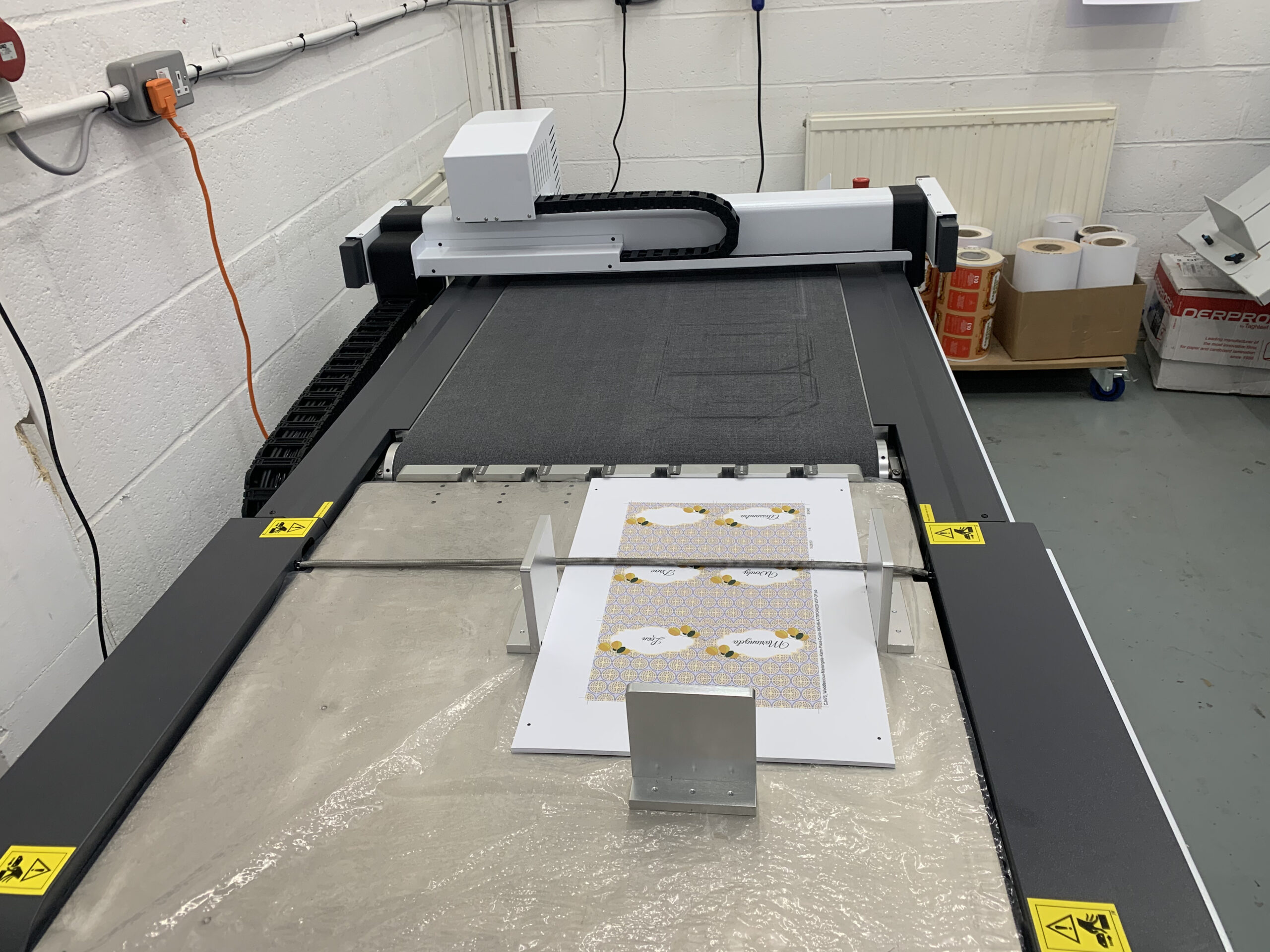
Part of that preparation is a digital die cutter that sits alongside one wall of the finishing space. This is the first of Duplo’s B2 format PFI Blades, installed in April. It will handle a lot of the work that has had to be sent out, as well as opening the way to personalised finishing and value add techniques that Navy Blue can exploit.
“We had started to look at digital die cutting early last year. Much of what we looked at was B3 in format which, while we have a two page press currently, would have been narrowing our market,” says Brady, clearly considering a larger digital press for when Print4UK moves when its lease expires later this year. Some suppliers were ruled out because of questionable quality despite an appealing price, others because of the printer’s prior experience with that supplier.
“We liked the software on the PFI Blade,” he says. This was written by the same company that has worked for Zund, so understands the requirements of the industry, enhancing the standard machine which is brought in from the Far East.
Within days of installation, Print4UK had produced paying jobs on the Blade. And it has had chance to put what is the first of its kind in the UK through its paces. Brady enjoys this. In a previous life he was the digital press minder for the beta installation of the Kodak M700 Nexpress. “Every machine we get we put to the test,” he says, “and we make it work somehow.”
The deep understanding it strives for means that its five-year-old Indigo has fewer service calls than most because it can be fixed internally. And there are fixes identified for the new cutting and creasing machine already. One relates to the delivery and a tendency for sheets to catch on each other. This should be simple to sort out. Second Brady wants to be able to adjust the vacuum strength from the small control panel on the machine rather than by having to remove the side frame. Again it ought be an easy update. “And we are waiting for an embossing tool and a wider creasing tool, that haven’t been delivered yet,” he adds. While waiting, a double hit with the creaser is effective.
He reckons that the company will be able to retain around 75% of the die cutting work that had previously been sent out as well as expanding the range of deliverable products. But not all. An advent calendar has been mocked up on the Blade to check how doors will open and the strength of the material used. But the cutting sequence takes four and a half minutes to process each sheet and the order is for 3,000 units. This will go out.
At the other extreme the machine can produce simple rounded corners for Foamex backed signage, round cornered business cards, or can cut a winder for wool without the expense needed to produce dies. “We are trying to learn the costs of it. We need to find out the running costs, what makeready is needed and so what the break even between doing it ourselves and sending out will be,” he says.
And he is eyeing further new opportunities. A website for youngsters to be able to design a series their own avatar and then puzzles which draw upon the group’s expanding capabilities to design, to print and cut print in intricate ways.