
Printers need not panic that their UV curing system is about to be outlawed under legislation to phase out the use of heavy metals by industry.
Outwardly this would affect traditional UV lamps which rely on small amounts of mercury to generate the UV energy needed to cure inks and varnishes, but almost printing receives an exemption as a litho printing press qualifies as a ‘large-scale fixed installation’. Such equipment is exempt from the EU’s WEEE directive and from the RoHS 2 directive which excludes equipment forming part of a larger machine designed for a specific purpose and which can only be replaced by the same specifically designed equipment.
This covers current and future installations of UV curing systems, including Komori’s H-UV which use mercury vapour lamps. Print is not the only industry affected. UV lamps are used in curing adhesives, to cure lacquers and to purify water by killing water-borne microbes which might otherwise pose a risk to health.
Confusion has arisen because of the availability of LEDs to generate UV and because some smaller printing machines may not qualify as large scale fixed installations. Suppliers of inkjet technology using LEDs have been quick to point out the benefits of their technology, in terms of eliminating excess heat as well as meeting the requirements of the legislation. Rollfed machines, which are generally supplied on a wheeled carriage, cannot be described as fixed, but few, if any, use mercury containing UV lamps.
Large flatbed machines, requiring a team of experts to install and remove, to service and maintain, and which remain in a fixed place, will be exempt from the legislation.
“The legislation is about the use of mercury in street or factory lighting,” says IST UK joint managing director Chris Schofield. “It does not affect UV printing. The use of UV lamps in printing as part of a larger printing press is exempt until at least 2021. If there is confusion, it is created by those who only have an LED solution to sell.”
IST provides both type of LED generating system, as does Baldwin. “We think it will take until 2030 before diodes can provide enough of the short wave UV to replace conventional lamps. Mercury vapour lamps are going to be around for a very long time,” says Baldwin vice president Pat Keogh.
Nor can LED deliver the depth or quality of cure needed in some areas of print. The technology has yet to make a breakthrough in the carton industry and many installations will use LED for interdeck curing with a conventional lamp or more in the delivery. Even on EFI UV flat bed printers, LED is used to pin the ink in place before the full cure is delivered through a mercury vapour tube.
“And in coatings, LED has a way to do,” says Keogh. “The efficiency of LED is improving dramatically. In 2010 only about 10% of the energy delivered was converted to UV light, now it’s about 45%.
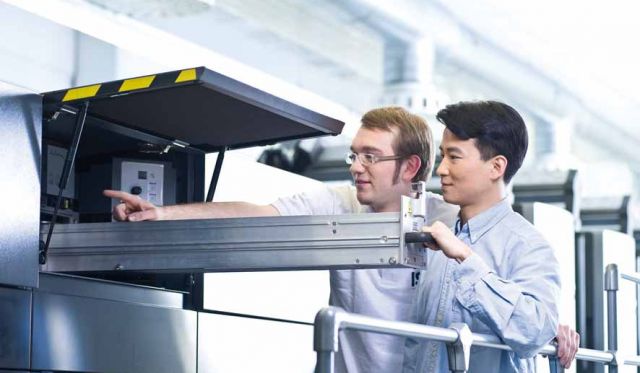
Sheetfed litho presses can continue to use mercury vapour UV lamps despite EU directives to outlaw the use of the toxic metal. Likewise larger UV inkjet machines are likely to be exempt.