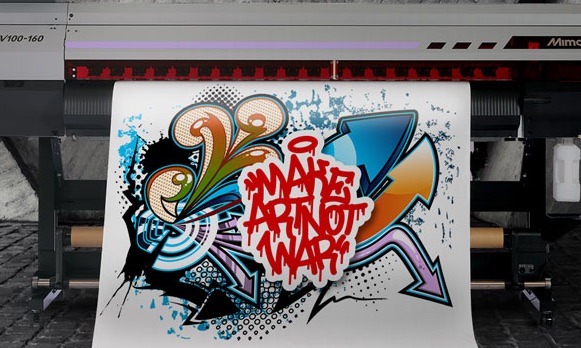
Global Graphics will supply its Harlequin Rip technology as core to Mimaki’s RasterLink 7 Rip. This will be rolled out across the range of Mimaki printers, including its newly announced JV100 160 and UJV100 160.
This is a 1.6m wide roll to roll printer that is capable of up to 23m2/hr for banners and signage applications. It has LED curing and a new inkjet, including a high opacity white. It will used to print to a wide range of materials, including films, which are protected from heat damage by the use of LED curing.
Mimaki’s choice of Harlequin as the core PDF processor in the new Rip follows hard on the heels of Mutoh announcing that the same technology will be part of its VerteLith Rip. This is available immediately on UV machines and is scheduled to become available on eco solvent machines.
The deal with Mutoh also includes the Opal advanced inkjet screens function to optimise screen algorithms for inkjet. The VerteLith Rip will also include a feature for flatbed UV printing to enable printing to objects held in a jig for gifting and personalisation.
The Mimaki RasterLink 7 Rip will highlight functionality for variable data printing, with opportunities in direct to textile and dye sublimation printing. It will also accelerate the Ripping process. Satoshi Kaneko, general manager of the Mimaki Engineering software design department, says: “There are significant quality improvements too; PDF transparency processes correctly and we have found that the expression of thin lines is improved.”
The company expects to ship more than 10,000 examples of the Rip in the next year.
As with Mutoh, the Global Graphics’ Tokyo office was closely used to tailor the Rip to Mimaki’s requirements, to match the performance of the printers and its inks. The software covers multi layer printing, the replacement of colours in graduated tints, exporting contours for cutters, and the addition of texts and graphics to submitted jobs for variable data printing.
The variable data feature uses the dynamic overlays in Harlequin which are specifically designed for those printing applications that require a simple form of VDP support. A templated background has areas that can be filled in from a CSV file using the overlay graphics function.