
Mimaki is aiming to become big in 3D printing, marketing the Massivit 3D printer through its dealer and distributor channels.
EMEA sales manager Ronald Van Den Broek explains: “It will go out through the same distribution network that handles other Mimaki products.” The difference is one of cost. The 3D GD is expected to be available for around €400,000, compared to some of the Mimaki low solvent and LED UV roll fed large format printers, which have been an entry level printer for many businesses.
Mimaki’s printers are not confined to the entry level, with powerful textile printing machines, 3.2 and 5 metre wide printers and a growing portfolio of flatbed machines, for both graphic arts and promotional products. 3D is the next logical opportunity and Mimaki has already established smaller, high precision 3D printers, but this machine has more in common with display print than additive manufacturing.
“In 3D there are two bottlenecks, production speed and cost,” he says. The new machine addresses the speed issue. A full 1.8 metre tall object is printed in seven hours. And that product is unlike the precision printed objects related to engineering and prototyping typical of the 3D printing sector. “These are very much related to the signage and graphics sector,” says Van Den Broek. “Objects that would have been outsourced by an exhibition stand provider to a model maker or artist.
“We can see an added value for our customers. We have known the sign and graphics market over the last two decades as we have been selling into that sector.”
The object is printed by extruding a gel which is UV cured at the point of printing, to build a 3D model which does not need supporting during the build, can be illuminated from the inside and decorated with a shrink film. The best colour when printed is white.
“We think we can add value and a route to market from a technical point of view. Thanks to thousands of installations, we have the network of service technicians that can offer fast service. We are not going to sell hundreds of these, but we have good access to our markets.”
The next step is to market the technology to that customer network having introduced the machine to dealers, if only though video and conference calls at this point. Already, feedback suggests that Mimaki will not have much difficulty in placing a first tranche of machines.
With an eye to the display print user base, the user interface is simplified compared to that on Mimaki’s other 3D printers. This will also suit the target customers, though inevitably 3D printing will remain more complex than 2D print, with software taking account of shrinkage values when applying film to the prepared 3D model.
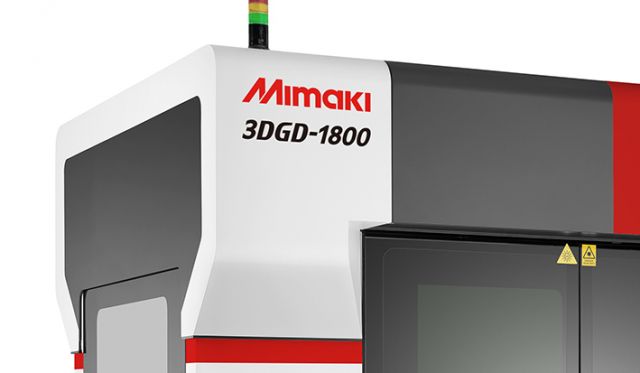
The new large format 3D printer will be distributed through Mimaki’s established network which reaches every known large format inkjet printer in Europe. The opportunity is there to expand into 3D printing as a natural extension of flat surface printing.