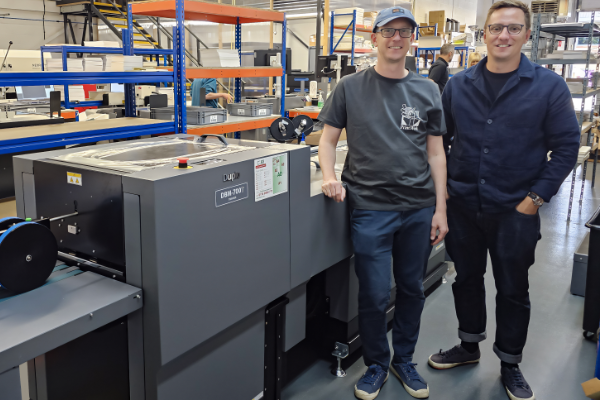
When PrintWork bought its first press, a Konica Minolta, in 2017 it was not because director Dave Rushton and Nick Goodliff wanted to become printers. It was to be entirely supportive of the web development business that the pair ran. “We were doing some print for clients in the hospitality sector,” says Rushton.
It needed some finishing equipment, choosing a guillotine and creaser, but hankered for more. When the pair went to view their choice of press. “We went for a demo and were thinking about short run digital print but didn’t know what we needed finishing-wise. I saw the DC616 in the corner and asked what it was, the demonstrator ran some business cards and creased jobs and that was the first time we’d seen this finishing done in such a way.
“We were completely blown away because it did everything that we needed it to do in one small unit that was easily programmed. We didn’t have the resources to act on it immediately but it had been in the back of our minds ever since. So we struggled on with the guillotine and creaser for about six months before purchasing the DC616 and from day one it just worked. It took all the fussy materials we could throw at it and before we knew it, it was working day in, day out.”
At that point the business was chugging along coping with 15 orders a day coming through the website. “And then came the pandemic,” says Rushton. With clients in hospitality forced to close, the young print business thought that it would need to sit out the storm. It had upgraded the multifinisher to a DC616 Pro.
A lot of people across its customer base were on furlough and used the opportunity to turn a hobby into a kitchen table side hustle. Where print was needed to support this, PrintWork was in pole position. It became the printer for creative businesses on Etsy. “We lucked out,” Rushton says.
“Tattoo parlours began selling their art in a different way, driving print orders, photographers wanted to sell single prints. We are not selling giclee quality at giclee prices, but nice affordable art.”
It was now handling 100 orders a day, all printed on papers with a strong environmental message. This includes recycled, part recycled, papers from agricultural or textile waste. These are being printed on a Kodak Nexfinity and since last year on an Indigo 7900 with additional silver and white colours.
Finishing too has been upgraded.
This has been a priority since the outset, and was one of the reasons for buying the Konica Minolta. “We have always used recycled and like alternative materials that have a nice feel and enjoy experimenting with them,” says Rushton. Papers made from agricultural waste he says hold colour well and are popular for end of year reports for farms and other agricultural businesses. The Indigo suits this market well as the flat finish on this type of uncoated paper
A first booklet maker, supplied by CJB, was a hand fed DBM150 followed by a refurbished DBM500. The first DC616 became a refurbished DC646 and DPB perfect binder. Now it has upgraded again, installing a new DBM700 with inline square spine unit after a visit to Drupa. A DC618 with integrated folder also arrived last month.
The move to the DBM700 was a big upgrade from the 2,500cph machine. “It is also more accurate and automated and produces the square finish inline. We have been adding the square finish offline and once customers have that, they can’t go back to standard stitching.” The DBM500 is being retained as a back up machine.
“Where we started with prints, these customers asked us for business cards and we are now starting to see requests for a lot more books and brochures from the same set of customers,” says Rushton.
While Etsy and others remain important platforms for these customers, there is a palpable growth in work for craft fairs where the public can get closer to the products than via a screen.
Goodliff explains: “We are now known in certain circles as the printer of choice for entire conventions and craft fairs because of our quality product and customer service. We’re always proud when walking around conventions like Thought Bubble to see a lot of our print on the stands. It is great to see our customers growing and exhibiting their products, knowing that we had a hand in it.”
The business keeps it hand in with a small number of websites, but it is not going back to go online. “We did web design for ten years, making the decision to scale back a couple of years ago. While we enjoyed it, we now enjoy not having so much client work. Now we focus on end customers rather than corporate clients,” says Rushton.
Success now brings the problem of finding new premises to cope with the growth. The hunt is on and “we’re waiting for the right place to come up” says Rushton. When that falls into place, the investment will continue. “We are going to need the space for when we move into large format.”