
“We are not a photocopying business!” says Oliver Renshaw, business manager for the University of Leeds’ Print & Mail operation, effectively its print inplant. He’s right.
The operation has been completely reequipped, an investment that needed a justification that included saving money on print, on offering a support service to students, to academics and to the commercial operations of the University and attached businesses. Given that the University of Leeds has a Digital First policy and no longer publishes a printed prospectus, convincing the appropriate authorities to support the print operation acquired an additional layer of challenge.
That Renshaw was successful is evident in the room filled with Konica Minolta presses and an adjacent room with Duplo finishing equipment. A third room has two large format printers and a mail inserter. Whatever any of the stakeholders throws at the operation, Print & Mail can cope.
“This has been the biggest ever investment in print,” says Renshaw. “It’s evidence that there is confidence from management that we can deliver the service that’s needed on campus.” That service is changing.
The pandemic played its part in this process. While volumes of print needed were decimated and staff furloughed (four chose not to return to work and have not been replaced), the print operation proved crucial to keeping the campus open and the university in operation. What it needed with investment was to take matters to the next stage.
“We are today a fully fledged digital print shop,” says Renshaw. With the investment the business has been rebranded as Print & Mail. “The Print & Copy Bureau name we used before was like something from the 1970s. Print & Mail is the right name for us.”
The Covid period proved that despite the increasing digital world that universities operate in, despite the way that Zoom and its like took over teaching during the months of social distancing, print has remained essential and its role was underscored by a review of print consumption across campus.
That is not enough for Renshaw. “Covid decimated the volumes of print we handled. We needed to think about how we could make print sexy again, so that people see it, love it and use it. That’s the rationale behind the investment.”
Or at least part of it. On a pragmatic level the department now takes charge of the fleet, the population of multifunction devices that are dotted around the various offices and corridors throughout the University.
Konica Minolta won the tender on convincing those that decided that its communications and print management software could ensure that jobs would be routed to where they are best produced, or whether they need to be printed at all. The tender though stressed that the chosen suppliers needed to be forward looking and to be able to offer innovation to the unit.
In an ideal scenario rational choices about print or digital communication would be made about what channel best meets the need. There will be a decline therefore in the print that the inplant operation has traditionally been associated with and better control over how and where print is generated to gain the best value. But also an opportunity to expand by developing different types of print, perhaps that had not been considered before.
To improve the print management side, the technology means that an individual student can find themselves locked out if there is not enough prepaid credit on their print card. The student will also be encouraged to print centrally. Likewise it is no longer possible for a professor to print out 50 pages of lecture notes for 100 students taking their course and having an assistant handle the collating and stapling the top corner. That job is now sent to the central print department where it can be both better produced and also more economically produced.
There the production workflow takes over using a series of applications appropriate for the different output and finishing devices to reduce the labour content needed. Connectivity is enabled through Enfocus Switch taking jobs from the online portals as XML files, imposing them using Ultimate Impostrip and connecting to the finishing units for set up data to be downloaded via barcodes.
“It’s about sending the appropriate jobs to the appropriate places. It stops the professor printing those copies on the machine in corridor, but to make it work, that customer can’t wait five days for us to deliver. We need to deliver within a few hours of the click to print,” he says.
It is about an open, vendor agnostic capability using appropriate applications and suppliers. Transeo Media for example provided the nous and applications headed by Impostrip to enable the operation to process hundreds of jobs a day if necessary. The workflow should not be the bottleneck.
Nor should the presses. The university specified these without inline finishing. The need was for the greatest flexibility, which is achieved when printing and finishing offline, enabling the presses to move seamlessly from one style of job to another. For example, if the job is urgent, it is not a problem to break into a longer run for the job that is needed first. This would not be easy should the press been engaged in a longer run job entailing inline finishing.
Before Covid this type of control was not possible. Before Covid too, the department operated a walk up print service with a counter where jobs might be ordered. That was unsurprisingly closed down during Covid and the switch was made to online ordering only. There are now four standing portals where different parts of the university family can specify and order print. “We had an online presence before Covid, but not many people used it,” says Renshaw. A poster on the wall advertises t shirt printing, perhaps for clubs and societies. This is no longer offered, in part because Renshaw has not yet come up with a web portal that can tackle online ordering of this type of apparel or promotional items. He will.
As happens with its other online portals, the software needs to guide users through the specification process, usually with success.
“Buying print can be quite difficult, so we went for online print ordering with an Amazon style experience to ordering print and it is working really well for us,” says Renshaw. There will be jobs where the job’s creator needs some help – an invitation designed on Canva for example in an A6 format with all the crop marks within the print area. “We get all sorts of gubbins through,” says Renshaw. “We will sort it out.
“It’s not only about print only for us. We have to show that print and and digital can co-exist. The challenge was that internal thinking across the university was that print is bad, that paper is bad when we know it’s not. They are complementary. It’s about being able to differentiate print from digital and for us that means making it tactile, produced in high quality and at speed. Now we are starting to see traction because of this.”
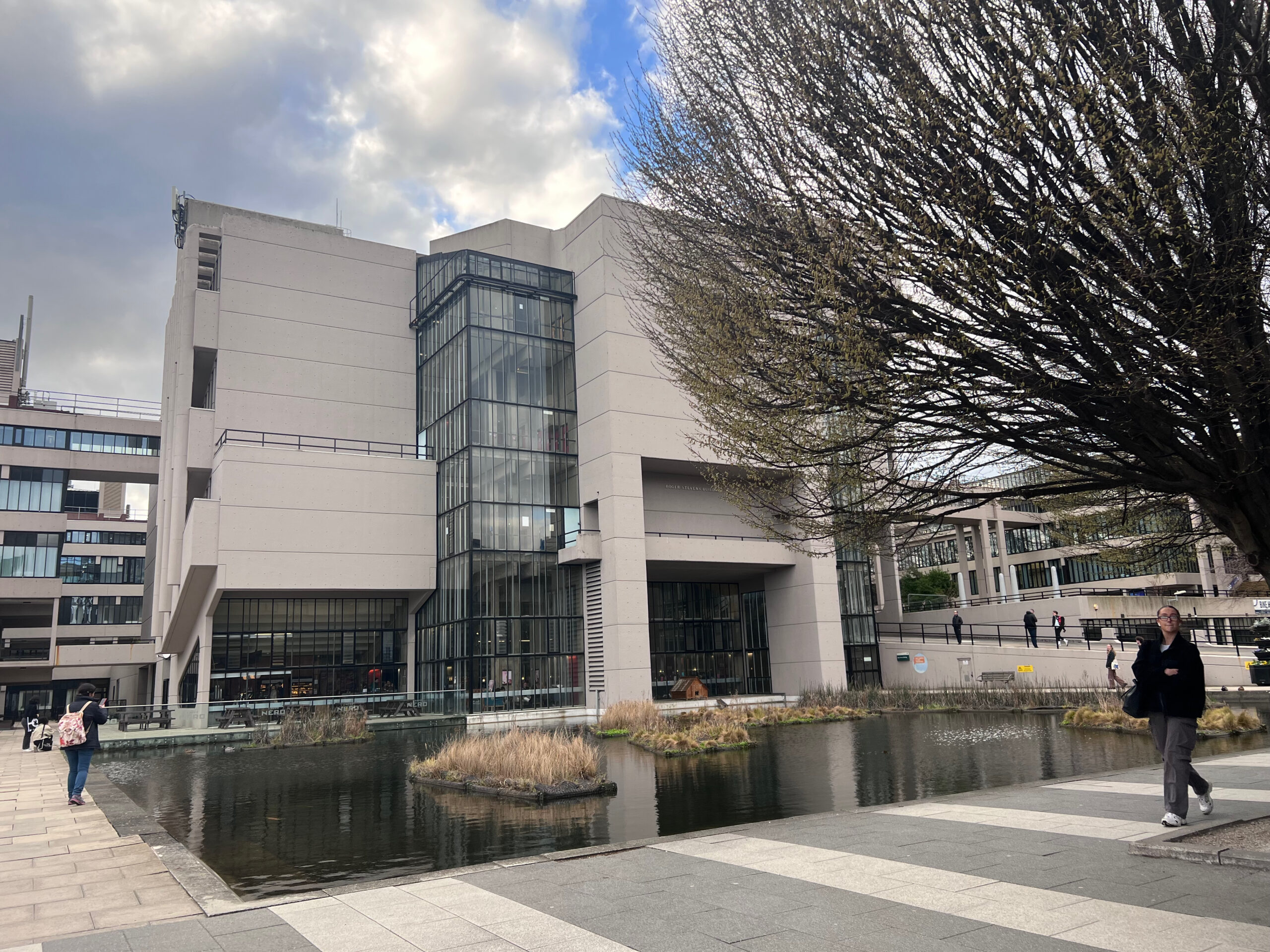
The traction is coming thanks to the department’s efforts at driving home the message and opening up to the campus world as much as possible. The operation has moved into the Roger Stevens Building where it occupies a space, not in the basement as once inplants were assigned to, but on the ground floor opposite a coffee shop. A glass door allows passers by to glimpse inside or perhaps to come in and pick up the poster that was ordered a few minutes ago while drinking coffee.
Beyond the door, the operation is in a brightly coloured if rather windowless space and parts of it are alongside the stairs if not below them, but the business knows how to maximise the use of space to squeeze in as much old and new technology as possible, it is freshly painted and also has room for a few plants in pots and is brightly lit. It is without question set up to be efficient.
It needs to be. The operation is highly automated to take the pressure off the 16 staff (four left during Covid and have not been replaced). Opening hours have been cut to 7am to 4pm with mailings going out at 7pm. “We are aiming to be more intelligent at batching jobs, automating as much of the admin as possible, using job tickets with different colours to identify the customer type,” Renshaw continues. “The difference is like night and day to how we operated five years ago. The change affects people too. We lost staff during Covid and those roles are not coming back, but we are recruiting for a front of house person.”
Four Konica Minolta presses occupy the main production room. Two are 6120 mono machines, one a C710 and one is a top of the range C12000. The latter prints the jobs where high quality is needed, for promotional literature for example; the C710 delivers the more reprographics quality print and the shortest print runs, while the mono machines are doing those lecture notes and the myriad of other jobs where colour is not needed.
Thesis printing falls into this category. Before Covid, every thesis submitted for judgement needed to be printed and a copy lodged in the University library. These were printed and bound using a Fastbind taped binding system. As a result of the pandemic, the university changed. Students no longer need a hard copy of their work, digital submissions are enough. However, students still want a printed thesis as this is the hard proof of many hours of very hard work. Moreover it is now a perfect bound product with a printed spine that looks the part. It may not be what Renshaw describes as sexy print, but it is a better product than before. “They can have text on the spine which they couldn’t before and they absolutely love it,” he says.
The investment has certainly provided the capability for sexy print thanks to the line up of finishing technology. A B2 Duplo Blade sits almost in the corridor while in the finishing area itself, a DC648 multifinisher, Matrix laminator with sleeking capability and a Duplo iSaddle cover all the bases. The capability provides room to grow being in excess of what many similar institutions would have. “The Blade and the iSaddle are making a real difference,” he says. The one can cut out cartons blanks for gift boxes for delegates at a high level conference, the standees for table decorations, invitation cards and the list goes on. The iSaddle can produce a higher quality stitched product than is possible with a standard booklet maker and offers greater scope for innovation.
“We did not want a booklet maker. There’s a productivity issue and this way we have greater flexibility in format sizes. We can do landscape A4 or 300mm square formats thanks to the long sheet capability of the Konica Minoltas. We wanted to be able to offer more than the standard A4 portrait or A5 landscaped products, something a little different. And we wanted something that would be commercial quality for print. We asked for suggestions about innovation from our suppliers in the tender and ideas of how we could push the print unit forward.”
Duplo provided some of those suggestions, as a result landing the lion’s share of the finishing equipment. It has also supplied the PB500 perfect binder, while there is also a Digifold from Morgana as part of the line up. The DC648, he adds, is “worth its weight in gold” for the number of applications it is already handling and will cope with as the operation explores its options which will be developed as the marketing of the revamped operation gets underway.
Selling that innovation is now part of the challenge for Renshaw and team. A series of open house events is planned to show the different departments how Print & Mail can help them. These will be tailored to the needs of each department and will demonstrate through samples and concepts how print can help to achieve their goals as well as improve the experience. Few, including the communications department, it seems are aware of what is possible. He pulls out a table standee listing guests seated at that table for a recent presentation dinner. It demonstrates how the operation is making print sexy. The product was cut on the PFI Blade, having been foiled with the table number and seating plan for guests in silver using the Matrix laminator.
The response was “I didn’t know you could do that!” from the event organiser who had expected something rather more prosaic. Hopefully, says Renshaw, that will stimulate further thoughts and conversations about what his operation can offer, and that other departments around the university want some of the same.
“Ninety-nine percent of our customers have no great print knowledge and do not know what is possible. We can handle anything from 100 business cards to a full corporate brochure to promote the business school or a conference,” he says. The idea is to fill that knowledge gap through better communication, through the portals to promote products and services and through showing the different departments what can be done. More is possible.
The existence of the unit is now better known to those running the design and marketing courses and they have been invited in to experience what print can do in their disciplines, so too students studying fine art that may need large format print produced. “We can invite students during the holidays,” says Renshaw.
Commercial activities are an increasingly important part of University life. The BPIF held its recent Visual media Conference at the adjacent Leeds Beckett University while the UK Real Estate Infrastructure and Investment Forum was expecting to attract 6,000 attendees and 500 speakers at the University of Leeds itself. The potential for print is everywhere.
The unit also prints for the National Institute for Health Research based in Leeds. It prints for departments chasing outside money to fund research projects where the ability to make an impression can make the difference between the contract coming to the University of Leeds and going elsewhere, perhaps outside the country.
All these events require print, just how much will depend on the event, its scale and importance. The operation will create a pop up website so that a visiting academic or their team can order print ahead of the event to drum up interest and drive ticket sales or reservations and avoiding the hassle of travelling with pop up banners, flyers, lecture notes and so on, or finding somewhere to have them produced with very little notice. It’s about creating print that was perhaps not there before,
It is what the business needs to do. Print & Mailing is no longer the University’s copy shop, but an operation that has to think and act like a commercial enterprise, albeit one that has a turnover of £1.6 million.
This would place Print & Mail in the Top 25 of university inplants in North America, let alone the UK, says Renshaw. Those are much bigger sites than Leeds which has around 38,000 students at any one time. Print is central to their life even if they are all digital natives and there is no longer a printed prospectus to browse and applications are submitted online.
“The student experience is key,” says Renshaw. And the print department is in turn essential to this. “We send out the offer letter within 48 hours of an email to that student and we print the graduation certificate. So they will get their first piece of paper from us and their last.” And many in between.

MORE FROM THE MAGAZINE
EXPLORE MORE ON PRINT AT UNIVERSITY