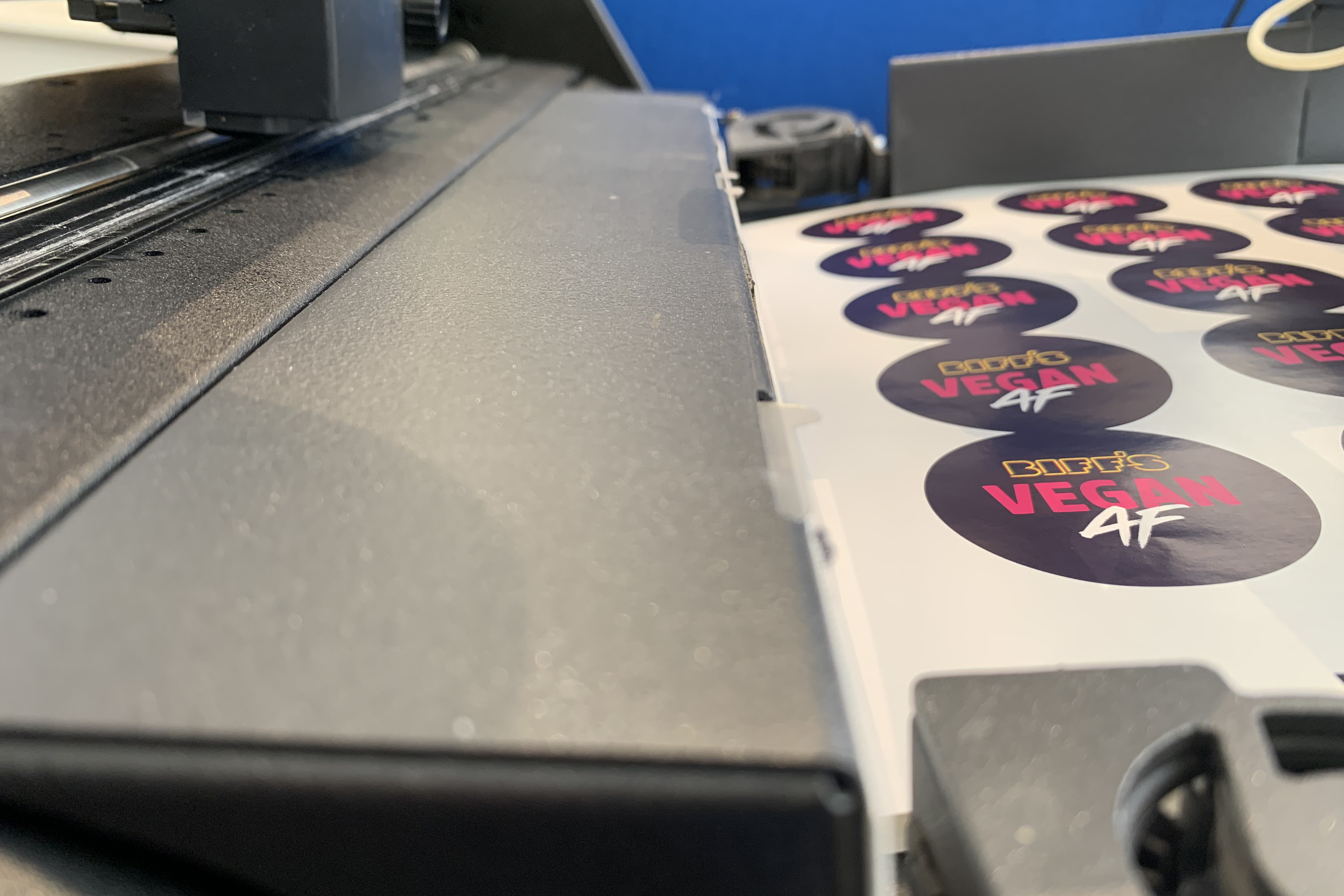
The digital cutting table, a flatbed plotter of limited format, is fast becoming an essential piece of equipment for many commercial printers. It is a relatively low cost investment that can both save money by keeping work in-house that might otherwise be sent to trade die cutters and can provide an additional service to enhance a (frequently) digitally printed job.
On the one hand these are shrunken versions of flatbed cutting tables familiar to the equipment that is is essential in large format display printers, on the other there are machines that have emerged from other industries where precision drilling and cutting is necessary.
Many of the machines come from the far east, often the same machine is sold through separate channels under different brands leaving sales price, service and software to distinguish one supplier from another. Economies of scale and large production volumes make it difficult for western manufacturers to compete. Hence the likes of Kongsberg and Zund do not have skin in this game – at least not yet. Kongsberg has recently regained its independence from Esko but will not be changing tack.
Italian manufacturer Valiani is an exception. It has a range of cutting tables for different applications with the Omnia machine as its smallest format machine for this application. Others have expanded from SRA3 formats into B2.
The Valiani Omnia has an automatic feeder loading up to 500 sheets of up to 500x800mm in format. A suction feed system lifts the sheet into position where a camera will home in on printed crop marks to register the cutting process before the finished job drops into an output tray.
The software can accept a cutting file from various applications while a QR code is used to identify and automatically download set up information for a job. It means the device can be loaded with different jobs and can be left to run unattended, provided the tools do not need changing. The Omnia will process a typical carton blank from an SRA3 sheet in 45 seconds, running unattended on material up to 10mm deep.
UK distributor is Morgana which also handles sales of the Optima cutting table, but this lacks the feeder that is deemed a necessity for commercial printers. A spokesperson says that Valiani is preparing to launch new models to expand its product range. Before then the Milton Keynes company anticipates installation of an Omnia. “This is a more robust, much stronger machine than its Asian counterparts,” says a spokesperson. It is also more expensive, though with the extra format and versatility offered, the ROI through keeping short run work that is sent out for die cutting in house or from the cost of die making, is relatively easy to justify.
The machines from China began with smaller format cutting tables, available through Intec, ICS, Duplo and Vivid. The latter uses the Veloblade name for its range while Duplo International uses the PFI Blade name.
Workflow is a key differentiating factor: Duplo has commissioned software from the same studio as developed the interface for the Zund range while Vivid uses ZipCore software with interfaces for Onyx and Caldera Rips. The software runs through a browser interface, allowing remote access to the cutting machine. This is useful for training and support, for users wanting to demonstrate its capabilities remotely to customers and for those working from home – though someone will still have to be present to load the machine’s 150mm feeder. Depending on stock this can be three hours of unattended operation. A CCD camera system picks up print marks to ensure registration with 0.1mm accuracy. A collection tray holds the finished items.
Vivid first introduced Veloblade two-and-a-half years ago, replacing the original model with the better specification of the Veloblade Volta. This comes in a number of versions from a 2mm cutting depth SRA3 model to a 10mm depth on a 1000x707mm sheet using an oscillating blade. The company has sold 120 machines in the UK, 40% at the smallest format, 50% for B2 sheets and 10% for newest and largest machine.
Duplo has also increased the specification of the PFI Blade, with a B2 version joining the B3 model. This includes unattended operation from a 100mm feed stack, 800x600mm maximum sheet cutting to a 6mm depth.
The first of the B2 machines has been installed at Print4UK in Enfield, only a few miles from BCA, the initial installation of the SRA3 version. Duplo has access to its network of engineers
These are still production capable machines, weighing in at over 380kg. In comparison the Computech F-Mark is an absolute lightweight, being a bench top machine that can be lifted away when not in use, thus useful where space is at a premium.
One user, says Dougie Smith, director of distributor Ashgrove Trading, keeps his on top of a filing cabinet. “It is very much an entry level machine for very short runs,” he says. It is also highly keenly priced (£5,500), making it a relatively risk free purchase. If demand takes off, a printer can step up to a more productive machine with greater refinement on creasing as well as cutting. For proof of concept, samples for promotional photography or focus groups, this is ideal.
“We were doing very well with them, though there has been a bit slow in the last 12 months. The people who have it tell us that it’s the one machine in their plant that has continued to be busy during lockdowns,” he says, “without the F-Mark they would have had nothing to do.”
It covers the range of social stationery, business cards and especially prototyping work without the need to pay for die making. “Short run packaging is now a massive part of the market today,” Smith says.