
The only way is up for Xaar after reporting a plunge into the red as the collapse of demand from the ceramic sector continues.
At one point ceramics accounted for sales of £90 million, the majority of Xaar’s revenue before Doug Edwards took over as CEO. That was in 2013. Now ceramics brings in £12 million. “There are opportunities to regain a little bit of share, but it’s never going back to those dizzy heights.”
The latest 2001 printhead could grow sales by £6 million this year, as Xaar claims 10% of new installations in the market.The same printhead also has potential in the growing decor segment where it is used to print flooring and other laminates.
Edwards has tried to move the company away from reliance of the single sector, moving into 3D printing, direct to shape and pushing through development of thin film print heads to lessen the dependence on ceramics.
That transition continues with hiccups around integration issues for its 1201 head for the Chinese large format market and early quality issues around the 5601, the thin film print head that takes Xaar into aqueous inkjet, into packaging, textiles and graphic arts.
The company is in talks with 20 companies about implementations of this print head with three declaring they are using it in new products. These include a French provider of coding systems, flex press manufacturer Windmoeller & Hoelscher and printed electronics company Kellenn. Xaar has also provided print heads to Italian packaging press specialist Uteco. It is being integrated into the presses of five major OEMs with a further 20 evaluating its potential.
But it is the continuing collapse in ceramics that has hit hardest leading to the loss and a drop in the share price from 134p to 113p in a week. Full year revenues were £63.5 million down from £100.1 million at the end of 2017. A gross profit of £24.4 million (£47.0 million) became a pretax loss of £11.7 million compared to the £18 million profit declared for 2017, thanks also to an increase in restructuring costs and impairment losses Within this, £26.6 million of the $36.6 million sales drop is attributable to ceramics. “That sort of decline is difficult to offset with new products,” says Edwards.
Revenue from ceramics has now bottomed out at £16 million, meaning the only way is up, says Edwards. There are also positive signs from its investment in building 3D printers where market leader Stratasys has a 15% stake in a specially set up company. This can be doubled to 30% in time. The first of these high speed 3D printers is now in the test phase and the product is on course for a formal launch at the end of this year under the Stratasys brand and with its go to market support.
The product printing division, which is formed around pad printer EPS, has expanded through additional partnerships in screen printing, which like pad printing will transition to inkjet. This has remained flat on a year to year basis.
The direct to shape and coding opportunities have pushed the packaging segment into the second most important for Xaar and with revenues at £16.6 million accounts for one third of all printhead sales.
This will be transformed if the 5601 printhead fulfils its potential. As a technology it is up against heads produced by Fujifilm and Epson, both of which dwarf Xaar. This is a key reason for seeking outside investment to underwrite the next stage of development of the printhead. The heads are produced in a silicon fab unit which is beyond the investment that Xaar can justify. Edwards would like a similar deal to that with Stratasys over 3D printing invoking a separate business, but its fate may be out of his hands.
The strategic review process begun in September has yet to unearth a deal that can be put to shareholders. It has a limited partnership with Ricoh and discussions are underway with “relevant industry partners” about options for the thin film business.
Thin film printheads are able to print aqueous inks and will have applications in textiles, labels, decor, packaging and single pass commercial printing, as evidenced by the scope of those that are working with the head.
“We recognise that we are some years away from reaching meaningful volumes in thin film and in order to continue to fund this activity at the level which will enable Xaar to realise the full potential value of our portfolio we area seeking, in addition to licensing arrangements, strategic investment,” Edwards states in the CEO’s report.
By Gareth Ward
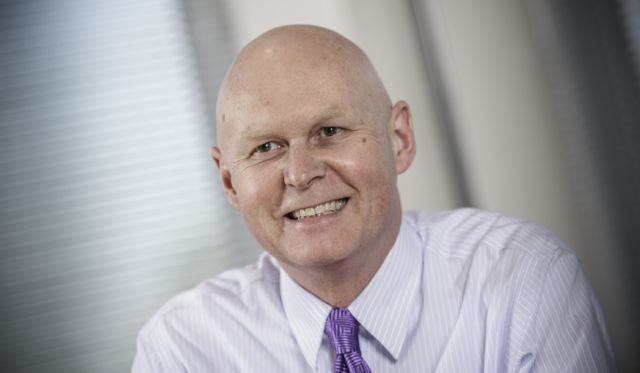
Doug Edwards remains upbeat about the long term prospects for Xaar despite reporting its largest ever loss. Even the ceramics business remains cash positive and the company has sufficient cash reserves.