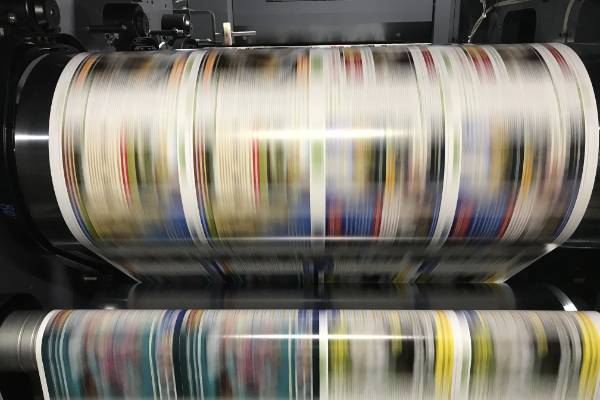
Warner (Midlands) has installed a dedicated coating press to apply gloss varnish to magazine covers at its factory in Bourne, Lincolnshire.
The Steinemann Colibri 104 UV coater has replaced a 14-year-old Komori Lithrone 640 which, no longer used for printing, had been used for applying coatings to covers. That press has found a new home, says marketing director Matthew Warner. “It no longer fulfilled the operational needs that we had,” he says, adding that he had a personal attachment to the machine as it had been the press that he first trained on.
The move, however, is a good one and while the Steinemann has only been in place for a few weeks, it is already proving up to the mark. “The quality is absolutely top notch,” says Warner. “This is a machine built for purpose. It is also more energy efficient than the previous method.”
The Steinemann Colibri 104 is a UV coater handling up to 11,000 B1 sheets an hour with a triple UV lamp system for even drying. Warners will run it with gloss UV varnish and has been running tests on various weights of paper to profile performance for the different substrates. “We are trying to find the ideal coating weights for each paper type,” says Warner.
“At the moment we are concentrating on gloss varnish only. We work with Celloglas when a different coating is needed for additional added value. We are good at printing and binding, and working with Celloglas like this gives us a good balance.”
The company has trained two operators for the coater to date, while others are having the opportunity to add to their skills as well, says Warner. “It’s about providing growth opportunities for the individuals,” he adds.
The first investment of 2022 comes at a time that interest in print is returning, says Warner, led by the holiday sector and print for the Queen’s Jubilee this year. The cloud on the horizon is the scarcity and cost of paper. It has required careful management on the print company’s behalf and at times accepting less paper than would be ideal, but it has coped without disappointing clients, he says.
“I think that the industry has done every well in the face of these challenges,” he says. “We make sure we keep communicating with our customers and suppliers. It’s nice to have the demand for print back.”