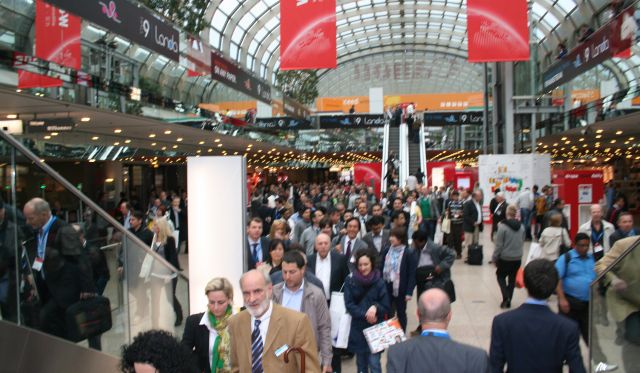
Maurice Chevalier sang Paris will always be Paris. He might have followed up with Drupa will always be Drupa. And despite pandemic and lockdowns preventing a full blown exhibition which printers from across the globe might walk around, Drupa will find a way. The printing industry needs its shot in the arm to give it direction for the next few years, to remind printers that print remains desirable despite its maturity and that through technology there is still hope.
Unfortunately the postponement from last year has played havoc with technology announcements. Some had been made before the decision to postpone and then cancel Drupa had been made; others have slipped out without the usual fanfare. This did not mean that the cupboard was bare, though the absence of Canon, Xerox, Ricoh, Agfa and others did not help.
Fujifilm led the way with announcement of a new version of the B2 Jetpress inkjet press – with not a dragon in sight.
At the time of the announcement the Jetpress 750S high speed version, printing at 5,400sph, is the fastest B2 inkjet press around, even though by the time the press is available in the autumn it may no longer be entitled to this accolade.
It was already the fastest B2 inkjet press at 3,300sph, slower in the B2 digital stakes than the Indigo 100k in EPM mode and it will remain so, though with a 90% uptime, according to Aoki, could lay claim to the most productive digital press crown.
Details about the new version are sparse. The speed increase has clearly been achieved through a switch from 1200×1200 dpi printing to 1200×600 dpi, a penalty which means that Fuji can address a larger segment of the litho market, both in terms of like for like quality and like for like cost. Feeding at this elevated rate will not be a problem, though information about drying and about paper formats and probing fluids are not being answered just yet.
No difficulties are anticipated. Users of the existing Jetpress 750S can upgrade to the new version in the field. Any changes can only be minimal.
Regardless of any competing machines, the opportunity with the Jetpress will be to expand its footprint from specialist niches in photo products and book covers where the Jetpress has been popular, to tackle more mainstream applications.
As these are shrinking in run length below the volumes that are comfortable for most sheetfed litho printers, the appeal of a digital alternative increases. Fuji’s decision to head in this direction may now be timely.
However, it is not going to have the field to itself. Ricoh is trailing its R75 B2 inkjet press, though with scant details at the time of writing. And there is competition too from continuous feed inkjet presses. To date most of these have a heritage in transactional printing, the formats, the quality, footprint and user base demonstrates this. The majority have been placed in transactional and latterly book printers.
Few have been designed from the commercial printing industry, indeed Heidelberg and before that Manroland’s efforts at digital printing have failed. One exception though is Kodak’s Ultra 520. This is a CF inkjet press that is definitely aimed at a commercial print user.
It is a first press designed around Kodak’s Ultrastream printheads. These made an appearance as a technology demonstration on a narrow web press at Drupa 2016 where Anton group was announced as the first development partner for the high quality printhead. In five years much water has passed beneath the bridge since then.
Kodak senior VP Print Randy Vandagriff provides three reasons why the press deserves consideration as a tool to move litho printing to digital. Quality is not a problem thanks to a 600x1800dpi resolution; it uses relatively low cost water based inks and can print on almost any grade of paper. A 150m/minute throughput is at least on par with the most productive of the piezo machines, possibly faster.
The first machines will be shipped to early adopters in the summer with commercial installations starting later this year, says Vandergriff. “We have started ramping up the supply chain, we have taken orders and people have been putting their money down,” he says.
Konica Minolta had announced its upgrade to the KM1 as the KM1E 12 months ago, so had little new to say about it. Not so Kyocera which has only recently started to ship the Taskalfa C15000 Pro, a first cutsheet inkjet production press from a supplier whose heads are incorporated into a number of digital presses and whose MFP devices have a reputation for reliability.
Kyocera is not pretending that this two-page press can transition litho work to digital, indeed it is printing on uncoated stock or inkjet optimised papers only. But it can print on white paper, eliminating preprinted litho for short run transactional and some kinds of book printing. It is rated at 1 million impressions a month, offering low energy consumption and relatively small footprint. Just how small depends on the modules that are added to the press that can stretch the space needed from 3 metres to 8.2 metres.
The same machine is being sold by Bluecrest as the Evolujet to feed printed sheets to its mailing systems and as a companion to the Intellijet presses badged from HP. The appeal, says Bluecrest, is the ability to bring work that has previously been outsourced under the one roof, saving time and cost.
There was little else from the digital press suppliers, nor from the litho presses as the 2020 version of the Heidelberg Speedmaster and the latest Koenig & Bauer Rapida had been announced last year. Both provided presentations on how artificial intelligence and big data are going to help shrink unplanned downtime and provide more control to printers thanks to the millions of data points that the manufacturers collect to discover patterns in machine usage and, though the application of artificial intelligence, to keep machines running.
The issue of artificial intelligence was a key one for the two track conference that ran over the four days. It is something that companies cannot ignore explained Michael Gale whose keynote presentation ran on both the opening and the closing days of Drupa. Artificial intelligence is coming and printers need to get to grips with its implications was the message. A ten-part questionnaire will unlock the understanding or lack of it, and provide indications of where attention needs to be given.
Others, like Heidelberg and Koenig & Bauer helped colour in the gaps with more nuanced implications and applications as a key theme for the presentations. Alongside these presentations on ecommerce and the consumer’s experience of packaging, textile printing and sustainability maintained Drupa’s reputation for exploring the future of the industry.
In all, the organisers says, more than 17,000 had registered to take part, far fewer than any real life show, but far more than any other virtual show to date.
It is not enough for virtual to replace reality, though some kind of mixed reality may emerge, especially with further developments in 5G, holographic projection and meeting room technologies.
They are not here yet, so Zoom had to suffice. Some presentations worked better than others, and from behind the scenes while there were some scrambles to link presenters from different parts of the world, the technology was effective, though it was sometimes painfully clear this was not the real thing.
In the end virtual Drupa had to suffice. As one exhibitor, associated with Drupa for more than 25 years put it when explaining why Landa Digital Printing had chosen (late in the day) to participate, Benny Landa put it: “Who can wait another three years to talk about the future?”