
United Print’s factory is a few hundred metres from KBA’s sheetfed factory near Dresden. At one time, part of its factory belonged to the press manufacturer as an R&D demonstration area, but the fast expanding printer has long since swallowed that up.
It operates both through the United Print and Print24 brands, starting in Germany and German speaking countries and expanding out. Now the UK is in its sights. “The UK market in general is very important to us,” says Ali Jason Bazooband, marketing director.
But the characteristics of the UK mean that a different approach is needed. The emphasis on fast turnaround means “our strategy must be to print inside the UK. This has to be the next step for all the European players if they want to match UK delivery times. In the UK, more than in any other country, delivery time is king.”
This means working with partners, printers that can deliver the volumes, the products and the prices that United Print needs. It spoke with Solopress two or three months before the UK company was acquired by Onlineprinters.
United is a privately owned business and cannot contemplate such a deal itself. Instead the aim is to build a network of companies willing to work with it. Already it can supply 20% of UK demand from UK producers. And it wants more, to cover expansion, to increase the product range UK buyers can get quickly.
“Three days is the standard delivery for the UK, he says. “In Germany customers pay a 20% premium for that and if they are prepared to wait, can receive a discount.”
The businesses that United are looking for will have the capacity, the right attitude and the technology to run an automated workflow. This is not as commonplace as people might think. “Many are willing, but lack the technology or can’t print at out prices which reflect the automated workflows we have,” he says.
Another requirement is the ability to print special colours. United Print stands apart in its willingness to print with special colours and in the range of value add finishes on offer. Bazooband mentions flood and spot UV varnishing, embossing, lamination. “We offer more in finishing than many of our competitors,” he says.
However, like them the bulk of work has been simple print and trim products. Business cards and flyers still account for the largest share of turnover and orders, but growth rates are slowing, around 5% a year not the 50% growth rate of large format. Digital in general is expanding at 25-30% he says.
There is also a drift towards higher value products, brochures, books and more sophisticated marketing collateral. These products are offered in incremental steps of 100 rather than several thousands for flyer products where a customer might have to choose to print 10,000 or 15,000. It is not worth the company printing intermediate volumes.
This enables some of the production efficiency needed to handle multiple jobs on the same sheet. That said, the company has recently introduced a 120gsm uncoated option for letterheads, growing the range and increasing production complexity. As more products are added to the range and more substrates, United Print must choose whether to work with partners or produce it all in-house.
“We are good at printing thousands of jobs and delivering to multiple delivery addresses. We are growing revenue and profits, think we can achieve double digital volumes.”
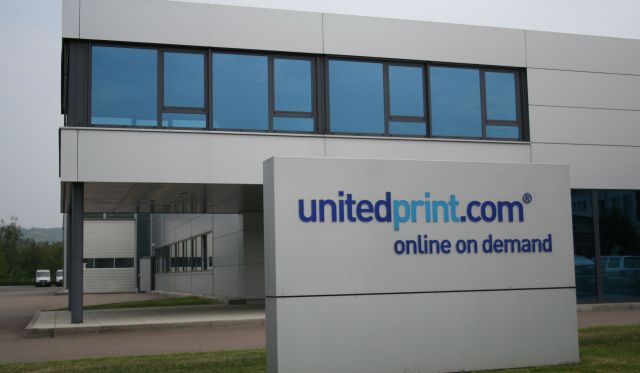
United Print has expanded rapidly from its factory close to KBA’s sheetfed factory in Dresden. It also operates under the Print 24 brand, pushing to improve service from the main operation and working with local partners to provide the level of service required by UK customers.