
Ultragraph installed a Muller Martini Presto II Digital a year ago with the aim of solving the problem of finishing work printed in collated order on its HP Indigo.
It has worked. The Ormskirk company no longer sends this work out to the trade, it achieves a saving and gains greater control of what it produces.
“We had been looking for a solution for a while,” says managing director Nick Jones. “One of the biggest considerations we had was space. The Bravo Plus we had been running previously had a lot of section feeders and we found we were sending short tun work out, or else doing this by hand.
“We looked at what suppliers associated with the smaller end of printing were coming up with. But the type of work that we produce is so varied and we had experienced some marking, so were not completely comfortable.
“Nevertheless we were edging towards the Horizon StitchLiner when Muller Martini came in to talk about preventative maintenance and asked about how we were finishing our digital work,” says Jones.
That led to a video presentation of the Presto II Digital and the provisional decision to buy it. “It was genuinely as simple as that,” says Jones. A trip to Switzerland to put it through its paces followed and the new digital stitching line supplanted the Bravo Plus in September last year.
A wide range of configurations are possible. For Ultragraph this meant a flat sheet feed into an MBO folder to producer the 4pp sections to be dropped on an accumulating saddle before stitching and trimming to the quality standard that conventional printed and folded sections enjoy. Conventional feeders handle the litho printed work.
Ultragraph has a solution that meets its requirements for space saving while having one machine instead of two to handle both types of work.
A barcode reader recognises the identification on each section and rejects copies that are not complete or have experienced a double feed. Details can be used to order reprints, says Jones, adding that waste has been reduced.
“We have a solution that is the best of both worlds. This is a standard stitcher and it is a hybrid machine and it occupies a compact footprint which is important to us,” he explains. A Palamides stacking unit supplied by Friedheim International is located at the end of the stitcher.
The investment lifted direct costs at the Lancashire business, but the net effect is positive, says Jones. It no longer has the cost of sending work out, nor of transporting sheets to be finished, and has full control over production.
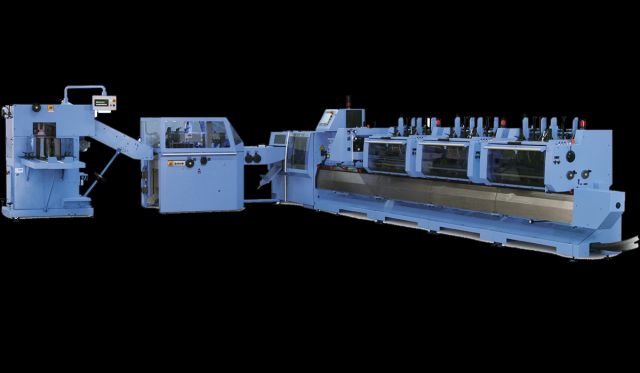
“We have a solution that is the best of both worlds,” says Ultragraph managing director Nick Jones. “This is a standard stitcher and it is a hybrid machine and it occupies a compact footprint which is important to us.”