
The stand out product in the recent Antalis Review was the Quite Delightful Project, a pair of publications designed by the English Group and printed by Opal Print in Bath on Edixion uncoated paper.
It did not fit in any of the prescribed categories for the Awards but impressed the judges to the extent it received a Special Commendation.
And helping it to stand out was a naked binding, where the stitches of the sewn sections were exposed rather than hidden beneath a cover.
“We call it bareback binding,” says Opal Print managing director Keith Lunt. “It is not as straightforward as standard section sewn work where as soon as you put the cover on, the spine is squeezed affecting how the book opens. In contrast we try to do this so that it stays flat.”
The gathered and sewn sections are sealed with a cold PVA adhesive and the fore edge receives a glue as well in order to hold the book in place under the guillotine as the 5mm opening edge is trimmed. This prevents the whole book slipping in the clamp.
The Quite Delightful publications run to 360pp each and are proof that this procedure works. The books are presented with the spine facing out in a slip case.
“It is only any use on short run books, fewer than 1,000 copies,” Lunt adds. For the prestige project, the effort and results are worthwhile. The company does not handle many like this in a year.
However, standard sewn section work is showing an increase, or at least resistance to the on rush of PUR binding that threatened to eliminate the more traditional form of binding.
Around the turn of the century, PUR binding seemed to offer all the advantages of sewn section binding in terms of strength and a flexible bind that could open flat. A lot of work that had been sewn quickly switched to the new process.
“All report and accounts work used to be sewn,” says Neil Armitage, director of Diamond Print Services. “A huge amount of these are now digital and many of the ones left that are printed are no longer thread sewn.”
The Enfield business continues to run two Muller Martini Ventura MC sewers, installed as replacements for the previous generation of machines, but they are not as busy as they used to be. It has also installed a Smyth to cope with the short runs needed for digital printing.
“Over the last ten years, there are certainly fewer products being sewn,” Armitage continues. “Quite a lot of what used to be produced in this way has gone to PUR.”
The Ventura MC is the most recent addition to the Muller Martini portfolio, bringing the traditional process into the networked age.
This includes the use of servo motors to help reduce the time for job changeovers and air blowers to help with loop formation. There is an entry level system running at 160 cycles a minute which suits short run litho work.
It would be no surprise to see the Swiss company extend its Digital portfolio into sewing. Its Presto Digital is a saddle stitcher that can from a reel of digital print or pre-collated digital sheets, folding and sheeting the web to accumulate four-page sections on a saddle before sending the product into the wire stitching heads.
The same principle can apply to delivering sections of collated digital sheets to a sewer, overcoming the intrinsic drawback of the limited sheet size of a sheetfed digital press.
This is certainly the arrangement that Smyth is using on its Smyth Digital-88 sewing line. In the basic version, sections are fed by hand or from a flat sheet feeder in the Plus version which can be set to feed different sized sections.
The sheets are folded to sit over the saddle and when the required number of sheets has been gathered, the section is moved to the sewing heads. A standard section feeder can be included to permit hybrid products to be finished.
Steve Giddins, managing director of Perfect Bindery Solutions, says: “We sold one from the stand at the Print Show to a customer that had not previously seen it. It can work with different sized sections sewing up to 15 sections a minute. The programmes will control the number of sheets that are fed. We are now dealing with a number of very serious inquiries.”
The interest is coming from both digital printers and from trade finishers looking to extend a service to new types of product he adds. The Smyth Digiline copes with higher volumes and demand, working from flat sheets of folded sections produced on a litho press.
A Smyth Magnum was installed earlier this year at Deanprint in Stockport to modernise production of very large format books. This can produce an A3 landscape product as well as sizes up to this format.
This has been joined in the last few weeks by an Aster 180, a more traditional sewing machine which will produce an A3 portrait format book.
The Aster replaces two older machines while the Smyth replaces a more bespoke solution to meet demand for large format open flat sketch books.
Operations director Kevin Lee says: ““We’ve found that over the last 18 month interest in larger format case bound books has increased and that other trade finishers can struggle with them, which means that it becomes a growth area for us.”
The Aster was the second installed by Kolbus UK in a matter of weeks. It had previously supplied another, again as a replacement for an older uneconomic machine, at Purfect Finish in Tunbridge Wells. Here there is an increase in the use of sewn binding for more prestige publications.
Director Bernard Hickey says: “We still produce a lot of PUR, burst and perfect bound books but when customers are looking for top quality lay flat products they are increasingly specifying thread sewn. With the demand for shorter runs, thinner products and consistent high quality we saw the new Aster Evo as an ideal machine for our needs.”
The Aster is the traditional sewing machine while Meccanotecnica also produces the Universe line for digital print applications, feeding from flat sheets, folding, gathering ahead of the sewing unit. This remains an automated machine rather than a handfed system, suited more to inkjet printing than book of one applications.
The Aster Legor unit takes a stream of folded signatures from an inkjet web press, stacks them to a height of 100mm before delivering them via a conveyor system to the indeed unit of an Aster sewer.
Robert Flather, managing director of Kolbus UK, has detected a growing interest in sewing. “There is a definite change in the air and sewing does appear to be making something of a comeback, driven by a desire for a high quality print product.
“The sewing process itself has not changed, but the latest machines have improved quality which gives much greater productivity and fewer problems. While the rated speeds have not changed greatly, the improvements in reliability make it easier to run at speed and to achieve greater throughput.”
A big change has not been noticed by UK Bookbinders in Weston Super Mare which reckons to have the second largest sewing capacity in the UK with a 12-station gathering line feeding twin Aster SA 220 sewers.
“These are not always in operation,” says chairman Alistair George. PUR has become the mainstay of the business even for report and accounts which used to be the biggest user of sewing capacity he says. “Sewing does seem to be making a little recovery,” he explains.
In Walthamstow, north east London, Cliftons is looking at investment to sew digitally printed work as London designers look to use the technique in products for the property market and in fashion.
“We are also seeing demand from the top end of the auction market,” says managing director Tim Clifton. “At present we produce these on an old Bremer which works alongside our Aster. We are looking at a solution for these books because we do not want to print the short run work on the high speed Aster.
“The designer market likes the look and feel of sewing, but only wants 50 copies at a time,” he adds.
This is part of a general return to traditional print values certainly drove GPS Colour Graphics to invest in a Muller Martini Ventura MC. “Customers that have always bought sewn products continue to want sewn products,” says operations manager Richard Benson.
“We can talk to them about PUR, but most want the look and feel of sewn books. They understand that sewing is the ultimate type of binding and what people expect a book to be like.
“We have customers that have been working on their book project for many years; it is their pride and joy. And as part of that they want it finished properly which they understand for a book is sewn, whether it is then limp or case bound.”
The investment by the Belfast company has kept a further process in-house and allowed it to exercise greater control as a result. “The Ventura MC is an excellent piece of kit, delivering thread sewing which is then heat sealed to secure the threads,” says Benson.
“It has allowed us to bring in work that perhaps we would not have attracted, regardless of whether it results in a sewn book. We can control costs as well. It has helped us increase press work as well.”
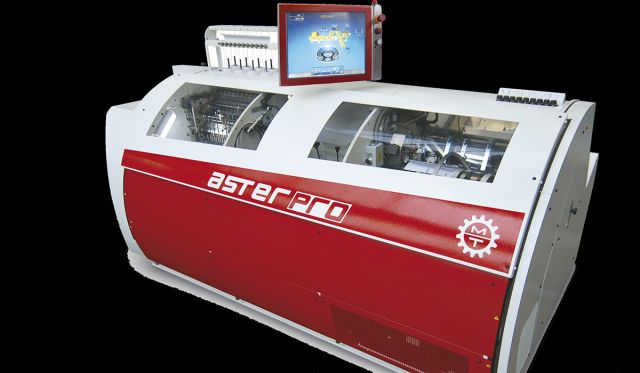
Deanprint in Stockport has installed an Aster 180, a more traditional sewing machine which will produce an A3 portrait format book. The Aster replaces two older machines. Operations director Kevin Lee says: ““We’ve found that over the last 18 month interest in larger format case bound books has increased and that other trade finishers can struggle with them, which means that it becomes a growth area for us.”