
Johnsons of Nantwich has become the first UK printer to install a complete wide format suite from Agfa covering Anapurna M2500i hybrid printer, Acorta cutting table and Asanti workflow. This is also only the second Acorta sold in this country, the first having gone across the Peak District into Yorkshire.
The equipment has been installed at a new factory in Crewe, a few miles from Nantwich, while litho and small format digital remain in the Cheshire town that the company started in in 1827. The two sites are linked by high speed high capacity cable, says managing director John McMillan.
The company has been dealing with a growing demand for large format print and while able to print roll to roll on latex printers, could not print on solid boards. It was putting this work out, but with variable results.
“We were getting more and more demand for print on Foamex and other boards, which we could not do inhouse,” he says. “But we are dealing with colour critical brands and most wide format has a screen printing background rather than litho. This meant we were struggling to get colour consistency when putting the work out. When we started to do the sums, we asked ‘Why not do it ourselves?’”
The answer was because the print quality of the machines he looked at was not up to the litho standards Johnsons’’ customers were looking for. “We looked at what we considered the main players, but the output never quite matched the standards that we wanted. Then we were invited to Antwerp where, having dismissed the old Anapurna, we were blown away with the new version in terms of speed and quality.”
The Asanti workflow was equally important, sharing an underlying technology and approach with the Apogee it had in Nantwich. It could offer the substrate profiles and colour control that McMillan was looking for. It links with the spectrophotometers and cameras on the press to keep colour consistent. But it is also simple, automatically coming up with the ideal CMYK breakdown for any colour.
This means, he explains, that customers must not create their own CMYK files for spot colours.
“We need to reeducate our customers,” says McMillan. “If we left the settings for PMS 289, for example, the result would be too washed out, but if we let the software decide, it comes much, much closer, and is a close match for the litho result. Even with Reflex Blue it gets a much richer blue than I thought would be possible.”
The Acorta cutting table, at 2.5mx3.2 metres, is larger than is strictly necessary, says McMillan and fits in seamlessly with the workflow, downloading settings from the Asanti and using cameras to ensure accuracy of cutting. Most of the work to date has been flat sheet printing, though there is the capacity within the workflow and cutting to use templates for free standing display units and other 3D items.
“We are already getting some demand for this from retail brands,” he says. A space at the new factory is being prepared as a showroom to display materials samples and act as inspiration to customers. There are also thoughts about bringing the other large format machines from the old factory to the new. He continues: “And if the work keeps going the way it is, we will be thinking about another Anapurna. There is another building on the site that is available.”
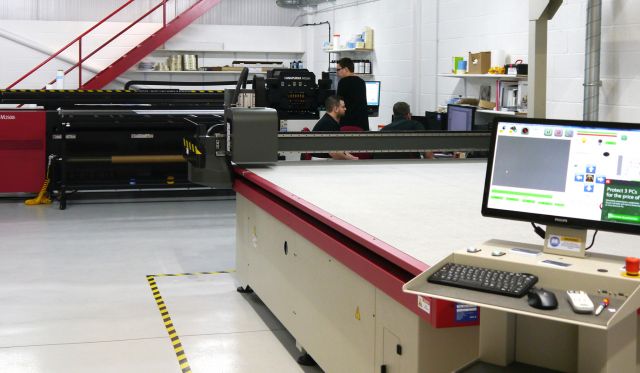
Johnson of Nantwich has had to move to Crewe to house its expansion into large format inkjet printing with installation of flatbed press, cutting table and workflow from Agfa.