At first it must have seemed one of those thought experiments, a game of What if played out at the end of an industry networking evening when the edges between reality, practicality and logic become blurred. But when on the morning after the logic still stands up, the question becomes not What if? but Why not?
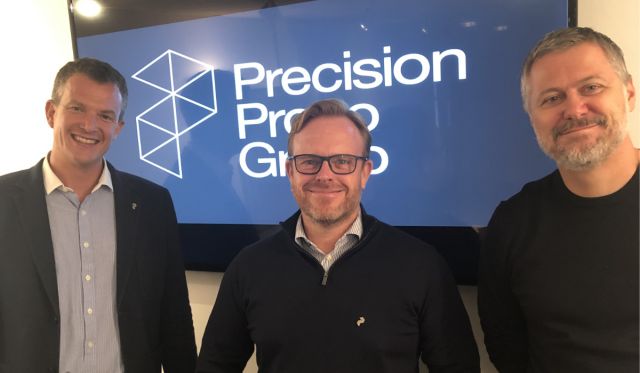
Little more than two years after Gary Peeling, Jon Bailey and Jon Tolley decided on Why not? Precision Printing, ProCo and Prime Group have joined forces to become a £45 million turnover super group, a five-site operation that is aiming not only to survive the tidal wave of digital change, but to ride that wave to further growth and success.
That opportunity lies with ecommerce, the rapid acceptance of purchasing online that has been given a turbo charged boost over recent months during the pandemic. Even so relatively little print is sourced and purchased through the internet. The logic behind this merger is that this will change and the new organisation will be driving that.
Business cards, flyers and leaflets and brochures are meat and drink to online printers, Where The Trade Buys included. Likewise consumers are happy to source photobooks and other photo merchandise through online portals. During lockdown they have also been going online to choose and buy greetings cards and creating photobooks, printed at all three of the companies that are now Precision Proco Group.
More complex products, corporate marketing campaigns and collateral, direct mail and even most books remain outside the online mainstream. The latter area is changing fast as publishers wake up both to the fragility of supply chains that stretch from Fitzrovia to Shanghai and back and to the costs that are tied up in warehousing and remaindered sales. Print on demand has barely scratched the surface, though not for want of trying.
This is the onshoring possibility that means that UK book printers have been thriving. “Onshoring plays a significant role in what we are doing,” says Tolley. “If Covid has done anything, it has brought home the importance of bringing production to a local level. British book production has gone through the roof and we want to be part of that conversation, offering a sustainable, long term supply chain and operating in the on demand space.”
These are areas that individually, the three print businesses would have liked to have tackled, albeit slowly. Now as a £45 million business the group has the financial clout to help drive through these transformations. It has the know how too. The fourth leg of the business is Climb, a software development house that has already developed the web to print portal for Where The Trade Buys and is geared to do the same for various corporate clients which have been identified as the mother lode the new business is mining. This will require seamless integration into ERP and procurement technologies that brands and corporate customers have. It is going to happen.
Purchasing in this way can be automated, can be managed by ensuring that brand guidelines are adhered to, and will be transparent to the client who can track spending and link that to locations, departments and cost centres. There is little difference between ordering print and purchasing widgets, cleaning materials or hotel rooms. Expert print buyers no longer exist nor are needed.
Those making the purchasing decisions are increasingly GenX and GenZ individuals who have lived their lives online and naturally turn to the internet to purchase print – if this can be made frictionless enough.
“Technology can help the simplification of access to print for corporate buyers and brands. That development is very much on the road map,” says Peeling, managing director of the new group. And if this change has been part of the plan since those initial head to head meetings, there is no doubt that the pandemic and lockdowns have accelerated change. There will be no complete return to working in pigeon hole offices, there are changes to how many food and non food items are purchased and how people shop. “The changes in retail that have been predicted for the next ten years will now take place over the next five,” says Bailey.
Speaking to Print Business earlier this year, Peeling had outlined the opportunity: “Looking back to 2017, 17% of EU commercial print sales were purchased online, amounting to £12.6 billion. And by the end of 2020 it will be 42% by value,” he said.
There is greater scope for growth in the UK which lacks the giant online print operations that exist in Germany, Italy and France. “Germany, for example, has four or five print providers with sales of more than €200 million. The UK is well short of that and if you were to put the largest online print providers together, their sales would still be only one-third of the largest Germany provider. This shows the transition that still needs to take place in the UK.”
Precision has sales of £25 million, still well adrift of the £100 million that Peeling believes is possible. “We are growing at 20% a year over the last two years with our upload and print business growing at 80% a year,” he says.
“We don’t think that growth of online print in the UK will slow down for the foreseeable future and the transition is going to be extremely quick.” At that time the plan to bring three leading businesses with this shared attitude was very much under wraps.
The union of the three businesses will enable Precision Proco to not only keep pace with but to lead this transition. “Mutual respect and trust can only go so far when trying to have real innovation,” says Bailey. “But we need to go one step further which is not as easy as three separate businesses. We want all the teams to be completely aligned.”
“In my mind we have four businesses that would have thrived in their own right and have been heading in the same direction. Had we stayed separate businesses, it would have taken longer to move the business plan faster without outside investment,” Peeling adds.
While of different sizes, each of the businesses had been completely viable. This was not acquisition driven by distressed circumstances, Peeling points out, the way that print groups have grown in conventional times. Bailey adds: “We have done this in a unique way. It means that it will be tough for others to follow what we have done.”
Now instead of each business trying to focus on a range of applications, there will be three distinct specialisations. Precision ProCo will be led by Bailey and will focus on commercial print, corporate and print management as well as daily communications; Prime, which retains it name, is led by Tolley and specialises in books, particularly personalised print on demand publications, as well as mass customisation, photo products and gifts. Peeling will be driving Where The Trade Buys and the other opportunities for upload and print.
“We can undertake wider projects for customers looking to expand and improve their ecommerce platforms. We will increase the product mix to ensure that we have the right products for them,” he says. That means including more sophisticated products than have been available to purchase online to this point and a challenge for the developers at Climb. It is already recruiting to increase its team.
That initial business plan has changed little in two years, though elections, Brexit and a pandemic have come along in turn. Then there have been the shareholders of the businesses to bring in line. All 20 of them, are staying and see the appeal of trying to reshape the UK printing industry rather than waiting to be reshaped by it.
“It takes a while to pull all this together,” says Peeling. “We had a sign off meeting in February, then two weeks later Covid and lockdown hit.
“The plan was driven by the realisation that digital disruption was not only changing our industry, but also our customers’ businesses and how they live, where they work, how they use print and how they see it. We want to be building something that can thrive. This is moving away from tested business models. It is a bold step with an ambitious road map.”
The three involved know each other well and have worked alongside each other to establish the HP Indigo (now broader) user group DScoop in Europe. This provides a shared background, respect and trust enhanced by acting as disaster recovery operations for each other and working jointly on a number of projects in the past.
Those would tend to be built on a lowest common denominator approach: that print and finishing platforms are the same – and largely they are with HP Indigo dominating the 15 digital presses the group has, and SiteFlow as the production workflow already standard. There are four RMGT9 SRA1 LED UV litho presses shared between Dagenham and Sheffield.
But equally there are differences: ProCo brings an HP PageWide T240 inkjet press; Precision has Scodix digital enhancement, Prime has a high spec Kolbus case making and casing inline being commissioned in a new factory.
Now each operation can bring a wider offer to customers by being able to call on the different equipment and skills each part of the group has. Using the same core technologies will enable shared loadings across the four production sites to even out peaks and troughs in business and will result in better utilisation of the capacity it has. But to achieve the growth anticipated substantial investment is going to be needed.
Technology for its own sake is considered more of an opportunity than a threat to the business. “It’s about Smart Automation, Smart Utilisation and Smart Collaboration,” Peeling says.
The new group is bringing in outside assistance if not lumps of private equity finance. Dominc Neary has joined the business this summer as CFO, bringing experience in ecommerce, in disruptive businesses, and larger companies.
He will also bring the experience in raising money that will be needed to hit the ambitious plan of doubling revenue in the next three years.
The chairman is Philip Osmond, a former British Airways director, again with experience of disruptive businesses and in integrating businesses following acquisition, having been involving in BA’s acquisition of Spanish airline Iberia. If Precision Proco is going to be involved with M&A, Osmond’s experience will be essential.
The six-man board is completed by Andy Skarpelis, COO of Precision before the merger and now chief production officer for the new group. Below him operating teams will have greater scope within the enlarged business.
The three leaders are now on a tour of print’s chat show circuit, taking part in online conference and webinar sessions. Feedback has been positive from across the trade and from customers. Bailey says: “Customers have really embraced the idea. They see the logic and that what we can offer together is even better for them.”
The Spark training courses for customers that ProCo initiated will continue, a new corporate styling has been rapidly rolled out, as if the separate companies have always been part of the same group.
“The key to success if we are going to innovate and change the industry,” says Peeling, “is to take the first step with confidence.” And on the website there is already a further declaration of intent: “In the coming months we’ll announce what we believe will become the new standard in responsible printing, both now and in the future. Watch this space.”
The printing industry will do precisely that.