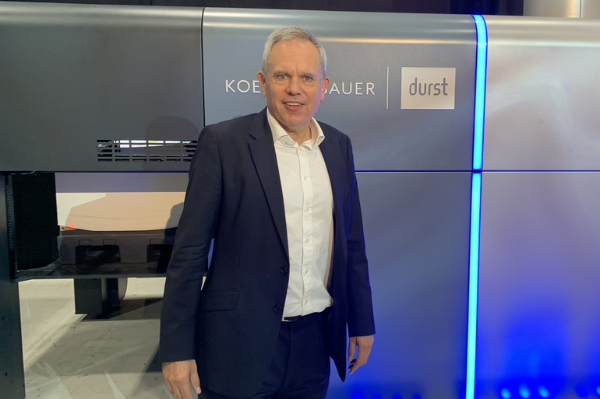
Brands hold the key to the success of the Koenig & Bauer Durst Varijet 106. This is the B1 press, the first clean sheet development by the joint venture business, which was unveiled at an invitation only open house in Dresden last week.
If brands want shorter runs, reduced supply chain risk, increased promotional possibilities, reduced waste and improved sustainability, then digital print packaging will succeed, according to managing director Robert Stabler. If the focus is on unit cost to the exclusion of all other possibilities, then the status quo will remain.
But, he says, there are growing indications that the total cost of a supply chain is coming to the fore, with waste, warehousing costs and impacts being taken into consideration. “I think that digital printing is very very relevant to some large brands,” says Stabler. “They are moving from paying lip service to thinking about the total waste in a supply chain, the track and trace possibilities, while the real opportunity for brands is in the ability to move very very fast and to change designs very fast.
“This is why we are focusing a lot of our effort on brands. It’s lot easier for a converter to sell to a brand that’s already convinced rather than where there’s lots of inertia, in other words to the mid level brands. The first job has been to get the press to the level of quality and productivity needed for the market.”
This was the reason for inviting 50 carton converters from across Europe to the space housing the 28-metre long, 21-tonne press adjoining the main assembly hall at the sheetfed factory in Radebuel. Over three days the press was put through its paces, switching instantly between a selection of jobs intended to show extra short runs to runs that might be accommodated on a conventional Rapida litho press, with special colours, light tints and fine reversed out text. To that extent it passed comfortably.
The press ran at 5,500 B1 sheets an hour with no makeready and only a few minutes for a head cleaning step while the pile at the feed end was changed. The quality at 1200dpi is more than commercially acceptable, and on jobs where an offset press would not have dropped straight into colour and fit from the first sheet.
The smart part of the the Varijet 106 is to exploit existing technologies and experience. The feeder is the established Drivetrnic unit with SIS infeed. The first unit is a priming step intended to give all materials a uniform surface for the waterless inkjet inks to adhere to. After a drying section, the sheet is transferred to a stainless steel vacuum belt to position and transport the sheet beneath seven inkjet arrays, held in position by vacuum power. The press can cope with sheets from B1 to B2 in format.
The seven colours offer orange, green and violet inks to expand on the CMYK gamut.
There is space for an eighth inkjet array which may be used to print white or a clear ink at some point in future.
The printheads are Fuji Samba piezo printheads, arranged with 24 across to give a total of 168 inside the machine. The imaging head is in the hands of Durst and is built around the experience of the Tau single-pass label press, which uses the same electronics, ink delivery (from 200 litre barrels) and ink technologies as the Varijet will use. These are of course food safe and meet regulatory standards. Durst will also supply the Rip and workflow technology.
On exit from the imaging section, camera inspection technology adapted from Koenig & Bauer’s currency experience will examine every sheet for defects. Any nozzle outages will be spotted and compensated for before becoming noticeable by human eye.
The sheet switches to a flexible belt, using material that is used in high temperature conditions before reaching the Koenig & Bauer OPV (on press varnish) unit for a seal or potentially a UV varnish before arriving in the delivery. Instant feedback from printers present suggests a double coating unit will be popular, while other modules can be added in future.
Currently there are three presses in existence, one each for the R&D teams at Radebuel and in Durst’s head office in Brixen. The third machine is the beta press used for the launch. It will continue to be stress tested on different substrates so engineers can understand maintenance and wash cycles, the impact of running poor quality materials and so on, before delivery in the early part of the new year to a carton converter in Europe. This machine will be joined by a second beta example before the details of the commercial introduction are announced.
In appearance the press seems both lower and taller than expected. The Koenig & Bauer units, using the sleek X generation side frames, seem lower, possibly because the machine is not on a plinth. The central inkjet section, however, is 5 metres high. Looking inside reveals that most of the space is a void. There is none of the intricate engineering that was revealed behind the glass on Heidelberg’s Primefire. Instead, the space is to provide access to the printheads for maintenance. These are raised vertically rather than withdrawn to the side as many inkjet press suppliers choose to do.
The adaptation of existing technologies for the new platform will be part of its strength. There is new technology around the imaging area developed for this project currently undergoing the patent approval process, limiting what Koenig & Bauer Durst wants to say at this point.
The company can also call on an existing worldwide network of engineers and technicians for field support, which also reduces the risk for any purchaser. But they will need deep pockets: the machine as specified, including web to print as well as Rip and production workflow, will sell for close to €4 million. But, as the saying goes, if you have to ask, you probably can’t afford it.