Printers have a wide choice of suppliers to select from when looking at continuous feed inkjet printing. It amounts to decisions on speed, width and resolution, though 1200dpi appears to be the acceptable quality for litho-like inkjet printing.
Here we list the major suppliers and what they have to offer currently. Others are likely to join the race either through ground up development or more likely through some kind of collaboration. This has happened in label printing where Jetrion was the only supplier until joined by Domino, Screen, Durst, Stork, Gallus, Omet and a host of others.
Canon
With more than 1,000 engines in use, Canon has more inkjet print engines in on the ground than any other supplier, a virtue of being in the game longer than others and being able to convert users of its laser print engines to inkjet printing.
This experience has led to a choice of products at either 520mm or 760mm width, optimised for speed or colour. For top quality colour, Canon can point to the upcoming ColorStream 6000 Chroma with a high pigment ink set or the ImageStream which is able to print on standard offset papers which is now shipping. The standard ColorStream and JetStream machines complete the line up.
There are differences in head supplier, resolution width and speed as well as target applications. The JetStream machines are available in two widths and are the presses aimed at book, newspapers and transactional applications. They are more closely related to the original laser web presses.
The ColorStream presses as the name implies are intended for colour heavy applications and operate at a perceived 1200dpi resolution. The market is the transactional space, replacing litho shell overprinting. The printers have space for six colours, which can include security and MICR inks. The new machine is the ColorStream Chroma which takes colour printing to a higher level with an expanded gamut ink set, expanding this by 10-40% and an ability to print on standard uncoated papers.
A key benefit to the Canon technology is its ability to print during the acceleration and slow down phase. It can also pick up printing where the web has stopped halfway through a page, Canon claims
However, Canon’s colour print focus is the ImageStream 2400, a 520mm wide press intended for direct mail, magazine and catalogue printing and other offset replacement jobs on standard offset papers with no priming stage. This is thanks to the inks used, related to the latex inks used in wide format. On printing the inks are protected by their own shell which also holds the ink on the surface of the paper and provides rub resistance.
The company believes there is a gap for higher volumes of variable data printing than it is financially feasible to print on HP Indigo or similar presses. By using the same papers as offset, inkjet becomes a companion to sheetfed printing and opens the way to products where print technologies sit alongside each other.
“Printing a short run of a 300pp book is a lot of signatures, a lot of plates and a lot of intermediate storage waiting for the last section to be printed before binding begins. Printing a complete book block digitally lets binding get underway while printing is still in progress it argues.”
The print heads used on the ImageStream are designed for continual running with through flow heads to keep the nozzles clear. With the ColorStream, heads need a cleaning routine, generally during a change of paper reel
At each step, Canon has evolved the drying technology to cater for the types of job expected. It has used heated saddle technology as the main way to dry the paper after printing. As the paper is held against the heated surface there is no risk of paper cockling, but it can be an energy intensive process.
Fujifilm
Fujifilm’s current offering is the 540W, a handful of which have been sold into book and direct mail printers. Fuji has no legacy of laser printers to fall back upon and has to compete for every order.
The 540 will this year, or perhaps next, be superseded by a new press which is as yet unannounced.
It will use the Samba printhead that is used on the Jetpress 720S B2 sheetfed, so would offer a higher level of quality than others currently on the market. Fuji will surely adopt a different droplet size for the web press in order to accelerate a running speed which can deliver 3,000 B2 sheets an hour.
It will certainly use an ink with a latex element to help the ink adhere to silk and gloss coated papers which are problematic for continuous feed inkjet presses. “It’s simply not possible to run all types of paper through an inkjet press. Even the same paper, but produced in a different mill, will perform differently,” says product manager Mark Stephenson.
The challenges that Fuji will be working on include the dispersal of water from the paper especially where high ink coverages are needed. “And it will be a challenge for a magazine printer to print with a lot of colour on 60gsm paper,” he says. “Inkjet is not just about transactional or paperback book printing any longer.”
HP
HP is another without a legacy to fall back upon, nevertheless it has done most to popularise inkjet with its T series, now PageWide T series presses. Beginning with the T300, the company followed up with the larger T400 series and lower cost T200. All have undergone significant upgrades including the ability to run with the HDNA print head.
HP has built its presses on the thermal inkjet print head which is a user replaceable, relatively low cost component. The HDNA print head adds a line of 24000 nozzles per inch between the two rows of offset 600dpi nozzles to give the graduations in colour that larger droplets alone cannot provide.
The shape of the nozzles is more elliptical than circular which helps droplet formation and prevents the creation of wicks, the tail which can cause unwanted effects if not tackled.
Each of the presses has a slightly different design to accommodate different combination of dryers as applications have developed. “The T300 was developed for the applications of the day, mostly books and transactional,” says David Murphy from HP’s PageWide web press division. “Now we have new ink formulations for the T350/360 which enable them to produce higher ink coverages for direct mail or posters.”
HP has also built single-side versions of the T400 machine for printing on corrugated along with the T1100, a 2.8 metre wide behemoth that has been built in collaboration with KBA. It has retained the characteristic arc used to keep the web under tension and in position as it is printed, though this uses a static roller system rather than dynamic rollers.
As well as going wider, HP has increased speed throughout to the point that 300m/min is possible. “There comes a point where quality would suffer through misplacement and the shape of droplets, if we try to run twice as fast,” says Murphy
Kodak’s Prosper was announced at Drupa 2008, the same event that HP introduced the T300 prototype. Kodak has built on its experience with the Versamark continuous inkjet technology that Scitex had developed in a facility that Kodak has sold to Scitex having acquired it from Mead.
Prosper is acknowledged as the fastest inkjet technology currently available, running at up to 300m/min for the Prosper 6000P publishing version for newspapers and books. A direct mail and catalogue or flyer version is the Prosper 6000C and runs at 200m/minute. Both machines show a marked difference from the Prosper 5000, the first colour press, and Prosper 1000 mono machine.
Key to the development has been siting dryers after inkjet arrays, giving the press the impression of being closer to a web offset press in design. The paper path is flatter than on other inkjet presses for example.
Kodak has been building sales steadily and sales of ink rather more quickly, but it remains an investment project that the company says it can no longer justify in terms of ongoing investment.
This is true also of the Ultrastream printhead which will be for third party suppliers to implement. Kodak has had its fill of building presses and the cost of selling and supporting them. A new owner, whose identity was not known at the point of publication is unlikely to change this approach.
Ricoh first inkjet press, the InfoPrint 5000, emerged very much from the Boulder facility that had been home to IBM’s production printing division in laser printing days. Screen’s knowledge of the printing industry, colour management and inkjet was bolted on to the paper transport, resulting in a press that was almost identical whether sold by Screen or Ricoh. A handicap has been the price of the Epson ink that is needed for this press.
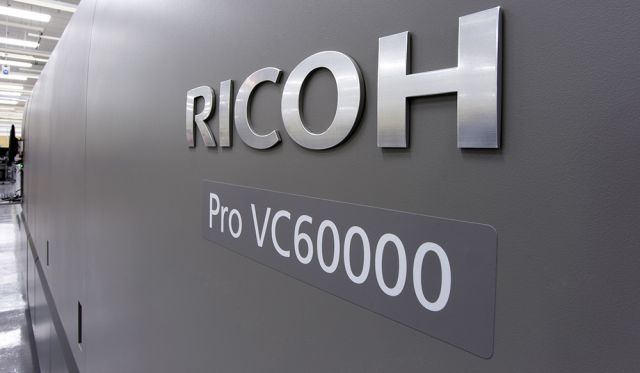
The key collaborators teamed up again for what is the VC60000, a ground up design that shows a divergence in approach between the developers. It uses Ricoh piezo print heads rather than those supplied by a third party.
There are VC60000 in use in several European countries including sales to MBA, Adare and DST in the UK. The intention is to print on standard offset papers, hence the addition of an inline priming unit as part of the machine.
Alongside HP and Kodak, Ricoh appears to be making most headway in developing commercial print applications for inkjet. At the recent Open New Worlds event at its customer experience centre in Telford, Ricoh discussed the applications that the VC60000 would hit.
As well as printing direct mail, newspapers, magazines personalised to subscribers, brochures on demand for the car industry in Germany, a company in Holland is printing posters for a web to print business. The consumer uploads digital images up to a daily cut off point. At this point the 350 orders a day are transferred to Zalsmann, printed on the Ricoh, sheeted and rolled into tubes with the associated address label.
Screen
The TruepressJet 520HD is Screen’s implementation of the VC60000. But Screen believes that the use of a new latex style ink and further development of papers will mean that there will be no need for a preprint treatment on the paper to be printed.
The new ink was announced at Drupa and has been expected to enter field trials around the start of this year. It will be designated the TruepressJet 520 NX and comes with expectations that quality will be a “closest yet” match to litho printing.
Just as interesting for Screen’s prospects is its distribution tie up with Komori. The litho press supplier has shelved its own plans for a webfed inkjet press, shown in concept at Drupa in 2012, and will instead sell and support the TruepressJet. This will give access to Komori’s vast user base across Europe.
Xerox
Xerox has wrestled with how to print digital colour as part of a web press for some years, trying different technologies including the CiPress solid inkjet machine which failed to convince printers that this was the answer.
However, having bought French developer Impika, Xerox is rapidly building a portfolio of presses using inkjet. Two years ago it introduced Rialto, a small format inkjet web press for printing A4 only sheets.
Then last year it added the Brenva sheetfed machine and Trivor, a web press. Each is using a slightly different combination of ink and printhead. It depends on the requirements of the application, says Paul Morgavi, COO of the inkjet division of Xerox and Impika general manager.
At the top of the tree is Trivor with 1200dpi Panasonic print heads and using a new High Fusion ink. This is a pigment ink originally designed for non porous substrates, coated paper for example. “It is a very, very important step for us,” says Morgavi. It is an ink that has more pigment than water he says and which can print on a wide choice of papers without pre coating these.
“Coating loses the the basic feel and quality of the paper,” he says. “It will feed well if a user wants to apply a post-print coating in any way. “Trivor is the first generation of new press for Xerox.”