
The Print Show is the first in real life traditional event where printers can meet each other over coffee or over discussions about equipment or technology to take place in the UK since lockdown was announced in March 2020. It is three years since the previous edition of the Print Show was rolled out in 2019.
There have been other events, Sign and Digital, for example, or Packaging Innovations, both taking place earlier this year at the NEC, which had some appeal for commercial print. Both also suffered from nerves afflicting both printers and exhibitors.
At that time the nerves concerned the likelihood of being infected with Covid so soon after the lockdown restrictions had eased. Now nerves concern the recession that the Bank of England and almost all economists predict making it difficult for printers to have confidence in what is around the corner.
But that very lack of confidence is a reason to visit the NEC. The industry continues to undergo significant change, a change that is having an impact on every print business. Equally change is affecting different businesses in different ways and with change there are opportunities for the agile where such changes can be understood.
That is the great power of an exhibition like the Print Show. Visitors get to see the possibilities at close hand and can collect the information that can help the business navigate what are sure to be choppy waters ahead. It is a question of identifying the currents that can sweep a business on to the rocks and those currents that can accelerate the company on its voyage.
In that regard what will valuable from the Print Show will not be the examination of grey boxes producing dots on paper or machines which fold, stitch, cut and embellish pieces of paper, but the applications that this technology enables a business to create.
Ultimately very few customers are buying print for its own sake, but are instead buying a carton, a greetings card, sales brochure and directional signage. Those placing the order are not thinking of this as print, but as a means to their end, whether ensuring people stay two metres away as the floor sticker has advised, that people are not lost thanks to the directional signage or that product sales are up thanks to a well presented sales brochure.
Only a very few buyers want to understand how something is printed. The technology used is immaterial in comparison to receiving the job on time and to the right quality. While in recent surveys the most important thing that customers want is innovation and ideas. With print moving away from a commodity communications tool to become something where impact is crucial, ideas and innovation are going to cover different papers, additional colours and finishes and bespoke applications.
It seems more and more exhibitors are becoming aware of this too and are teaming up to demonstrate how to deliver that impact.

Take Morgana. It will be putting the finishing touches to a personalised gift box, containing a small bottle of gin and can of tonic; both box and label can be personalised. It is working with eProductivity Software, better known perhaps as EFI, to create the personalised files, with ASL to print the job on board supplied by Antalis before finishing on Morgana’s AeroDieCut. This is a rotary die cutter that is aimed at commercial printers wanting to create this style of short run packaging.
This uses standard cutting and creasing forms combined with adaptable press rollers that create the pressure needed to apply to the material to cut and score it. It sits alongside the small current tables that Morgana’s owner Plockmatic is able to offer through the acquisition of Intec. A true die cutter offers much better creasing than is possible with a cutting table.
The AeroDieCut also deploys a stepping mechanism so that a single small die can be used up to five times as a printed sheet moves through the device.
As well as standard die cutting, the machine will also produce embossing and debossing work – the only embellishment that has no environmental impact.
This is not needed for the featured job which is a box and lid with a cut out to highlight the product. The job starts with eProductivity Software and well before the exhibition itself. John Morley explains that the idea was formed as a way to promote the new brand for the MIS supplier. Visitors intending to attend the show will be invited to a website where they fill in details needed for the job.
This will be a social led omnichannel campaign, he says, from which email is excluded. “We didn’t want to do email but wanted show how to acquire customers through social led campaigns and to show that print can be promoted alongside digital marketing,” says Morley. “We wanted to show how lights out automation can be used in a real example.”
The requested details will allow the team to produce the gift boxes ahead of time, including the printing of a personalised label. This will not be possible for visitors to the show that register on the day, for practical rather than technological reasons. It also helps the logistics as visitors will be asked on which of the days they plan to attend.
Once the details are captured and applied to the artwork, the job is approved by the visitor. It can also include a 3D rendition that visitors can rotate to view from all angles. Once approved, the file is transferred to the EFI Fiery Rip on the ASL stand along with production information used by the press and then by finishing. The sheets of 600 micron calliper 520gsm folding carton board, will be printed on the Ricoh Pro C9200 on the stand before then being taken to Morgana for completion.
Apart from lining up the technology and data links between them, Morley says there were other considerations to take into account. It had to include Challenge 25 information to prevent alcohol being given to those that are under age. For a related reason, none of the partners plan to supply ice. The pack is intended to be consumed after, not before, driving home.
Vpress has also lined up a team of partners to demonstrate a personalised product, this time a bottle of beer. It is a development of a feature that Vpress ran in 2018 which resulted in handing over 300 bottles with new labels in place. It is being printed on a Ricoh on the ASL stand where the portal for creating the personalised label will be available. There is also integration with Tharstern, PrintIQ, Tradeprint, Vivid and Morgana.
ASL is at the heart of other live applications as well as showing different presses from a range of suppliers. This includes the UK exhibition debut for Kyocera’s Taskalfa 15000 cut sheet inkjet press. It will be printing both colour and black and white jobs.
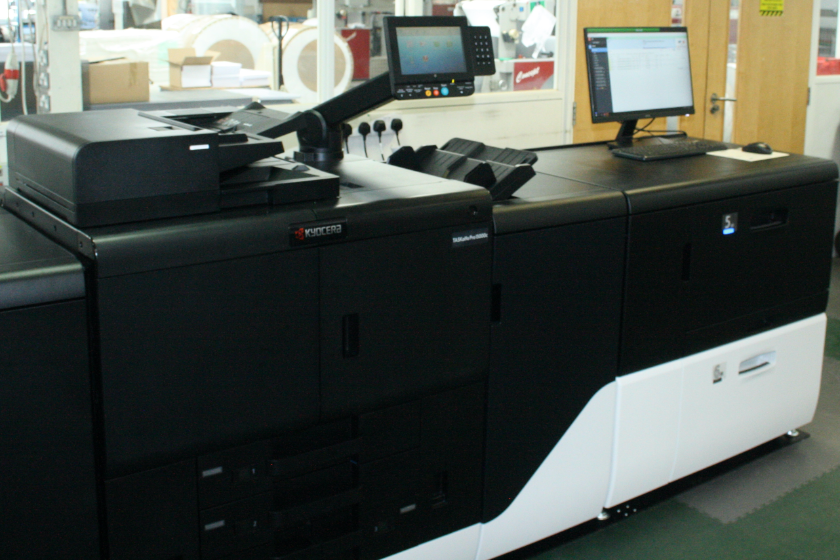
The stand will also include an Epson SC80600 rollfed large format press, the Ricoh Pro C9200 running carton board for food boxes/sandwich wraps, a KM7100 demonstrating its ability to load paper trays with long sheets and feed from these for multiple job types. There will be a Xerox Versant 280 running, not with CMYK toner, but with the value added toner set of white, gold, clear and silver toners. An Oki 1050 will be printing labels, including those for the Vpress personalised beer project. On the software front the company will have Solimar for managing workflow and Fiery to direct jobs to the required press. Much finishing will be produced on the neighbouring Morgana stand.
“The theme,” says ASL’s Paul Stead, “is The Choice is Yours. We want to be agnostic in terms of press provider and technology. We want to showcase the applications that printers can produce: greetings cards, business cards to sandwich wraps. It’s something a little different and something for everybody.”
ASL will also be directing some finishing work to Ashgate Automation for finishing books and wraps, with the possibility of sending some work to Duplo.
That company will have samples of three different book jackets produced on the DuSense DS8000 B2 embellishment press that was launched earlier in the summer. There will be a square format colouring book with a DuSense enhanced cover. But Duplo has decided against bringing the machine itself. It would occupy the greater area of the stand on its own and limit the opportunity for other products.
Duplo will also be demonstrating greetings cards, highlighting the DC618 multifinisher. This is another machine that has not been seen at a public event having been launched during lockdown. Duplo anticipates completion of a number of deals, many of them upgrades from the previous model. There will be a first showing too for the Bagel iLam laminator that the company has taken on in recent weeks. The range of booklet makers is represented by a DBM150, while samples from the top of the fleet iSaddle will be on hand. These will demonstrate the ability to compile a book with different size pages and printed on different material, something that Duplo believe to be a distinct feature of its technology.
The PFI DiCut rotary die cutter will be running a playing cards set as well as a fold up promotional gimmick that becomes an interactive promotional giveaway. The company will also be producing the picture frames used for photos with the celebrity guests attending the show for visitors to create their own selfies with a star. These have been produced on the DuSense ahead of the show and will be cut out on the B2 PFI Blade cutting table.
It amounts to a stand split into three zones: small format finishing, automation and embellishment, each with samples of different applications. The intention, the company says, is that “marketeers and print buyers will see examples of how they can enhance their design and their campaigns around print, to increase conversions and to wow their customers with high quality, relevant and engaging products.”
This is the plan too for Konica Minolta. It is the only press manufacturer (at the time of publication) with a stand in its own right.
It had decided on the stand in order to reconnect with customers, according to Jon Hiscock, head of production and industrial print solutions for Konica Minolta Business Solutions UK. The pace of change across the industry makes the Print Show an important event.
This includes a drive for sustainability for the brands that printers serve, a need for print to create an impact through embellishment and a requirement for print to click with wider trends towards automation. These become areas for Konica Minolta to focus on within a wider Igniting Print Possibilities campaign.

The star of the stand, however, will be the first demonstration of the AccurioShine 3600. This is the upgraded version of the MGI 3D One small format embellishment press. The device will be put through its paces with the gamut of two-page digital print work, from business cards to calendars, invitations to plastic cards. It will be running with a number of live applications details of which are being worked on.
The AccurioShine 3600 uses inkjet heads to apply clear varnish which acts a highlight, or as a base to attach a hot foil. It uses technology from the larger MGI Jetvarnish machines to register the sheet as well as the heads, fluids, foils and operator’s interface for the device.
Hiscock says: “The entry level device enables users to add value to the print they produce and respond to market demand, because in order to survive and grow their customer base they need to expand their reach and products offered.
“Many are finding that it’s not enough to just offer fast turnaround, quality and low pricing. The AccurioShine 3600 is great for adding 2D and 3D gloss effects and digital hot foiling tactile finishes.
“To take it another step forward, it also supports variable data printing, to add more impact to printed products, personalised packaging and labels.”
The stand will also feature an AccurioPress C4080 its light production press that is one of the company’s best selling devices. And there will be samples from the KM1 B2 inkjet press. “We’re looking forward to engaging with our customers to help them expand their businesses and increase their profitability,” says Hiscock.
Another of the key trends that will be evident at the show will be the proliferation of digital cutting tables, from the entry level machines offered by Intec to the increasingly sophisticated and larger machines offered by Vivid Laminating. These systems are ideal for ultra short runs of packaging, as part of ecommerce applications, for prototyping or samples. They are equally adept at high value greetings cards, folders and book covers, gift packaging and jigsaws. The digital cutting table is becoming a natural partner to many digital print operations for logical reasons and a low cost way to move towards growth sectors like packaging.
Vivid Laminating, a week before the Print Show, is staging an open house at its premises near Leicester to demonstrate a packaging set up comprising an Epson inkjet printer, GMG colour software and Veloblade cutting table.

The company has taken a stride forwards by adding a taping applicator to the cutting head of the larger tables. This applies a double sided tape to the packaging that is being cut out. It automates what can be a tiresome and lengthy manual task and delivers a neater application with the precision of automation. Blanks are ready for assembly as soon as the head is moved away from the table.
Online tradeprinters, both offering their services and looking for agents, will be represented by Solopress, Printism, Tradeprint and Nettl. These are rapidly moving on from business cards and print and cut applications to multi-section and higher value work.
The large format world is represented with Hybrid, Perfect Colours, Sedo, Graphityp, and Soyang leading the charge. These will have models from Mimaki, HP and Agfa to join the Epson on the ASL stand. There is still space for commercial printers to move into large format graphics, particularly through investment in flatbed printers which do not suit small sign shops that lack the space and financial strength to take advantage.
There is also a strong showing from MIS software suppliers. There is less cost associated with their participation as exhibitors need only the decoration for the stand, internet connection and a couple of laptops. Thus MIS is represented by eProductivity Software, Accura, PrintIQ, Tharstern, Optimus and Imprint, with Zaikio able to demonstrate its workflow automation concept.
Switching from one MIS provider to another is not something undertaken lightly. However, the danger is that that reticence may prove costly if it holds back development of the business to encompass automation, diversification and a high value added platform to carry the business through coming years.

