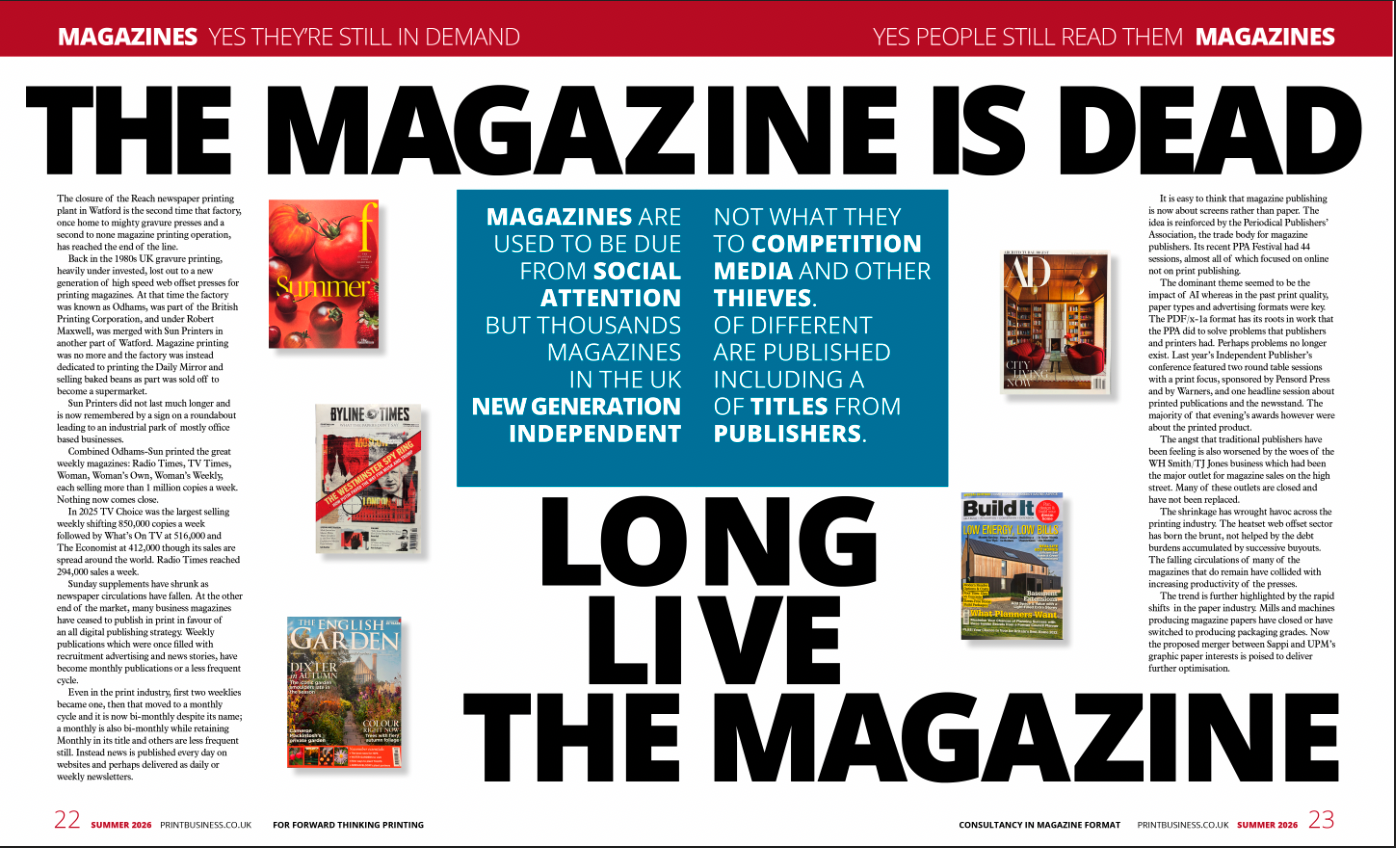
The closure of the Reach newspaper printing plant in Watford is the second time that factory, once home to mighty gravure presses and a second to none magazine printing operation, has reached the end of the line.
Back in the 1980s UK gravure printing, heavily under invested, lost out to a new generation of high speed web offset presses for printing magazines. At that time the factory was known as Odhams, was part of the British Printing Corporation, and under Robert Maxwell, was merged with Sun Printers in another part of Watford. Magazine printing was no more and the factory was instead dedicated to printing the Daily Mirror and selling baked beans as part was sold off to become a supermarket.
Sun Printers did not last much longer and is now remembered by a sign on a roundabout leading to an industrial park of mostly office based businesses.
Combined Odhams-Sun printed the great weekly magazines: Radio Times, TV Times, Woman, Woman’s Own, Woman’s Weekly, each selling more than 1 million copies a week. Nothing now comes close.
In 2025 TV Choice was the largest selling weekly shifting 850,000 copies a week followed by What’s On TV at 516,000 and The Economist at 412,000 though its sales are spread around the world. Radio Times reached 294,000 sales a week.
Sunday supplements have shrunk as newspaper circulations have fallen. At the other end of the market, many business magazines have ceased to publish in print in favour of an all digital publishing strategy. Weekly publications which were once filled with recruitment advertising and news stories, have become monthly publications or a less frequent cycle.
Even in the print industry, first two weeklies became one, then that moved to a monthly cycle and it is now bi-monthly despite its name; a monthly is also bi-monthly while retaining Monthly in its title and others are less frequent still. Instead news is published every day on websites and perhaps delivered as daily or weekly newsletters.
It is easy to think that magazine publishing is now about screens rather than paper. The idea is reinforced by the Professional Publishers Association, the trade body for magazine publishers. Its recent PPA Festival had 44 sessions, almost all of which focused on online not on print publishing.

The dominant theme seemed to be the impact of AI whereas in the past print quality, paper types and advertising formats were key. The PDF/X-1a format has its roots in work that the PPA did to solve problems that publishers and printers had. Perhaps problems no longer exist. Last year’s Independent Publisher’s conference featured two round table sessions with a print focus, sponsored by Pensord Press and by Warners, and one headline session about printed publications and the newsstand. The majority of that evening’s awards, however, were about the printed product.
The angst that traditional publishers have been feeling is also worsened by the woes of the WH Smith/TJ Jones business which had been the major outlet for magazine sales on the high street. Many of these outlets are closed and have not been replaced.
The shrinkage has wrought havoc across the printing industry. The heatset web offset sector has born the brunt, not helped by the debt burdens accumulated by successive buyouts. The falling circulations of many of the magazines that do remain have collided with increasing productivity of the presses.
The trend is further highlighted by the rapid shifts in the paper industry. Mills and machines producing magazine papers have closed or have switched to producing packaging grades. Now the proposed merger between Sappi and UPM’s graphic paper interests is poised to deliver further optimisation.
It is not all doom and gloom. For every magazine that closes another is launched, albeit with a very much smaller print run. The new magazines are emerging from independent publishers, sometimes the spin outs of larger businesses that are undergoing reorganisation, sometimes ground up products more akin to the fanzine phenomenon from 50 years ago. Instead of collage and photocopied pages, the new generation magazine embraces high production values.
This is a revival based on appreciation of the tactile nature of magazines, the enjoyment of a well designed physical product and something permanent compared to the ephemeral nature of the digital world. It belongs to the same emotion as vinyl music.
The epitome of this is a magazine called We Are Makers. It finds artisan producers in different part so the world who are keeping craft skills alive, visits, photographs and publishes their stories. Its cofounder Kathrine Lennie took to LinkedIn to explain why in a post headed ”What print taught us about trust”. She continued: “Building a brand, building a magazine, is not an easy road. I wouldn’t put anyone off doing it, but you need to work hard.”
The publication has now reached issue 19, printed by Mansons in St Albans, as a specialist magazine printer and is building its audience through subscription rather than casual newsstand sales.
It used to be said that everyone has a book inside them, now it seems that everyone has an idea for a magazine inside them.
This is where an organisation like the International Magazine Centre steps up. It is a supportive network providing training for would be publishers, freelancers and running both digital and in person networking events. A popular monthly session is How to Launch a Magazine.
Sponsors of the organisation include Park Graphius, Mansons, Micropress, Mortons and Warners, each printing magazines for the new age of periodicals.
At Warners, marketing director Michael Warner says the business is celebrating its centenary having started as a newsagent in Bourne. “People can start with one issue, then when they get to issue two, they can be considered established,” he says. Not all get that far.
Warners is in position to assist, asking questions about the style of binding, whether the paper needs to be FSC. “We have to go back to basics with the questions so that we can build the bigger picture of what they want,” he says. “What is the right style of binding for them? What does FSC paper mean? We try to get efficiencies, say to standardise on A4 formats rather than on A5; can we reduce the paper from 80gsm to a bulkier 70gsm to help keep mailing costs down perhaps.”
Warners has its own publishing arm, specialising in hobbyist titles, which provides an insight into the pressure that magazine publishers face. What the company wants is for a new magazine to be a success and then for the publisher to become a regular customer. “We have a couple of customers dating back 30-40 years,” he says.
The customer service people have been in place for many years in some instances, forming strong relationships with publishers. This was enhanced during the Covid period he explains when many customers were grateful that the printer remained in operation.
The customer service team is as important as the recent investment programme that has brought a new building with new Manroland Lithoman 32pp web press, Manroland Sheetfed R700 and both binding and stitching and palletising robots. This has made the internal systems more efficient enabling a stitching line to be operated by 1-2 people. Binding though remains more labour intensive, and is crewed so that this does not become a bottleneck. Solema packing systems help by operating inline with the binding lines to box magazines automatically.

Over the years “the nature of how people consume their content now has changed. They want choice so the consumer dictates how they receive content,” says Warner. The content they consume has also changed, partly down to the internet and especially social media, but also because design and print technology has changed to enable shorter run publications to be viable. This movement began with the rise of desktop publishing 40 years ago and has only accelerated since.
Warners remains true to principles that have helped it retain staff and customers. It means that the directors consider themselves stewards of what is a families business. Michael himself worked across the business rather than being parachuted into the boardroom. “Nobody here is too important to sweep the floor,” he says. “And anyone can make suggestions. If the team says we need a new compressor and makes the case, they get the answer quickly. The companies that are left in the sector are there because they are the strongest, the know their market and they know their products.”
This is something that Mike Roberts at Acorn Web would concur with. It too has installed a new Manroland Goss Lithoman web in recent years, adding a Komori SRA1 covers press this year. Like Warners the portfolio includes a swathe of hobbyist or enthusiasts magazines which have never stopped printing. They include titles about model railways, buses and cars. “They come from publishers looking for a reliable printer that can produce their titles in a sustainable and cost effective manner,” he says. “We are not confined to one sector of the publishing market, nor to publishing alone as we have commercial work alongside magazines.
The Normanton company has the year introduced a calculator that can provide a carbon number with each job. “This helps with their own carbon reporting,” he says.
The shift to the new format on the sheetfed press has had a beneficial impact on the sustainability line as the smaller sheet means a saving on paper and in turn on plates. This is without the greater automation and efficiency that will result from using the latest technology. “We are still optimising the press, but already we are noticing the improvements in productivity and a reduction in waste figures. We have been delighted with it.”
Longer run magazines have fewer options, it boiling down to which of the Walstead plants is the best fit. Shorter run titles are better served. The specialists in this area include Stephens & George and Buxton Press, each producing hundreds of titles a month. For these companies it is about optimising efficiency, by minimising makeready as much as possible. The idea is to run by lifting a set of plates and keeping every other setting the same.
Buxton Press has this year installed a ten-colour perfecting XL106 with CutStar as the imperative to keep abreast of the latest litho print technology is strong. Stephens & George is likewise well invested with the latest Speedmasters capable of running at 21,000sph after the company insisted that it needed the speed that Heidelberg had hitherto reserved for the carton version of the XL106.
Both are also well invested in robotic pallet loading systems to minimise stress on staff and to cut out a manual process. However, the collection of business magazines, local magazines, titles for professional associations these print and so on is about the most competitive segment of the magazine publishing sector, let alone one where every printer can compete.
One area of growth is in the local or regional lifestyle magazine. With the decline in local newspapers, these have sprung up with the support of very local advertising which does not work well with online search and which may be missed as not every potential customer uses Facebook and the like.
A printed magazine can tell local stories with local ads, say for the Indian restaurant in the high street, for the nearest plumber or car tyre specialist, that used to advertise in a newspaper that is no longer there.
It means as Stephens & George notes in the 2025 financial results there has been “an intensifying of the constant price pressures from aggressive competitors which have plagued the industry as businesses chased less work”.
There is, however, a part of the market, which while not immune to these price pressures is less driven by the need to produce at the lowest cost at all times. These are the independent magazines, published by a disparate group of small, often first time, publishers.
Some have emerged from the blogosphere and wanting something tangible rather than transient or digital; some are promoting lifestyles where print is superior at telling stories and engaging an often like minded audience; some are wine fuelled ideas that come to fruition.
They tend to share high production values, for which Monocle magazine with different papers and formats, set a path; there is a focus on high design and photographic quality which plays well in print and they may use an eclectic set of papers. These are also reader rather than advertiser focused publications so have a higher than average cover price. Distribution is not via supermarkets, corner newsagents or the high street, but via websites, subscription and specialist magazine shops.
This includes Charlotte Street Magazine and MagCulture in London, Unitom in Manchester or Unique Magazines in Newcastle as well as We Love Print, which operates from a stall in London’s Spitalfields Market. All are run by print and magazine enthusiasts and will stock independent magazines from around the world.
Unique Magazines runs other activities around displays of the magazines from around the world that it sells. There is a podcast, collections of suggested titles for long flights, hidden gems of lesser known magazines, in store talks and events.
Magazines like this can start with ultra short production runs of fewer than 500 copies. Some will not make it to a fifth let alone 500th issue, but for those that do, circulations can grow. Like the Wind for example is a magazine about running produced by a husband and wife team who were inspired to create a quarterly magazine for running in the style of magazines that already existing for cycling, mountaineering and water sports. It was started on a shoe string in 2014 and this year had published a first US edition. Production values, featuring a mix of photography and graphic illustration, are high to distinguish this from more conventional titles. It is printed on uncoated paper.
Another publisher of this type of magazine is Kepler Interactive, normally a computer games company. It launched Reset magazine this year “to highlight video games as a core element of the current cultural landscape”. It is not being produced on a shoe string: the first issue has commissioned artwork, uses typefaces that connect to the heritage of computer gaming and has been described as an artwork in its own right.
Kepler Interactive CEO Alexis Garavaryan explains the motive for bringing out a magazine: “We always value the analogue and the tactile. As the world moves increasingly towards the ephemeral, we wanted to celebrate permanence and legacy. Reset is the embodiment of that, and it was our goal to create something beautiful. An object that can be held, experienced and kept as a lasting point of reference.” It is printed by Graphius.
Printing these magazines requires a different approach to that where publishers are used to producing files with to the PDF-X/1a specification and with pages that will pass an online flightcheck process. A more consultative approach is needed, helping the frequently inexperienced publishers select the papers, the formats and then the workflows that will help them get their vision into print and the printer to do so without incurring too much last minute pain.
A designer or production consultant may be engaged to help this process. Simon Esterson is both a designer and publisher of his own independent magazine Eye which examines graphic design from around the world. He agrees that more specialist magazines are a way ahead. “The mainstream four-colour magazine is struggling for advertisers and circulation, not helped by the decline in newsagents and limited space in supermarkets.
“We are seeing instead customers coming up with less frequent publications, bi-monthlies or quarterlies, and using all the tools available like different papers, foils and finishing. It’s all about differentiating print from what we see on screen and to make something that’s so impressive people will want to keep it. That’s the growth area and that tends to be from smaller publishers.”
The standard magazine can have no justification for its existence, so is bound to go online instead as is clearly happening. It’s not dissimilar to the changes on the printing industry itself says Esterson. “The industry is sorting itself our into the bigger companies and smaller specialists. The general printer in the middle has disappeared. He mentions Warners as a family run printer that is capable of producing niche magazines with quite small runs.
“In sheetfed printed magazines there are the efficiency focused specialists like Buxton or Stephens & George running on a limited number of papers and are very efficient at what they do which makes them attractive to some publishers.
“There are companies like Pureprint or Park who have four-colour-plus printing, very good repro and finishing and will work with you and experiment if needed, say to mix the papers used, some coated, some uncoated or a coloured paper or a matt coated. It’s horses for courses.”