The curtain came down on what might prove to be a pivotal Hunkeler Innovations Days on Thursday last week.
Certainly the attendance exceeded the most optimistic forecasts with many adhoc visitors arriving to sign up on the day. Certainly after an almost three-year fast from commercial printing exhibitions in Europe, there were a host of never before seen products and because of this, there will now be printers and suppliers running calculations on projects to see whether an investment in inkjet can be justified.
Certainly the quality shown by all the reel fed inkjet presses at the show, let alone the Canon iX and the samples from the still to be seen Ricoh Z75 stand comparison with offset, which has been the aim of the technology providers. As well as brand new machines from Kodak and HP, Canon introduced the Prostream 3000 as an upgraded machine as its flagship continuous feed inkjet press, Ricoh showed the Pro VC70000E, outwardly the same but with software changes and Screen had a new ink on the Truepress 520 HD Plus. It also showed the single-sided version designed to print on barrier papers for packaging applications.
And to prove that not everything is obsessed with droplets of ink, Xeikon showed the Sirius 30000 in public for the first time since its launch in 2020. Since then a number have installed not least for book printing where the quality suits trade illustrated, photobooks and so on and as Xeikon was keen to point out, at a price point well below the very much faster inkjet presses.
Books remained a dominant theme in finishing, with host Hunkeler demonstrating its Starbook line, a high speed finishing line capable of delivering four-, six- and eight-page folded signatures with three-minute changeovers from one format to the next. It runs at 250m/min, faster than almost all the inkjet presses available. It delivered book blocks to a sorter of the kind that suits a fully automated production process.
Muller Martini’s focus was on both the latest version of its Vareo book of one binder, able to end paper and prepare books for cased in binding, and a variable pagination saddle stitching line. Integral to both is its Connex workflow, which is able to create the impositions needed to drive automatic operation of the upstream presses. This would need a dedication book factory. Workflow efficiency is now to the fore with all press vendors demonstrating automated imposition, ganging and batching capabilities that border on artificial intelligence and are designed to maximise efficiency.
Alongside Muller Martini, Horizon demonstrated a fully automated line producing notebooks from a Hunkeler unwind, through folding, gathering, perfect binding, trimming and delivery with no hands involved. Meccanotecnica provided the sewn section interest while Kern and Bowe the mailing lines to show that transactional and direct mail remains a key market for digital printing.
The introductions continued in the adjacent hall where Plockmatic offered the most surprising launch, the Intec 6000, a small footprint, small format cutting table where the paper moves beneath the knife rather than the cutting tools moving above the substrate. Its appeal will be greatest to smaller digital printers unable to justify investment in the inkjet behemoths.
Duplo appeared for the first time, promoting the B2 format DuSense, where it was up against the first viewing of the Scodix 6000 UHD ultra high definition digital embellishment press. The initial cost is high, but with the volume and low running costs, the quality can overcome some the constraints of conventional foiling, not least the lengthy and skilled set up time. Scodix in contrast is ready to run in one minute.
Kyocera and Riso provided the interest at the lower end of the inkjet market, the Kyocera Taskalfa 15000 making its show debut in Europe having sold 125 machines already. It can now be configured with an inline booklet maker as well as multiple feed bins stretching the end to end length of the set up to some distance.
This is perhaps the machine that may make many printers move to inkjet for the first time: Kyocera may not yet be able to offer four colour print on high quality papers, coated as well as uncoated, but as a return on investment proposition, it seems unbeatable.
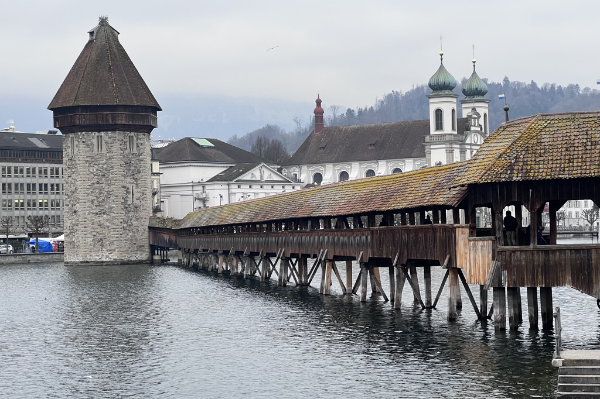
The curtain may have fallen in Lucerne, it may just be rising on the inkjet transformation of print.