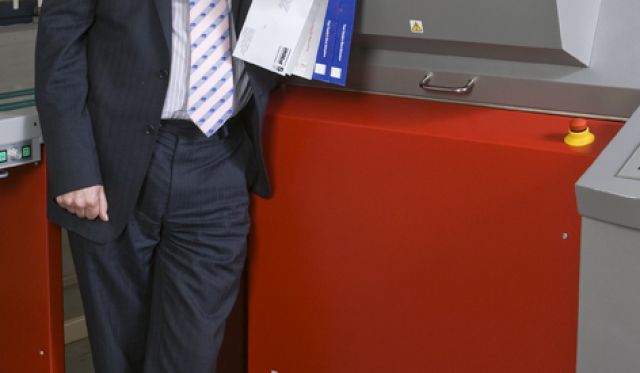
SYNERGY IS THE NAME CHOSEN BY A TEAM OF WOULD-BE ENTREPRENEURS on television’s The Apprentice. It is in no way to be confused with Synergie, a fast developing group run in an entrepreneurial way by Terry Hannam. Despite buying White Horse Press in Newbury earlier this year as the fourteenth and most recent acquisition, Hannam insists that Synergie is not a print group. This despite a fleet of Kodak digital presses, Duplo finishing systems and plans to buy a B1 press for White Horse early in the new year. He has a strong case, for within the group previous acquisitions have made Synergie a major provider of school uniforms and it also sends computer components around the world. There is a common thread in there and it is not about ink on paper.
It never has been. Hannam came to the industry as an accountant who started out in the motor trade. “Coming from outside the industry you look at things differently, you try to be more innovative and you don’t follow the expected trends,” Hannam says. He still lives in the West Midlands, spiritual home to Britain’s car production. As a consultant to the long defunct KNP group, he worked with a Group4 prison near Rugby to have inmates working to stuff envelopes on a direct mail project. When KNP went under in 2001, Hannam kept the project rolling using laserprinters spread around his home. Then followed “the first serious machine” into printing proper with a NexPress in a small unit in Redditch. “This was a true leap of faith,” he says. “It was a very exciting time and we have stayed with Kodak ever since.” The group acquired a proper name, Web2print, and a plan was hatched to provide a trade digital print service through a network of NexPress facilities about 90 minutes apart so guaranteeing a fast turnaround.
AS WITH MANY SUREFIRE BUSINESS PLANS, THE STRATEGY HAD TO BE ADJUSTED. “We used to get phone calls asking for web offset printing,” says Hannam, so the name had to be changed. He and his wife came up with Synergy, but found all the URLs around this name had gone, but those spelled ‘Synergie’ were available. A business was forming. Then came the acquisition of Butterfly Dreams in January 2006, a failed printer with a NexPress near York. While this was outside the 90-minute radius, the enthusiasm of the three-strong team running the business, provided something greater. “It started the ball rolling in acquiring businesses that had failed. And because the three continued to run the operation, they allowed me to work on the business, not just in the business,” says Hannam. His entrepreneurial flair could be given full rein.
Acquisitions swiftly followed: Bridgepoint Solutions, Tadcaster; Lowe Aston, a calendar producer in Cornwall; print and packaging producer Magellen; print management company Lime; Basingstoke Press and so on until March this year when Hannam bought White Horse Press, now Whitehorse-Synergie, from the receiver. All the acquisitions have been of failed businesses and all have been paid for out of cashflow. There has been no refinancing of assets says Hannam, something which means that more cash is tied up in machinery than the accountant would find ideal. Some machines have been sold and he acknowledges the value of the support of David Bunker at Close Asset Finance. When the time comes to buy another litho press, Hannam will be working with Close Asset.
THE ACQUISITION TRAIL WILL GO ON. He is a patient man, prepared to watch a business and wait until an inevitable collapse happens. Currently there are three targets under observation. White Horse Press was being looked at for a year, he says. Nor does every collapse lead to a deal. He has walked, on occasion, even when a purchase could take place without huge costs. “Due diligence can show up some unexpected things,” he explains. “What we are not is another MPI group.” There have been consolidations, moving elements of a business into another to make best use of equipment and reduce overheads by leaving some expensive offices. Print production facilities in Lymington for example were closed and production shifted to Newbury while prepress and sales have stayed in the New Forest.
The strategy is to buy the failed businesses, integrate them with existing operations and exploiting any cross selling opportunities and customer databases that are part of the assets acquired. The common thread is in marketing and promotional goods. “We have ended up being a marketing and promotional goods business, aiming to go from design and data through to the finished product, whether we manufacturer it ourselves or buy it in,” Hannam says. As an example he says the company sourced £140,000 of branded lanyards, key fobs, USB sticks and so on for a major mobile phone launch in Europe.
HOW THIS APPLIES TO PRINT IS CLEAR. The schoolwear business is attached to a promotional embroidery business that is a major producer of T-shirts, with good contacts in the Ministry of Defence. A collection of Synergie produced T-shirts has been on the final voyage of HMS Ark Royal while others are in Afghanistan or Iraq. Many of the customers for the clothing business will become customers for the calendar operation. Both are providing branded promotional goods and packaging to go with them. “Both businesses are working for B2B customers supplying promotional goods so there is a big overlap potential in the customer base,” he adds.
This scope to supply all types of branded produced another sizable order for a new sales rep, recruited from a litho printer. He dropped in to see an old customer, Hannam says, to explain that he could not sell litho print any longer, but emerged with a six-figure order for more lanyards and paraphernalia. The point is that Synergie does not have to sell print, though it certainly has the capability of doing so.
“Our elevator pitch to customers and prospects is that ‘we are working hard to keep your name in front of your marketplace’. The key that drives this is that everything we do is innovative. And because the sales team is not tied to litho printing, we can open doors and we move away from being price sensitive and we get greater acceptance for the message,” he explains. “By selling non-print items we are accepted in more places, more quickly than if we had print alone. If you are a buyer in a decent sized business you are always looking for innovation because you face competition and want to get your message across a bit differently. We can help and help grow their business in partnership.”
THE PARTNERSHIP WITH KODAK HAS CONTINUED and Synergie has become the largest user of Kodak digital presses in Europe with presses spread around the group. Using digital print next to the old letterpress calendar production at Lowe Ashton has been transformational. The unit has an old board lining machine dating from 1949, platens and everything needed to make the traditional style desktop block calendars where the client name is blocked in place on a standard background. “And 20 feet away is a NexPress,” says Hannam. Now the background mounting can be personalised as well and when added to the board lining expertise results in a unique capability for the company.
Hannam is keen on offering what others cannot. At the main site in Solihull there is the only Magnacutter in the UK. It is a high precision rotary die cutter that is perfect for digital print, says Hannam, running at 4,000 sheets an hour, with rapid makeready and highly accurate very fine cutting thanks to laser imaged die production. He is planning to start producing packs of round cornered promtional playing cards, slashing the entry point for this type of product. It is already used for CD sleeves and complex labels.
At Basingstoke there is the UK’s first Kern K515 EasyMailer. This takes a sheet of digital print, splits out the half of the sheet carrying the letter or message and uses the second half to form a folded envelope, guaranteeing a match between the tool in a single hands off operation. “We can have the artwork in at 10am,” he says, “and can be putting envelopes in the post at 5pm.” Cameras and 2D barcodes ensure the integrity of the mailing piece against the database.
IF THE POTENTIAL FOR THIS IS VERY INTERESTING, WHAT REALLY EXCITES Hannam are the possibilities thrown up by Kodak’s Dimensional Ink. While not unique to Synergie, there are only a handful of UK companies with this version of the NexPress, enabling the digital press to add a raised clear image to enhance the appeal of a printed product, adding significant value. And it works. As an example Hannam cites one sales rep, who joined Synergie from a direct mail agency.
“He took some images from the marketing literature of a company he wanted to approach and used these to produce a postcard enhanced with Dimensional Ink. He sent them to selected prospects in the company with the message ‘Don’t you wish your print felt like this?’. The response was immediate and he was called the next day for meetings and had signed orders within five days. Price ceases to be the issue. It’s all about what we can do for the customer.”
There is a project to use Dimensional Ink to enhance the quality of 40,000 brochures for distribution around Europe. It is expensive, but the client points out that quality is the priority, not cost. There are more mundane purposes for which the feature can be put to good use. Another customer is a major group with thousands of staff spread around the country. While a web to print system was in place, it was not being used effectively. Consequently the company suffered the problem of the interpretation of corporate colours and inappropriate substrates. While a handful of printers was approved, an audit showed that 72 printers had been used because local print shops had been used on an adhoc basis. Synergie was asked to look at the problem and devise a solution that would use web to print with payment using a company credit card, which had not been possible previously. It implemented the web to print application with a 48-hour turnaround on print, but also used Dimensional Ink on the corporate logo, making it a security feature to prove that the business card was from an official source. It is no surprise that Hannam gets as excited as any printer when discussing the potential of the technology.
NOW SYNERGIE IS EXPECTING TO RECEIVE THE FIRST OF THE EXTRA LONG NEXPRESS MACHINES following the launch at GraphExpo a few weeks ago. It should arrive before Christmas, says Hannam. It will offer Dimensional Ink as well as the ability to print six page formats, meeting Hannam’s criterion as something unique that the company can offer. It will be ideal he says for high quality property brochures of the type that Whitehorse-Synergie has specialised in, while also printing book covers beyond the capabilities of the standard machine.
Nor is the investment stopping there. There is a Roland DG UV inkjet printer which can give the same raised image effect as Dimensional Ink on a larger format for posters. There is a robotic Esko cutting table, seen at Ipex, that will run overnight and allow the company to produce short runs of high quality packaging. “We could turn around short runs of perfume boxes enhanced with Dimensional Ink inside 48 hours. Of course there is a price aspect to this,” he smiles.
The company is part way through a large investment with Duplo, a £570,000 package signed at Ipex for three DC 645s, two DPB-500 perfect binders, System 3500 and System 5000 booklet makers, creaser/perforator, collators and three-knife trimmer. This investment is about automation as much as functionality and capacity. “We don’t want to people who have to think about how they run different machines. We have Duplo kit so that we can standardise one equipment supplier across different parts of the business. It fits with our needs to automate what we do as much as possible,” he says. And now Hannam and his team are currently looking at an MIS investment that will span the group’s operations.
FURTHER AHEAD LIES THE MOUTH-WATERING PROSPECT OF INKJET. “The future is definitely inkjet,” Hannam predicts. “I saw Kodak’s Prosper in Dayton and signed a letter of intent on the spot. We are still in negotiations to become an early adopter of the Stream technology. To my mind there are many advantages to the continuous inkjet technology.
“We have multiple plays which would support the investment, from promotional direct mail, commercial jobbing print and so on. We don’t need to persuade a large contract customer to use it.” Whether this will encourage Kodak to place the first UK unit with what is an emerging group rather than, say, a customer like St Ives or Anton, remains to be seen. Either way, it will not dent his enthusiasm for the technology. “The quality will improve, the speed also. The impact of what this can do could mean the end for 1,000 UK printers in the next three years.”
SYNERGIE IS UNLIKELY TO BE ONE OF THESE. CURRENTLY SALES ARE AT £8 MILLION, but the growth has hardly begun. There’s a strong management team in place under the group managing director and a gradual rebranding of the units to carry the Synergie name. Further acquisitions are sure to follow, bringing more data handling capacity, more unique product types, but no extra litho press capacity. A new website selling promotional goods in a sector that has yet to be tackled is on the way. Hannam does not want to say any more at the moment. Innovation works best when you can be first to the post.
DECEMBER 2010