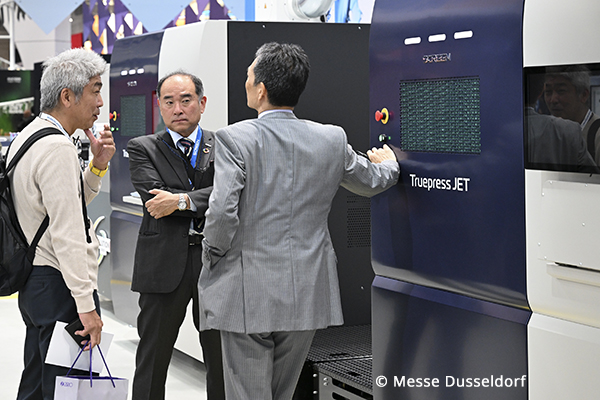
Screen and Ricoh entered continuous feed inkjet printing on the same platform, one that had largely been inherited from IBM’s production printing operation in Colorado.
It was effectively a joint venture and spawned the InfoJet 5000, becoming the Screen TruePressJet 520 and the Ricoh Pro VC60000. Under the skin both had the same paper path, same inkjet heads and same drying technology. The drive software and inks were separate.
The next iteration saw some divergence: Ricoh adopting a heated drum and web path that wound its way around a series of heated rollers to dry the paper. Screen stuck to an NIR approach. Ricoh also offered a priming fluid; Screen didn’t. However, these were still very much the same machine.
Not any more. Both companies have returned to the drawing board for what are now their flagship machines, the TPJ560 for Screen and VC80000 for Ricoh. These are very different machines built on a shared heritage. Both took pride of place at Drupa.
The Screen TPJ560 lifts production speed from 50m/min at the full 1200dpi resolution to 100m/min for the same resolution, with 150m/min for 1200x600dpi. This is more than enough to deliver commercial quality colour printing. Screen no longer offers a 600x600dpi option on this machine.
There is an increase in print width, as much because the press uses five Kyocera print heads across the web. This is the latest generation of the K4JB piezo printhead, offering a flow through technology to help keep the nozzles open and temperature control systems to ensure a steady environment to deliver consistency which might be at risk when temperature fluctuates.
A further advantage of this is that Screen no longer needs to take up white paper by printing purge lines to keep nozzles open.
The printheads are positioned on a carrier that is easily removed using levers rather than allen keys to unlock and remove. It means that in operation, a well trained in-house technician can carry out immediate repairs without having to wait for a trained engineer to call. It is possible to remove and replace the array in three minutes. The press can be up and running in ten minutes, something of a game changer according to Screen Europe senior vice president of sales Bui Burke.
Screen has continued its policy of printing without application of a priming or optimising fluid. It does have a new ink, SC2 that is water based, that includes the pigment dispersed in a fluid with the ability to adhere to a coated paper as well as an uncoated paper.
The increase in speed requires a matched change in drying capacity. For Screen this means pioneering a digital drying technology, carbon radiators, the first time this has been used in inkjet printing. Four of the carbon dryers are positioned in a separate cabinet to the ink application chamber.
Like the diodes used for UV curing, the carbon dryers can be switched on and off to match the level of drying needed. This comes from analysis of the original PDF to match energy needed to ink coverage and so avoid overheating the paper.
The paper path then takes the print through a turning system between the two print units or through spectrophotometers on exit of the press. Screen has previously positioned jet inspection systems to check that nozzles have fired correctly, but this is no longer necessary. The inline spectrophotometer can be used to create profiles in around ten minutes. This is a vast time saving over the previous method where it could take an hour or more to generate a profile.
The printer can run to a rewind or inline to a Hunkeler or Tecnau finishing line. At Drupa this was the set up, the TPJ560 running to a Hunkeler cut and stack unit or to a rewind for a more sophisticated finishing requirement. Screen has anticipated the requirement for inline finishing with the ability for the press to slow to a crawl, filling a festoon buffer while the cause of the stoppage is cleared.
Once the jam is cleared, the finishing line and finishing line can accelerate to full speed, printing during the ramp up to avoid paper waste.
Previously Screen would have enacted a hard stop for the press, wasting time and paper when starting again. That becomes a big advantage, says Burke, in keeping production disruption to a minimum.
It has adopted the universal finishing interface supported by both print engine providers and finishing technology developers to open the door to swifter integrations for printers wanting end to end systems. This applies too to operating with automated autosplicer reel changing at the front end. As a splice moves beneath the printheads the press will either slow to a crawl or the web is distanced from the heads to avoid the thicker splice causing damage.
Screen is taking the press back to the Screen Europe inkjet customer centre to put the press through its paces and check that it can be confident over all these issues before commercial shipments begin in in Q3.“I think this will be a cracking machine,” says Burke.
Ricoh will share the sentiment regarding the VC80000 which received its show debut at Drupa. While the press is designed to run directly to standard offset papers, the option to apply what Ricoh calls an undercoat remains. This will ensure a consistent surface for the ink regardless of the actual paper being used. There is evidence that papers which are very similar in behaviour for offset printing are not always so close in the inkjet world. And with the manufacturers selecting different inks and drying technology it stands to reason that a comparison will be different.
While the press is outwardly the same as the VC70000 or the Screen TruepressJet, once the covers are removed, there can be no mistake.
The web transport and drying design is completely different. This is an evolution of the heated drum system used on those earlier machines, retaining the idea of heated rollers and a web path that takes the paper around these to heat the web with less risk of distorting the paper itself.
To the observer the way that the ends of the rollers light up because of the IR dryers in a seemingly random way gives rise to the name Firefly.
It is much more than simply a series of 13 heated rollers. “Drying is more about moving the air to carry moisture away than it is about the heated surface. With Firefly we can control everything.
“This is far more effective than the previous system and explains why we can run at 150m/minute with full ink coverage,” says Ricoh’s global marketing director inkjet production solutions Tim Taylor. “The drying technology is the crown jewel and enables us to run 250gsm.”
The VC80000 uses a version of Ricoh’s water cooled Gen5 piezo print head firing a water based ink. Ricoh claims that the gamut from its four-colour inks is greater than the process colour offset gamut, which may or may not be useful. Like Screen the press offers 1200x1200dpi for 100m/minute or reaches 150m/min at 1200x600dpi. This is the resolution it was running at Drupa with zero complaints about quality.
Within the press are inline spectrophotometers to measure colour density and a camera system to spot and compensate for the loss of any nozzles while printing. It is about ensuring that operator stress is minimised and stabilising production.
Ricoh also uses what would have been called chill rollers in a heatset web press to maintain the condition of the paper so the front and back are printed under the same conditions.
The out of the box configuration is for 40-250gsm, extending to 300gsm with a heavy paper option. This is not to cope with lightweight cartons, but to be able to print the sort of direct mail postcards that are exceedingly popular in North America and is sector that Ricoh cannot afford to ignore.
The real target is litho transformation, taking work that is currently being printed on sheetfed presses with a series of process steps from plate making to folding and binding that require manual touchpoint and replacing them with something that has minimal touchpoints and therefore minimal waste levels and reduced labour costs. A new operator interface is also designed to guide the user and make operation as simple as possible. It is, Taylor says, a real game changer.
Screen and Ricoh may have started from the same place and may have the same destination in mind. But the Japanese companies have decided to go there separate ways to get there. Now it is up to them to persuade printers that their chosen route is the better option.