
Royalpack Printing House is a Polish success story. The company has grown in three years into a major producer of corrugated packaging for food, chemical, cosmetics, construction, toys and electronics industries. Sales reached €3.5 million in 2014 and thanks to the scale of investments, revenues have the scope to grow steeply.
It was formed in 2011 by Andrzej Tatar who had already established a long career in this sector, having started the Polish operation for German converter Europa Carton.
After it was taken over by Smurfit Kappa, Tatar took the opportunity to strike out alone, with a secondhand four-colour KBA Rapida 162 and Bobst 1575 platen, aiming to create litho laminated corrugated packaging. Litho lamination remains in demand as it offers the highest quality for this style of packaging.
Two years later, with the support from the EU, Royalpack set about building a new 5,500m2 plant on a greenfield site. The company chose at site at Slane near the border with Germany, its main export market. It also supplies customers in Belgium and Scandinavia.
The factory opened last year with the original equipment supplemented by a five-colour plus coater KBA Rapida 162, a new Bobst 1600 VisionCut, workflow, platesetter and plates from Kodak. With a maximum sheet size of 1,200×1,620mm, the Rapidas are using Kodak’s Sonora XP process-free plate.
The company was starting with what amounted to a clean sheet so could take a fresh view of what was available for the new prepress department. Previously, says Tatar, the business might have to wait several days for plates to be supplied from an external source.
“We can now produce a set of plates for ourselves in 20 minutes,” he explains. “This is a huge time saving for us.”
It is also a big competitive advantage, helping to reassure customers that Royalpack can meet tight delivery schedules or remake plates at short notice.
Kodak’s reputation appealed to the young business. Tatar says: “I appreciated the advantages of using the Kodak plate. Eliminating chemical processing means that there is no need for buying and maintaining a processor, no associated electricity and water costs and no requirement to purchase, store, prepare and dispose of chemistry.”
It also saves on labour costs and removes any inconsistencies that might be introduced if the condition of the processing chemistry varies. “All we have to do is to image a plate, mount it on a plate cylinder and start printing, shortening the whole process while making it more stable,” says Tatar.
And while it is early days, the savings are beginning to mount up. With a conventional processed plate, he reckons that Royalpack would be using 14,000l of water for every 700m2 of plates; there is no chemistry and no electricity to run a processor. “Overall we estimate that implementing the process-free plate has brought us total savings of 30%, far beyond what we had imagined.”
He does not quantify the more hidden savings because the business no longer has to re-make plates that are not suitable for reprints, or from press time previously lost by having to wait for plates to arrive.
The plates are exposed on a Kodak Trendsetter Q1600 platesetter, which is in turn driven through a Kodak Prinergy workflow complete with the Pandora step and repeat software for nesting cartons and multiple jobs on the large format sheet.
Tatar had first seen the VLF platesetter at Drupa 2012 and realised that SquareSpot imaging, with the stability of the imaging head and its ability to form a 10-micron dot, would be required to meet the plans he was formulating.
“Moreover the software solutions we decided on, such as Prinergy and Pandora step and repeat software, have also streamlined and shortened the job preparation process. This eases pressure on our operators without any compromise on quality,” he says.
The prepress department also includes Kongsberg cutter for proofing, samples and R&D work. Product development is a key part of the business where Royalpack uses ArtiosCad, Cape Pack and 3D visualisation software to create new styles of packaging or point of sale units.
The aim, the company says, is to be able to offer an independent product design service for customers optimised to the production equipment it has. This has led to the filing of a patent to protect developments it has come up with for an ultra strong box, which also delivers high marketing impact through litho lamination.
There are already plans to extend the factory in the next couple of years. Kodak has delivered in terms of partnership, helping Royalpack achieve production and environmental targets.
“Another unexpected benefit of the Sonora XP plates is that they fit both our new printing press and the older one, manufactured 28 years ago. We’ve been very impressed by the volumes we’re able to make using them,” says Tatar.
“Print runs of 10,000 impressions are no problem at all, meaning that the plates are also improving our sustainability and company image. We could not be more satisfied with our new purchases.”
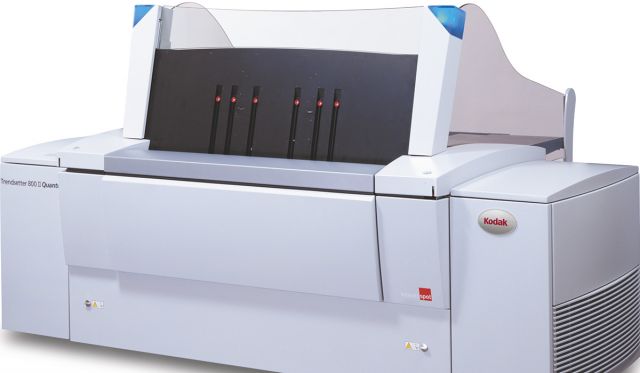
The plates are exposed on a Kodak Trendsetter Q1600 platesetter, which is in turn driven through a Kodak Prinergy workflow complete with the Pandora step and repeat software for nesting cartons and multiple jobs on the large format sheet.