
Schools will have the printing industry to thank for a return to class after the extended summer break. Printed floor graphics, posters, signage, are all crucial to enabling the safe return of school children this week and of students to college and university later in the month.
And just as some printers have been able to shift into production of PPE and then social distancing floor graphics for retail, a swathe of printers have recognised that there would be demand from the educational sector and have designed and created products specifically for schools, either as an extension of pre existing work for the sector, or as a new supplier.
Signet Signs names education as one of the key sectors it serves and as schools closed down at the start of lockdown, it worried about the future. “It was looking really grim,” says managing director Mike Rawlings. Then came a range stickers, wall and floor graphics aimed at getting the message across to young children in a friendly way.
It has been a huge success and the company almost found itself swamped. “It’s been borderline not being able to cope busy, to the point where we had to have a three day session – Friday, Saturday and Sunday – and we don’t usually work at the weekends – where we were packing solidly. We were putting prints into boxes, labelling them and then placing them by the back door. We had to have a dedicated pick up from our courier because there was so many orders going out,” he says.
That it managed is thanks to investment in a Mimaki CJV150 130 solvent roll printer and Esko X24 cutting table, purchased from CMYUK. The Shrewsbury dealer had also supplied Fantasy Prints in Berwick on Tweed.
Its location straddles the border between England and Scotland where schools have already returned. “We have been flat out with work for schools,” says managing director Paul Martin. “Most is for floor graphics to signal one way systems and there’s other signage so that schools don’t have to bother with designs.”
He spotted the opportunity early, working on SEO for the website at the start of the lockdown and stressing signage for social distancing. It led to a 6,000% increase in traffic “and it hasn’t really stopped since,” he says.
The company needed it. Before lockdown the vast majority of work was for holiday parks. These closed down overnight, though as restrictions have eased work has been edging back. As a result Martin has been able to bring staff back from furlough.
But the real gain has been work for schools. The Scottish education establishment has already begun the new academic year, the English system kicks in this week. Government advice for schools in England and Wales does not stipulate the use of signage or floor graphics, emphasising instead the need for hand washing, face masks and social distancing, with describing what this might entail. School leaders are asked to make informed judgements, says the advice. It adds that there are “no plans at present to reimburse additional costs incurred” though there is mounting pressure for government to do so.
The blurriness of the recommendations and the different ways that the advice is being interpreted across the system perhaps accounts for some of delays in take up that some printers have experienced.
“We developed a range of social distancing products, some specifically targeting schools and other educational establishments,” says Gary Peeling, CEO of Where The Trade Buys. “That was when two metre distancing was mandatory. Schools have been engaging, but not at the level we expected because the regulations have changed.”
The products included desk screens, branded to the school, not unlike the screens that are now widely used in retail. Most have gone to independent schools. The focus on keeping children in bubbles is also causing schools to hesitate over what might be needed. “Clear taller banners that help manage queues safely have been popular. They help to control some the spaces that people need to move through in schools.”
This is not the experience at Fantasy Prints, possibly because it straddles the two education systems. Once the orders started “we are finding that schools are ordering more and more,” says Martin. This is been based on experience and the carrying out of risk assessments, showing that there needs to be signage to tell children where to line up in the playground for example, or instructions for parents to be tied to the railings outside the school grounds. “There are lots of things that they didn’t think about at first.”
The work has spilled over into the university sector where the numbers of students is much greater, the discipline less tight and the area to be protected much greater. One Scottish university, says Martin, ordered a batch of 50 floor stickers to test adhesion on different surfaces around its premises and has since ordered 5,000 more.
“I reckon that we have picked up about 1,000 new customers and we are finding that they are ordering new stuff from us, leaflets, posters, even clothing, not just sign and display products. Over the next few months we’re hoping that we will do far more than floor stickers for these customers. It’s helping to compensate for the lack of business from our traditional type of customers.”
Other online trade printers have had the same experience as Where The Trade Buys. Because they do not sell direct, they depend on other printers and resellers to fin the customers. Schools have not been top of the priority list. But where the company has thought about the opportunity, the results can be impressive.
Cotswold Printing was a typical local large format printer at the start of lockdown. It swiftly engaged with the Gloucestershire NHS to provide 45,000 face visors and has now switched focus to schools. “We took our standard business packs and made them more friendly to suit schools,” says managing director Adrian Soble. “We call this internally making Lemonade.
“We called around schools, finding that some had read the guidance and some had found it had changed again and again. As a result we have tried really hard to come up with solutions that are aimed at children.”
Cotswold has put together packs for £200 that include standard items, including stencils for schools to mark out playgrounds with paint rather than having to use floor stickers. These are available to match the school uniform colours that a school might have, chosen by a stew poll of colours staff remembered from their school days. “It’s because not everybody has the artwork they would need,” says Soble. “There are 30 floor graphics, 20 wall stickers, posters in different sizes and so on. It’s a good mix for junior and infant schools. And it’s branded by their colours not by the school crest or logo because we took the view that it was better for the schools to have the material now from what we have in stock without worrying about how long it would take to deliver.”
On the eve of schools returning some schools had come back for a second pack while the inquiries and orders were still coming in.
“We reckon we have used 3,000m2 of floor graphics, 1200m2 of Perspex, produced clear roller banners and since month by month sales increases every month since June. We are definitely expanding, first with PPE and using equipment to cut out scrubs materials and now with schools. Thanks to this, we are no longer just a small local printer, but are becoming a national supplier.”
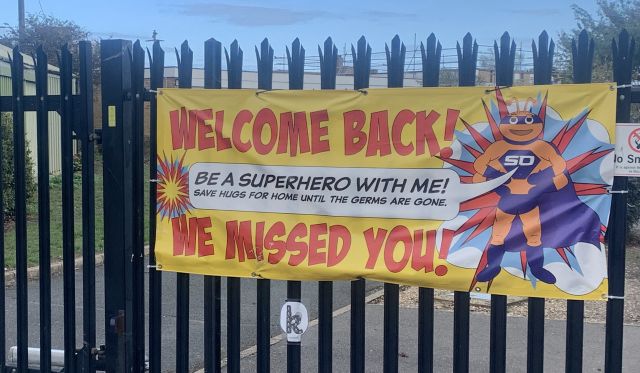
Schools have been uncertain what print they will need as schools reopen this week. They are also uncertain about whether there will be some financial help from government, resulting in last minute decisions about what print will be needed. But print is key to getting children back to school in safety.