
Ryobi will demonstrate a new digital sheetfed press that has been jointly developed with Miyakoshi at Drupa.
The press is dubbed the RMGT (Ryobi Mitsubishi Graphic Technology) DP7, a four-colour B2 press based on a Ryobi 750 litho press and Miyakoshi’s high viscosity liquid toner technology. Demonstrations will highlight the suitability of the press for custom production for small print runs according to Ryobi.
At Drupa 2012, there was a prototype of this machine on a sparsely populated Miyakoshi stand and it was not seen to run. There were print samples on the Ryobi stand under glass, but not handed out to examine. This time the press will be part of the main RMGT stand alongside two litho conventional litho presses. Both these will have LED UV curing fitted and all presses will share the same styling.
The conventional presses are the RMGT 10, a B1-plus format machine based on the previous Mitsubishi V3000, and the RMGT 9, an SRA1 940 mm machine. The company will show a six-colour version of the RMGT 10 capable of printing on 1 mm thick boards. It will be set up in a carton configuration with inline quality control, non stop feeder and coater which will also used LED UV curing.
The RMGT 9 will be an eight-colour perfecting model built on the same sheet transport as the larger machine. It has LED UV units to cure both sides of the sheet, simultaneous plate changing and PQS inline quality control. Both presses are controlled through a new large display monitor.
There is no announcement regarding inclusion of Kodak Prosper inkjet heads on a sheetfed press, something that was promoted at Drupa 2012 following installation at a Japanese printer. No other installations of these machines, where the inkjet heads were mounted between press units, have since emerged.
RMGT is not disclosing specifications of the DP7 at this point. However, Miyakoshi is selling the press as the catchily named 30NX-8000. It states that the press will print variable data; shorter print runs than suited to conventional litho; will feature short makeready and manning requirements and a low cost per page.
Resolution is 1200x1200dpi using an ultra fine particle liquid toner. Speed is 6,000sph, to increase to 8,000sph. Paper size to 788x600mm, and print area to 765x580mm, weight from 64-360gsm. The machine is four-colour only, with a 4/4 version to come.
After the four print units the paper passes into a taller drying unit comprising fusing rollers and infrared heaters.
Miyakoshi is using liquid toner technology in a web press, the 20NX-5000 with the same specification imaging system. This will achieve a speed of 100m/min, rising to 120m/min in future. Print width is 487mm on a 520.7mm web, It will print endless banners.
A version of the same liquid toner technology is being used by Xeikon in the Trillium . Its speed is initially 60m/min planned to reach 120m/min.
Miyakoshi has tended to work through OEM arrangements in recent years, Océ takes one of its inkjet machines for example. Longer ago, it sold a range of offset litho presses for business forms printing. It opened an office in Spain last year.
RMGT is the company formed from the merger of Ryobi’s printing machines division and Mitsubishi Heavy Industries’s sheetfed press operation. Ryobi owns 60% of the business. In the first half of the financial year, the company reported a rise in exports to Europe, the US and the rest of Asia due to the depreciating value of the Yen. It reported sales of £83.5 million generating an operating profit of £3.1 million.
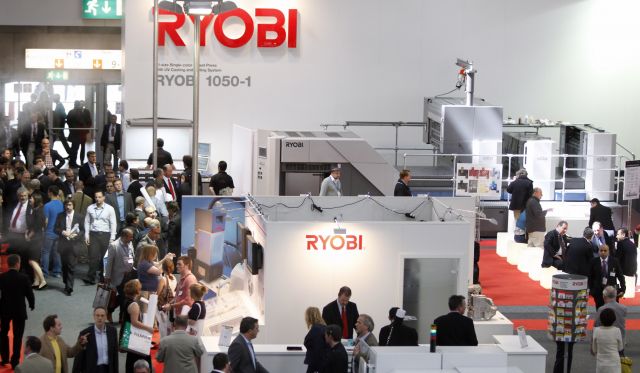
RMGT will make its first appearance at Drupa since combining the press manufacturing arms of Ryobi and Mitsubishi Heavy Industries. Star of the stand will be a B2 digital press using liquid toner technology.